Unexpected origins: Bronchopulmonary dysplasia and the unusual spectrum of cystic lung disease
Irfan Ul Haq, Mansoor Ali Hameed, Shakeel Ahmed, Mushtaq Ahmad, Ibrahim Rasheed

Abstract
Genes, proteins, chemicals, diseases, species, mutations and cell lines named across the full text — each resolved to its canonical identifier and authoritative record.
Click any figure to enlarge with its caption.
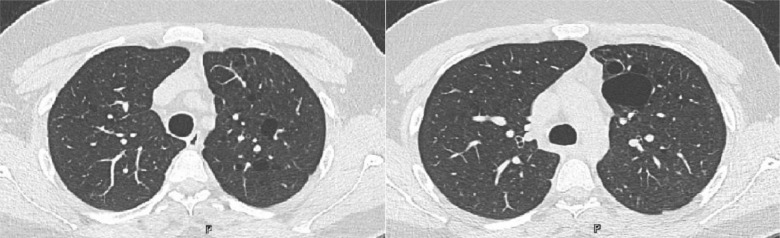 Figure 1
Peer Reviews
No public reviews on file for this paper yet. If you reviewed it on a platform where reviews are public (OpenReview, ICLR, NeurIPS, ICML), you can paste yours below so the community can read it here.
Videos
No videos yet. Explain this paper in a talk, walkthrough, or lecture? Add one.
Taxonomy
TopicsCongenital Diaphragmatic Hernia Studies · Neonatal Respiratory Health Research · Medical Imaging and Pathology Studies
Introduction
Cystic lung diseases are a group of diseases that have a variety of presentations, but all have radiological characteristics of multiple air-filled cysts. Chest CT scans may incidentally reveal lung cysts. However, additional testing is often required to determine the underlying cause.
Case Presentation
A 25-year-old male was sent by the military to rule out asthma. He occasionally experienced wheezing and shortness of breath after mild exercise. He reported that he was prescribed inhalers for possible asthma when he was young. He had no other medical conditions, did not use illicit drugs, and did not smoke. He had no family history of lung conditions, including asthma. Upon reviewing his medical records, an abnormal chest CT scan from 10 years ago was discovered. Multiple lung cysts were seen on chest CT at the time, and this was confirmed by a follow-up scan that revealed no progression of the findings (Figure 1). Additional information from his online medical records indicated that he was treated for bronchopulmonary dysplasia and was born before term at 28 weeks. Bilateral cystic changes were noted on chest X-ray at three months of age. He then underwent spirometry and a methacholine challenge test, which was positive at PC 20 of 7.91 mg/ml. He was prescribed inhalers, and no additional testing was mandated.
Discussion
Lymphangioleiomyomatosis, pulmonary Langerhans cell histiocytosis, Birt–Hogg–Dubé syndrome, and lymphoid interstitial pneumonia are the four most common causes of cystic lung disease.^1,2^ However, it is important to consider rare congenital causes of cystic lung disease, such as bronchopulmonary dysplasia, congenital lobar emphysema, congenital bulla, and bronchial atresia, particularly in young individuals who are born preterm.^3^ A thorough clinical history and evaluation of previous medical records can occasionally help narrow the differential diagnosis of cystic lung disease.
Conflict of Interest
Authors declare they have no conflict of interest.
The reference list from the paper itself. Each links out to its DOI / PubMed record.
- 1Gupta N Vassallo R Wikenheiser-Brokamp KA Mc Cormack FX Diffuse cystic lung disease. Part I American Journal of Respiratory and Critical Care Medicine 2015;191(12):1354–136610.1164/rccm.201411-2094 CI 25906089 PMC 5442966 · doi ↗ · pubmed ↗
- 2Gupta N Vassallo R Wikenheiser-Brokamp KA Mc Cormack FX Diffuse cystic lung disease. Part II American Journal of Respiratory and Critical Care Medicine 2015;192(1):17–2910.1164/rccm.201411-2096 CI 25906201 PMC 5447298 · doi ↗ · pubmed ↗
- 3Odev K Guler I Altinok T Pekcan S Batur A Ozbiner H Cystic and cavitary lung lesions in children: Radiologic findings with pathologic correlation Journal of Clinical Imaging Science 2013;3:6010.4103/2156-7514.12408724605255 PMC 3935260 · doi ↗ · pubmed ↗