Right ventricular strain in pulmonary embolism (PE) in Covid-19 pneumonia
Muhammad Yousaf, Liaquat Ali, Ahmad A. Abujaber, Salah Almughalles, Saad Rehman, Muhammad Sharif, Syed G Naqvi, Imran Mohammed

Abstract
Genes, proteins, chemicals, diseases, species, mutations and cell lines named across the full text — each resolved to its canonical identifier and authoritative record.
Click any figure to enlarge with its caption.
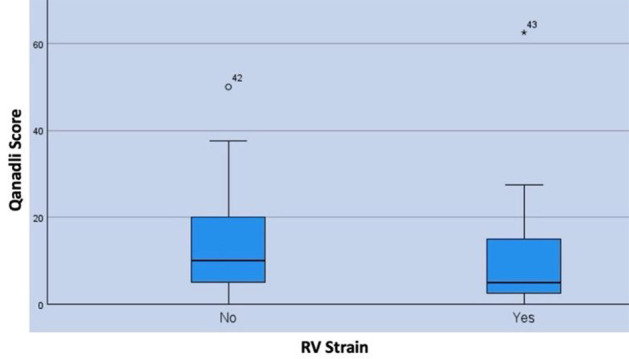 Figure 1
Peer Reviews
No public reviews on file for this paper yet. If you reviewed it on a platform where reviews are public (OpenReview, ICLR, NeurIPS, ICML), you can paste yours below so the community can read it here.
Videos
No videos yet. Explain this paper in a talk, walkthrough, or lecture? Add one.
Taxonomy
TopicsVenous Thromboembolism Diagnosis and Management · Climate Change and Health Impacts · Ultrasound in Clinical Applications
Background
Prompt diagnosis and risk stratification play a crucial role in minimizing the likelihood of adverse clinical outcomes and mortality associated with acute pulmonary embolism (PE). We conducted a post hoc analysis of our published study on PE in Covid-19 pneumonia.^1^ The objective was to assess the incidence of right ventricular (RV) strain and its association with mortality and clot burden, as determined by a Qanadli score.
Methods and Results
The study^1^ had a population of 153 Covid-19 cases with a reported incidence of PE at 41.8%. We analyzed 63 cases of PE in patients with Covid-19 pneumonia. The mean age of the sample was 52.9 ± 10.2 years. According to the American Thoracic Society guidelines for pneumonia, 83% of cases were categorized as critical pneumonia. We defined RV strain on CT pulmonary angiogram (CTPA) by an increased RV/LV ratio of ≥ 1.0, evaluated by two independent radiologists. The analysis revealed an RV strain incidence of 22.2% and a mortality rate of 25.4%. Both logistic regression and univariate chi-square test did not show any significant association between RV strain and Qanadli score (Figure 1). Additionally, there was no association between RV strain and mortality or age. Another study reported similar results,^2^ while others reported variable outcomes. A review of PE distribution and its relationship to RV strain revealed that peripheral PE does not entail a lower risk of RV strain than central PE. The incidence of central PE in our cohort was 11%.
Conclusion
We found no statistically significant association between RV strain and clot burden in PE in Covid-19 pneumonia. Recognizing the need for a larger and more representative sample is imperative to comprehensively address the pertinent question raised by this study.
Conflict of Interest
The authors have no conflicts of interest to declare.
The reference list from the paper itself. Each links out to its DOI / PubMed record.
- 1Ali L Sharif M Naqvi SGA Mohammed I Baig MA Muntaha KS To study the correlation of clinical severity and cytokine storm in COVID-19 pulmonary embolism patients by using computed tomography pulmonary angiography (CTPA) Qanadli clot burden scoring system Cureus 2023;15(5):e 392633734274910.7759/cureus.39263 PMC 10278873 · doi ↗ · pubmed ↗
- 2Gleditsch J Jervan O Klok FA Holst R Hopp E Tavoly M Does the clot burden as assessed by the Mean Bilateral Proximal Extension of the Clot score reflect mortality and adverse outcome after pulmonary embolism?Acta Radiologica Open 2023;12(6):1–1110.1177/20584601231187094 PMC 1032805637426515 · doi ↗ · pubmed ↗