The innominate artery, a seemingly benign artery that can cause major airway complications
Safa Mahgoub, Manu Sundaram, Andrew Durward

Abstract
Genes, proteins, chemicals, diseases, species, mutations and cell lines named across the full text — each resolved to its canonical identifier and authoritative record.
Click any figure to enlarge with its caption.
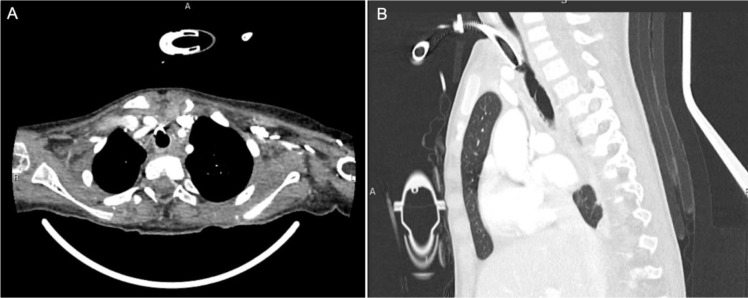 Figure 1
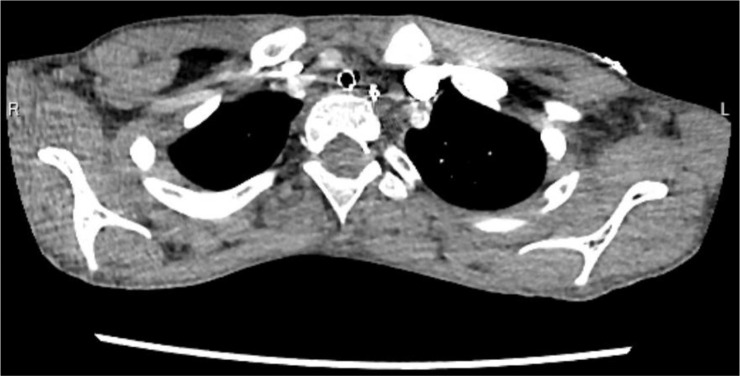 Figure 2
Peer Reviews
No public reviews on file for this paper yet. If you reviewed it on a platform where reviews are public (OpenReview, ICLR, NeurIPS, ICML), you can paste yours below so the community can read it here.
Videos
No videos yet. Explain this paper in a talk, walkthrough, or lecture? Add one.
Taxonomy
TopicsTracheal and airway disorders · Congenital Heart Disease Studies · Vascular anomalies and interventions
Introduction
The innominate artery is the first branch of the aortic arch. It traverses anterior to the trachea and crosses it at the 9th tracheal ring from left to right without airway compression.^1^ In rare cases, due to anatomical variation, the innominate artery can exert severe compression on the trachea,^2^ which in tracheostomized patients can contribute to the development of tracheo-innominate fistulas that lead to life-threatening massive bleeding.^3^
Cases Presentation
Here we present two cases in which innominate artery compression of the trachea caused life-threatening airway problems. The first case is a 4-year-old girl who was newly tracheostomized following a traumatic cervical spinal injury. She developed acute intratracheal bleeding due to erosion of the innominate artery into the trachea with a cuffed tracheostomy tube, creating a tracheo-innominate fistula. Despite prompt ENT and cardiothoracic surgical intervention, this progressed to massive life-threating hemorrhage, with hypovolemic shock resulting in prolonged CPR and hypoxic ischemic brain injury. A retrospective review of her initial chest CT revealed close proximity between the end of her tracheostomy tube tip and the innominate artery (Figure 1), which is a known risk factor for tracheo-innominate fistula formation.^1^
The second case is a 9-year-old boy with dystonia and a history of multiple cardiorespiratory arrests. CT revealed that the cause was a narrow thoracic inlet, where the trachea was compressed by the innominate artery between the sternum and vertebral bodies (Figure 2). Airway compression was relieved by an aortopexy and sternal expansion. The child was extubated and is recovering in PICU.
Conclusion
These cases illustrate the important, although rare, life-threatening complications of tracheal compression by the innominate artery under certain conditions. Clinicians should be aware of these complications and consider them in the differential of patients with airway problems.
Conflict of Interest
All authors do not have financial or any other relevant relationships with commercial interest to disclose.
The reference list from the paper itself. Each links out to its DOI / PubMed record.
- 1Wang PK Yen PS Shyr MH Chen TY Chen A Liu HT Endovascular repair of tracheo-innominate artery fistula Acta Anaesthesiologica Taiwanica 2009;47(1):36–3910.1016/s 1875-4597(09)60019-919318299 · doi ↗ · pubmed ↗
- 2Koivikko A Puhakka HJ Vilkki P Innominate artery compression syndrome ORL 1976;38(3):187–19210.1159/000275274781580 · doi ↗ · pubmed ↗
- 3Yogo A Komori M Yano Y Fujita K Sando E Kotani MA case of tracheo-innominate artery fistula successfully treated with endovascular stent of the innominate artery Journal of General and Family Medicine 2017;18(4):162–16410.1002/jgf 2.3729264016 PMC 5675153 · doi ↗ · pubmed ↗