Case report: Iatrogenic tattoos caused by skin marking pen in a postoperative patient
Hanxing Zhao, Xingru Wu, Yue Yu, Chang Cao

TL;DR
A patient developed a tattoo-like mark from a surgical pen used during eyelid surgery, leading to pigment retention.
Contribution
This case highlights pigment retention as a new potential risk of surgical marking pens.
Findings
The patient had blue-black marks from a surgical pen that persisted after blepharoplasty.
Pigment was found in the epidermis under dermoscopy.
Surgical excision was used to remove the pigmented skin.
Abstract
In this report, a female patient suffering from pigment retention caused by a skin marking pen was elucidated. The patient underwent blepharoplasty 6 months ago and presented with blue-black linear marks at the upper eyelid incision 2 weeks after surgery. Under dermoscopy, scattered pigments were observed to accumulate in the epidermis of the upper eyelid. The patient was diagnosed with iatrogenic tattoo by a surgical marking pen. We chose surgical excision of the skin with the pigmentation. Previous studies have established that the risk of bacterial contamination, contact dermatitis, and allergies may increase with the surgical marking pens, while pigment retention has not yet been mentioned yet. Here, we present a case with a pigment retention in the incision. The selection of the surgical labelling methods and the management of the pigmentation were also addressed. According to our…
Genes, proteins, chemicals, diseases, species, mutations and cell lines named across the full text — each resolved to its canonical identifier and authoritative record.
Click any figure to enlarge with its caption.
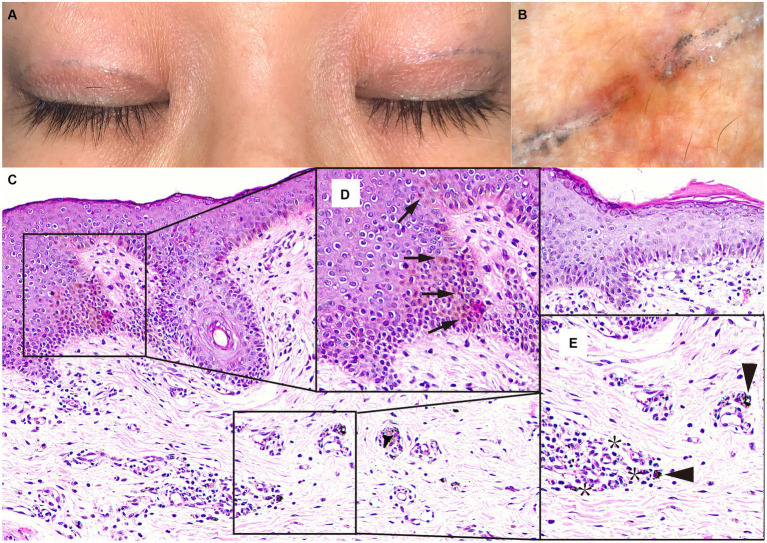 Figure 1
Peer Reviews
No public reviews on file for this paper yet. If you reviewed it on a platform where reviews are public (OpenReview, ICLR, NeurIPS, ICML), you can paste yours below so the community can read it here.
Videos
No videos yet. Explain this paper in a talk, walkthrough, or lecture? Add one.
Taxonomy
TopicsTattoo and Body Piercing Complications · Body Image and Dysmorphia Studies · Dermatologic Treatments and Research