Duration, numerosity and length processing in healthy ageing and Parkinson’s disease
Z. Romeo, S. Dolfi, M. D’Amelio, G. Mioni

TL;DR
This study explores how aging and Parkinson’s disease affect the ability to judge time, number, and length, finding that discrimination precision declines but not in a domain-specific way.
Contribution
The study is the first to compare duration, numerosity, and length processing within the same experimental framework in healthy and pathological aging.
Findings
Discrimination precision varied across domains, with higher accuracy in judging number and lower in judging time.
Both healthy aging and Parkinson’s disease led to reduced discrimination abilities, but no domain-specific impairments were found.
The decline in discrimination may stem from a general cognitive decline or a shared system for quantity processing.
Abstract
People constantly process temporal, numerical, and length information in everyday activities and interactions with the environment. However, it is unclear whether quantity perception changes during ageing. Previous studies have provided heterogeneous results, sometimes showing an age-related effect on a particular quantity, and other times reporting no differences between young and elderly samples. However, three dimensions were never compared within the same study. Here, we conducted two experiments with the aim of investigating the processing of duration, numerosity and length in both healthy and pathological ageing. The experimental paradigm consisted of three bisection tasks in which participants were asked to judge whether the presented stimulus (i.e. a time interval, a group of dots, or a line) was more similar to the short/few or long/many standards. The first study recruited…
Genes, proteins, chemicals, diseases, species, mutations and cell lines named across the full text — each resolved to its canonical identifier and authoritative record.
Click any figure to enlarge with its caption.
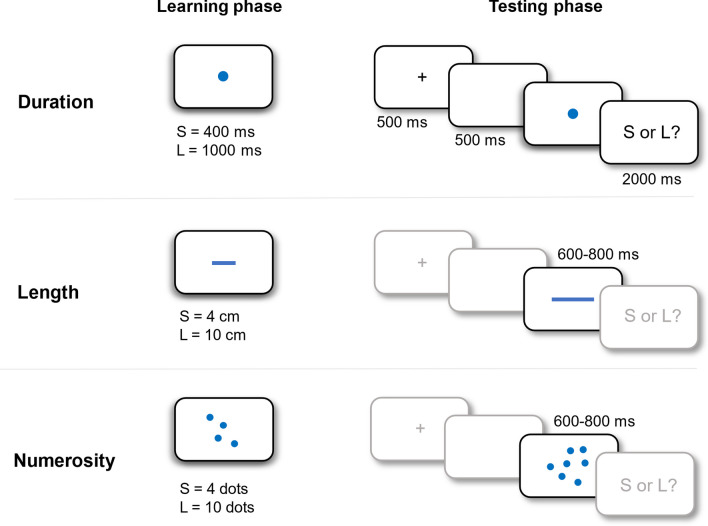 Figure 1
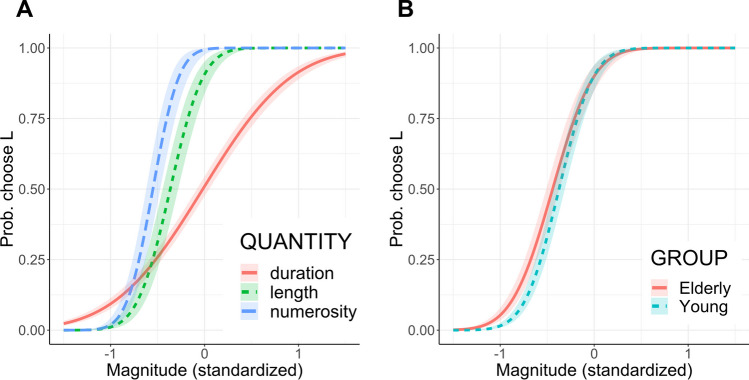 Figure 2
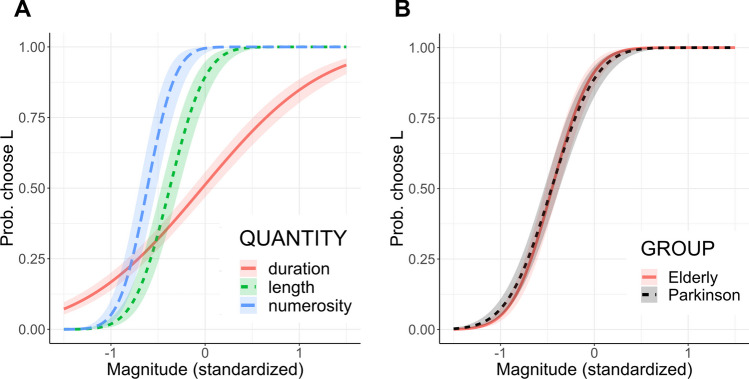 Figure 3
Peer Reviews
No public reviews on file for this paper yet. If you reviewed it on a platform where reviews are public (OpenReview, ICLR, NeurIPS, ICML), you can paste yours below so the community can read it here.
Videos
No videos yet. Explain this paper in a talk, walkthrough, or lecture? Add one.
Taxonomy
TopicsCognitive and developmental aspects of mathematical skills · Neuroscience and Music Perception · Mathematics Education and Teaching Techniques