Corrigendum: Interaction between habits as action sequences and goal-directed behavior under time pressure
Sascha Frölich, Marlon Esmeyer, Tanja Endrass, Michael N. Smolka, Stefan J. Kiebel

Abstract
Genes, proteins, chemicals, diseases, species, mutations and cell lines named across the full text — each resolved to its canonical identifier and authoritative record.
Click any figure to enlarge with its caption.
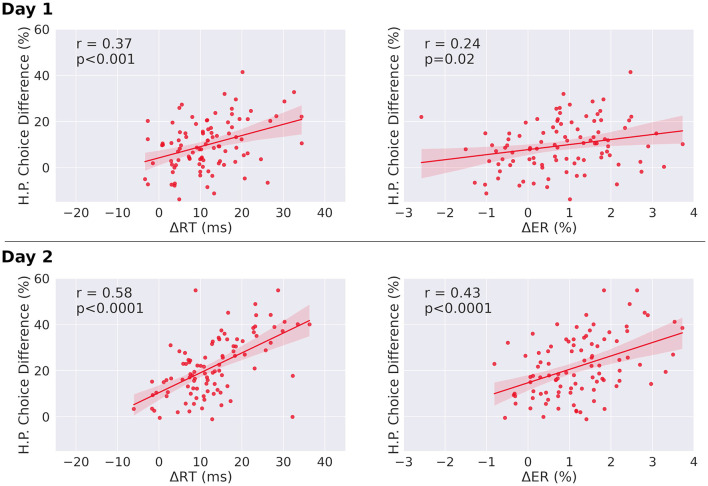 Figure 1
Peer Reviews
No public reviews on file for this paper yet. If you reviewed it on a platform where reviews are public (OpenReview, ICLR, NeurIPS, ICML), you can paste yours below so the community can read it here.
Videos
No videos yet. Explain this paper in a talk, walkthrough, or lecture? Add one.
Taxonomy
TopicsBehavioral Health and Interventions · Eating Disorders and Behaviors
In the published article, there was an error. The reported results for the repeated measures ANOVA on the high reward-probability choice frequencies in section 3.3 were incorrect. The results stated a significant main effect of day, which was incorrect. A correction has been made to section 3.3. Increase of sequence impact on day two, 2nd paragraph. The first sentence previously stated:
“A repeated measures ANOVA on the high reward-probability choice frequencies yielded a significant main effect of choice trial type [F_(1, 99)_ = 77.8, p < 0.0001, partial η^2^ = 0.12], a significant main effect of day [F_(1, 99)_ = 194.6, p < 0.0001, partial η^2^ = 0.36], and a significant interaction between these two factors [F_(1, 99)_ = 77.8, p < 0.0001, partial η^2^ = 0.12].”
The corrected paragraph appears below:
“A repeated measures ANOVA on the high reward-probability choice frequencies yielded a significant main effect of choice trial type [F_(1, 99)_ = 201.7, p < 0.0001, partial η^2^ = 0.46], no main effect of day, and a significant interaction between these two factors [F_(1, 99)_ = 94.7, p < 0.0001, partial η^2^ = 0.1]. This main effect of choice trial type can be readily seen in Figure 3, where participants generally chose the response option with the high reward probability more often in congruent than in incongruent trials. This reflects the relative increase of this choice difference from day one to day two. In random blocks, in the absence of a repeating action sequence, the frequency of high reward-probability choices increases from day one to day two and can be interpreted as a baseline without sequence influence. On both days, participants chose the high reward-probability response more often in congruent trials than in random choice trials (85.5% in congruent trials, 79.6% in random choice trials on day one, p < 0.0001, Cohen's d = 0.62 day one, 90.7% in congruent trials and 84.0% in choice trials on day two, p < 0.0001, Cohen's d = 0.86, two-tailed paired t-tests) and less often in incongruent trials than in random choice trials (75.0% in incongruent trials on day one, p < 0.0001, Cohen's d = −0.39, and 68.1% on day two, p < 0.0001, Cohen's d = 1.19, two-tailed paired t-tests). Participants seem to learn the action sequence quickly, with a difference in the high reward-probability choices between congruent and incongruent trials of 25.9% in the second half of the first sequential block, compared to 10.6% to the first half, and no difference within the first 40 trials of the first block.”
In the published article, there was also an error in Figure 5 as published.
The correlation plots between ΔRT and H.P. Choice Difference for days 1 and 2 were incorrect. The Pearson correlation on day 2 is stronger than previously reported (0.58 instead of 0.54). While we previously reported that the regression slope does not change from day 1 to day 2, it does in fact increase significantly (p = 0.03 instead of p = 0.1).
The corrected Figure 5 and its caption appear below.
The authors apologize for these errors and state that this does not change the scientific conclusions of the article in any way. The original article has been updated.