Seroprevalence and Risk Factors of Chlamydia Infection in Pigs in Hunan Province, Southern China, 2017–2018
Junkun Yang, Shilin Chen, Minxiu Quan, Leqin Li, Ling Shang, Zhongxin Fan, Shifeng Hu

TL;DR
This study found a high rate of Chlamydia infection in pigs in Hunan, China, and identified risk factors like altitude and rearing systems.
Contribution
The study provides the first comprehensive seroprevalence data and risk factors for Chlamydia in pigs in Hunan province.
Findings
The overall seroprevalence of Chlamydia in pigs was 26.90%.
Altitude, sampling regions, and rearing systems were identified as risk factors for infection.
The findings highlight a potential risk to human health from Chlamydia in pigs.
Abstract
Chlamydia is a Gram-negative obligate intracellular bacterium that is pathogenic for humans and a large variety of veterinary animal species. However, there is no continuous monitoring of chlamydia infection data in pigs in Hunan province, southern China. Therefore, in order to evaluate the seroprevalence and identify risk factors associated with Chlamydia infection in pigs within this region, a comprehensive study was conducted. A total of 3848 serum samples were collected from pigs (from farmers and companies) between May 2017 and August 2018. The presence of specific antibodies against Chlamydia was determined through the employment of the indirect hemagglutination assay (IHA). The overall seroprevalence of Chlamydia was determined to be 26.90% (1038/3848, 95% confidence interval: 25.60–28.40). By employing statistical analysis using SPSS software (p < 0.05), factors such as…
Genes, proteins, chemicals, diseases, species, mutations and cell lines named across the full text — each resolved to its canonical identifier and authoritative record.
Click any figure to enlarge with its caption.
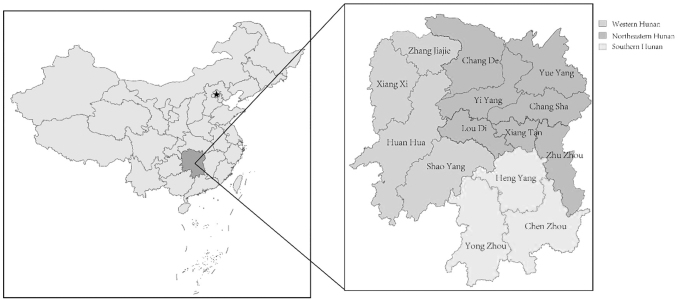 FIG. 1
| Region | City | No. examined | No. positive | Prevalence (%) |
|---|---|---|---|---|
| Southern Hunan | Hengyang | 106 | 46 | 43.40 |
| Yongzhou | 221 | 88 | 39.82 | |
| Chenzhou | 543 | 89 | 16.39 | |
| Total | 870 | 223 | 25.63 | |
| Northeastern Hunan | Changde | 804 | 223 | 27.74 |
| Yueyang | 205 | 5 | 2.44 | |
| Yiyang | 121 | 28 | 23.14 | |
| Changsha | 549 | 195 | 35.52 | |
| Loudi | 298 | 119 | 39.93 | |
| Xiangtan | 327 | 93 | 28.44 | |
| Zhuzhou | 339 | 89 | 26.25 | |
| Total | 2643 | 752 | 28.45 | |
| Western Hunan | Zhangjiajie | 64 | 11 | 17.19 |
| Xiangxi | 120 | 7 | 5.83 | |
| Huaihua | 60 | 37 | 61.67 | |
| Shaoyang | 91 | 8 | 8.79 | |
| Total | 335 | 63 | 18.81 | |
| Total | 3848 | 1038 | 26.90 |
| Region | Prevalence (%) | Date of investigation | Method | Literature |
|---|---|---|---|---|
| Hunan Province | 9.00 | 1986.04–1987.12 | IHA | Jiang et al. ( |
| 16.70 | 2000.08 | IHA | Qiu et al. ( | |
| 22.25 | 2004.03–2005.04 | IHA | Li ( | |
| 62.70 | 2010.01–2012.08 | IHA | Zhang et al. ( | |
| Tibet Province | 16.63 | 2010.04–2010.12 | IHA | Zhang et al. ( |
| Jiangxi Province | 58.59 | 2012.01–2012.12 | IHA | Jiang et al. ( |
| Fujian, Jiangsu, Zhejiang Province, etc. | 62.40 | 2015–2016 | FRET-PCR | Li et al. ( |
| Shandong Province | 24.15 | 2017.01–2018.12 | IHA | Sun et al. ( |
| Yunan Province | 18.50 | NA | IHA | Bi et al. ( |
Peer Reviews
No public reviews on file for this paper yet. If you reviewed it on a platform where reviews are public (OpenReview, ICLR, NeurIPS, ICML), you can paste yours below so the community can read it here.
Videos
No videos yet. Explain this paper in a talk, walkthrough, or lecture? Add one.
Taxonomy
TopicsGeographic Information Systems Studies · Soil and Land Suitability Analysis
Introduction
C**hlamydia is an obligate intracellular pathogenic microorganism, Gram-stain-negative, and has a two-phase life and development cycle of the primary body and reticulate body. It exhibits a global distribution and infects a broad spectrum of hosts, ranging from protists to higher vertebrates, encompassing amoebas, insects, aquatic animals, reptiles, avians, mammals, and humans. Notably, there is currently no effective vaccine available to combat Chlamydia infections (Elwell et al., 2016, Horn, 2008, Schautteet and Vanrompay, 2011). At present, there are 2 genera of chlamydia in the chlamydia family, encompassing a total of 20 identified members, some of which, such as C. abortus, C. pecorum, and C. suis, have the ability to infect pigs (Laroucau et al., 2020; Laroucau et al., 2019; Staub et al., 2018; Taylor-Brown et al., 2017; Taylor-Brown et al., 2016; Vorimore et al., 2021; Vorimore et al., 2013). Several studies have documented a high prevalence of mixed infections with C. suis and C. abortus in the pulmonary and gastrointestinal tracts of pigs (Hoelzle et al., 2000; Rohner et al., 2021).
Moreover, reports from China have indicated varying prevalences of chlamydial infections, ranging from 18.79% in piglets to 80.89% in pregnant sows (Jiang et al., 2013; Li et al., 2017; Nie et al., 2018; Sun et al., 2020; Zhang et al., 2014). Previous research has suggested the zoonotic potential of C. suis, as it has been identified in single or mixed infections with C. trachomatis (Dean et al., 2013). In addition, C. suis DNA has been detected in conjunctival swabs of employees in a Belgian pig slaughterhouse, as well as in pharyngeal and rectal swabs of Belgian pig farmers, highlighting the potential public health implications of pig pathogens (De Puysseleyr et al., 2017; De Puysseleyr et al., 2014). Consequently, pig pathogens may not only affect the pig production, but also potentially play a role in public health.
China, being a predominantly agricultural nation, relies heavily on animal husbandry, with pork accounting for over 50% of domestic meat consumption in 2022 (source: https://www.statista.com/). The country holds the distinction of being the world's largest pork producer, consumer, and importer. Chlamydial infection in pigs has been reported in various provinces of China, such as Shandong (Sun et al., 2020), Yunnan (Bi et al., 2011), Fujian (Zhou et al., 2008), Jiangxi (Jiang et al., 2013), and Hunan (Zhang et al., 2014) provinces. However, the majority of these studies have been published in local journals in the Chinese language, making them less accessible to international researchers. Furthermore, despite being the second largest pig producer in China, there is a lack of continuous epidemiological reporting on chlamydial infections in pigs in Hunan province, hindering the monitoring and management of Chlamydia.
The aim of this study is to investigate the seroprevalence of Chlamydia in pigs within Hunan province and explore the underlying factors contributing to the epidemic of Chlamydia. The findings of this research endeavor will provide valuable data to enhance precautionary measures and control strategies aimed at preventing Chlamydia infections in pigs across China.
Materials and Methods
Investigation sites
This study involved 14 regions throughout Hunan Province, south China (Fig. 1), including 7 cities located in Northeastern Hunan, 4 cities located in Western Hunan, and 3 cities located in Southern Hunan, respectively. Hunan Province (24°38′–30°08′ N, 108°47′–114°15′ E) is located in the south of China, which has a subtropical monsoon climate with distinct differences in the four seasons. Additionally, from east to west, the altitude gradually decreases. The western and southern Hunan are dominated by mountains, while the northern Hunan is dominated by lakes, resulting in a significant difference in weather.
Map showing the geographical locations and seroepidemiological distribution of Chlamydia in Hunan Province, China.
The collection of serum samples
Three thousand eight hundred forty-eight serum samples were randomly collected from pigs from 14 regions in Hunan Province between May 2017 and August 2018 (Table 1), including Heng Yang City (n = 106), Yong Zhou City (n = 221), Chen Zhou City (n = 543), Chang De City (n = 804), Yue Yang City (n = 205), Yi Yang City (n = 121), Chang Sha City (n = 549), Lou Di City (n = 298), Xiang Tan City (n = 327), Zhu Zhou City (n = 339), Zhang Jiajie City (n = 64), Xiang Xi City (n = 120), Huai Hua City (n = 60), and Shao Yang City (n = 91); with 870, 2643, and 335 serum samples being collected from Southern Hunan, Northeastern Hunan, and Western Hunan, respectively. The serum samples were transported to the laboratory and stored at -20°C.
Serological tests
The specific antibodies against Chlamydia at genus level from pigs were detected by indirect hemagglutination assay (IHA) using a commercially available kit (Lanzhou Veterinary Research Institute, Chinese Academy of Agricultural Sciences, Lanzhou, China) according to the manufacturer's instructions, and this kit can be used to detect antibodies against Chlamydia at the genus level in all mammals (Li et al., 2020, Ni et al., 2015, Zhang et al., 2014). Briefly, the serum was diluted by serial fourfold from 1:4 to 1:64, and the positive and negative serum were separately added to each plate. The serum samples were considered positive if agglutinated layers of erythrocytes formed in a dilution of 1:16 or higher. The results between 1:4 and 1:16 were considered as “doubtful” and were retested.
Statistical analyses
Differences in the seroprevalence of Chlamydia in pigs of different geographical origins and categories were analyzed with T test by using SPSS software (SPSS, Inc.; version 19). The cutoff for statistical significance was p < 0.05.
Results and Discussion
In this study, the presence of antibodies against Chlamydia was detected in 1038 out of 3848 randomly selected pig serum samples, resulting in a positivity rate of 26.90% (95% CI = 25.60–28.40) using the IHA with a 1:16 cutoff. Comparative analysis with previous research findings (Tables 1 and 2) reveals a gradual upward trend in the prevalence of chlamydial infection in Hunan Province as a whole. Several factors contribute to this observation:
(1)Before 2000, the pig industry predominantly comprised individual farmers operating on a small scale (three to five pigs). These farmers were less inclined to proactively report pig health issues. Even in cases of pig illness or mortality, they would typically slaughter and consume the animals themselves, resulting in potentially unreliable data.(2)Since 2014, the pig industry has shifted toward corporate dominance, leading to improved standardization and increased attention to infectious diseases. Consequently, data collection, monitoring, and traceability have become more sufficient.(3)Historically, pig breeding and sales were largely confined to individual cities or provinces, limiting the spread of epidemics (−2000). However, the modern pig industry spans multiple provinces, facilitating rapid transmission of diseases once outbreaks occur, as was witnessed during the African swine fever outbreak in 2018.
Comparison with other regions (Tables 1 and 2) reveals that the prevalence of mycoplasma infections is relatively lower in the mountainous western region, while the plains and lakes of the north and central regions exhibit a relatively higher prevalence. Specifically, Tibet and Yunnan (western China with mountainous regions) exhibit prevalence rates of 16.50% and 18.80%, respectively, which are lower than the overall level observed in Hunan Province. Conversely, Jiangsu (eastern China with lakes) and Shandong (northern China with plains) exhibit higher prevalence rates compared with Hunan Province. Moreover, within Hunan Province, the prevalence of chlamydial infections is lower in the mountainous western areas (Xiangxi, Shaoyang, Zhangjiajie) compared with the northern plains. These findings suggest the need for targeted regional divisions to facilitate focused prevalence assessment, prevention, and control strategies.
The findings of this study reveal that pigs in the western region of Hunan had the lowest susceptibility to Chlamydia infection. This observation may be attributed to the unique topography of Hunan Province, where the southern and western regions are characterized by mountainous terrain, while the northeastern part of the province boasts abundant water resources and expansive areas. These geographical variations, coupled with a higher density of live pigs in certain areas, likely contribute to the differences in Chlamydia seroprevalence.
It is important to note that the data collected in this study had limitations regarding the information obtained from farmers and companies. To enhance the understanding of Chlamydia infection risk factors in pigs in China, more comprehensive and detailed information is necessary. This includes factors such as gender, age, breed, sources of water and food, as well as other potential exposures that pigs may encounter, and the specific conditions of their rearing environments. Future studies should aim to investigate these specific elements to refine our knowledge of the risk factors associated with Chlamydia infection in pigs and improve the accuracy of the data.
Conclusions
In conclusion, the results of this study indicated that Chlamydia seroprevalence of pigs is quite high in the mountainous region of Hunan province, southern China. Comparative analysis with previous research findings (Table 2) reveals a gradual upward trend in the prevalence of chlamydial infection in Hunan Province as a whole. Moreover, sampling regions, and rearing system were identified as risk factors for Chlamydia infection in Hunan province. For example, the prevalence of chlamydial infections is lower in the mountainous western areas (Xiangxi, Shaoyang, Zhangjiajie) compared with the northern plains. The findings of this study reveal that pigs in the western region of Hunan had the lowest susceptibility to Chlamydia infection. Our results could provide important data for the strategic control and prevention of Chlamydia infection in China.
Ethics Approval and Consent to Participate
All experimental procedures involving animals complied with the National Research Council's Guide for the Care and Use of Laboratory Animals and were approved and overseen by the Institutional Animal Care and Use Committee at Hunan Agricultural University (no. 2021085).
The reference list from the paper itself. Each links out to its DOI / PubMed record.
- 1Bi J, Yang B, Gao L, et al. Serological invetigation on porcine choamydiae infection in Yunnan Province. Prog Vet Med (In Chinese) 2011;32(03):134–136; doi: 10.16437/j.cnki.1007-5038.2011.03.030 · doi ↗
- 2Dean D, Rothschild J, Ruettger A, et al. Zoonotic Chlamydiaceae species associated with trachoma, Nepal. Emerg Infect Dis 2013;19(12):1948–1955; doi: 10.3201/eid 1912.13065624274654 PMC 3840858 · doi ↗ · pubmed ↗
- 3De Puysseleyr K, De Puysseleyr L, Geldhof J, et al. Development and validation of a real-time PCR for Chlamydia suis diagnosis in swine and humans. P Lo S One 2014;9(5):e 96704; doi: 10.1371/journal.pone.009670424816542 PMC 4016100 · doi ↗ · pubmed ↗
- 4De Puysseleyr L, De Puysseleyr K, Braeckman L, et al. Assessment of Chlamydia suis infection in pig farmers. Transbound Emerg Dis 2017;64(3):826–833; doi: 10.1111/tbed.1244626576707 · doi ↗ · pubmed ↗
- 5Elwell C, Mirrashidi K, Engel J. Chlamydia cell biology and pathogenesis. Nat Rev Microbiol 2016;14(6):385–400; doi: 10.1038/nrmicro.2016.3027108705 PMC 4886739 · doi ↗ · pubmed ↗
- 6Hoelzle LE, Steinhausen G, Wittenbrink MM. PCR-based detection of chlamydial infection in swine and subsequent PCR-coupled genotyping of chlamydial omp 1-gene amplicons by DNA-hybridization, RFLP-analysis, and nucleotide sequence analysis. Epidemiol Infect 2000;125(2):427–439; doi: 10.1017/s 095026889900444611117968 PMC 2869617 · doi ↗ · pubmed ↗
- 7Horn M. Chlamydiae as symbionts in eukaryotes. Annu Rev Microbiol 2008;62:113–131; doi: 10.1146/annurev.micro.62.081307.16281818473699 · doi ↗ · pubmed ↗
- 8Jiang HH, Huang SY, Zhang WB, et al. Seroprevalence of Chlamydia infection in pigs in Jiangxi province, South-Eastern China. J Med Microbiol 2013;62(Pt 12):1864–1867; doi: 10.1099/jmm.0.066555-024008500 · doi ↗ · pubmed ↗