Maxillofacial haemorrhagic symptoms in emergency department patients: impact of antithrombotics
Pieter Date van der Zaag, Stephanie Geurts, Romke Rozema, Inge H. F. Reininga, Baucke van Minnen

TL;DR
This study shows that patients using antithrombotics have more maxillofacial bleeding symptoms, but these symptoms still predict facial fractures in both users and non-users.
Contribution
The study identifies specific maxillofacial haemorrhagic symptoms as predictors of fractures in patients using and not using antithrombotics.
Findings
Patients using antithrombotics had higher frequencies of peri-orbital hematoma, raccoon eyes, and subconjunctival ecchymoses.
Maxillofacial haemorrhagic symptoms were significant predictors of fractures in both antithrombotic users and non-users.
Intra-oral hematoma was a strong predictor of fractures, especially in non-users (OR=7.1) and even more so in users (OR=22.0).
Abstract
To investigate the effect of antithrombotics on the occurrence of maxillofacial haemorrhagic symptoms, and to determine if these haemorrhagic symptoms are predictors of maxillofacial fractures. A prospective cohort study was conducted of consecutive patients with maxillofacial trauma who had been admitted to the emergency department of four hospitals in the Netherlands. This study compared five haemorrhagic symptoms (peri-orbital haematoma, raccoon eyes, epistaxis, subconjunctival ecchymosis, and intra-oral haematoma) between patients not-using (NUA) and using (UA) of antithrombotics, and whether these maxillofacial haemorrhagic symptoms served as predictors for maxillofacial fractures. Out of the 1005 patients, 812 (81%) belonged to the NUA group, and 193 (19%) to the UA group. UA patients exhibited higher frequencies of peri-orbital hematoma (54% vs. 39%, p < 0.001), raccoon eyes…
Genes, proteins, chemicals, diseases, species, mutations and cell lines named across the full text — each resolved to its canonical identifier and authoritative record.
Click any figure to enlarge with its caption.
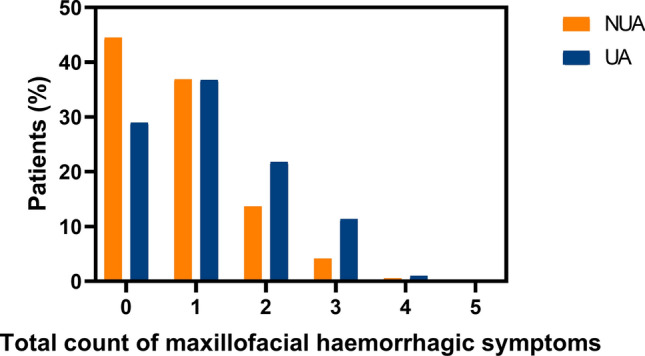 Figure 1
Peer Reviews
No public reviews on file for this paper yet. If you reviewed it on a platform where reviews are public (OpenReview, ICLR, NeurIPS, ICML), you can paste yours below so the community can read it here.
Videos
No videos yet. Explain this paper in a talk, walkthrough, or lecture? Add one.
Taxonomy
TopicsIntracerebral and Subarachnoid Hemorrhage Research · Atrial Fibrillation Management and Outcomes · Hemophilia Treatment and Research