An assessment of the psychometric properties of the Coping Strategies Questionnaire – Sickle Cell Disease (CSQ-SCD) among adults in the United States
Monika Salkar, Meagen Rosenthal, Kaustuv Bhattacharya, Sujith Ramachandran, Marie Barnard, John Young, John P. Bentley

TL;DR
This study evaluated the reliability and validity of a questionnaire measuring coping strategies in adults with sickle cell disease in the U.S.
Contribution
The study clarifies conflicting findings about the CSQ-SCD's factor structure and proposes a revised three-factor model.
Findings
Confirmatory factor analysis supported a three-factor model over a two-factor model for the CSQ-SCD.
Internal consistency was satisfactory for active and affective coping factors but inadequate for passive adherence coping.
An exploratory factor analysis confirmed a three-factor structure with praying and hoping loading on active coping.
Abstract
Previous studies have reported conflicting factor structures of the Coping Strategies Questionnaire - Sickle Cell Disease (CSQ-SCD). This study examined the psychometric properties of the CSQ-SCD among adults with SCD in the United States. This study implemented a cross-sectional study design with web-based self-administered surveys. Individuals with SCD were recruited via an online panel. Psychometric properties, including factorial and construct validity, and internal consistency reliability, of the CSQ-SCD were assessed. A total of 196 adults with SCD completed the survey. Confirmatory factor analysis (CFA), using maximum likelihood estimation and the 13 subscale scores as factor indicators, supported a three-factor model for the CSQ-SCD compared to a two-factor model. Model fit statistics for the three-factor model were: Chi-square [df] = 227.084 [62]; CFI = 0.817; TLI = 0.770;…
Genes, proteins, chemicals, diseases, species, mutations and cell lines named across the full text — each resolved to its canonical identifier and authoritative record.
Click any figure to enlarge with its caption.
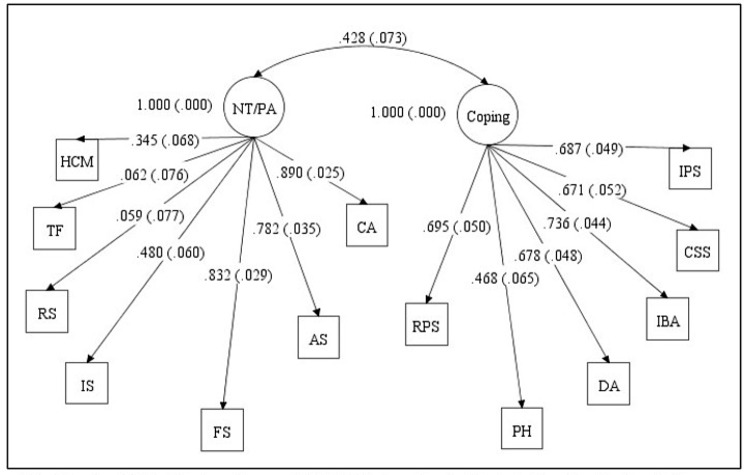 Figure 1
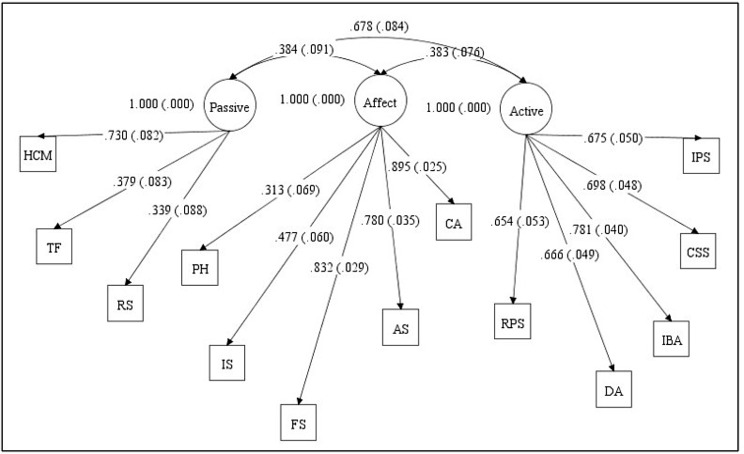 Figure 2
Peer Reviews
No public reviews on file for this paper yet. If you reviewed it on a platform where reviews are public (OpenReview, ICLR, NeurIPS, ICML), you can paste yours below so the community can read it here.
Videos
No videos yet. Explain this paper in a talk, walkthrough, or lecture? Add one.
Taxonomy
TopicsHemoglobinopathies and Related Disorders · Religion, Spirituality, and Psychology · Food Security and Health in Diverse Populations