Comments on the methodology and completeness of a meta-analysis on the association between social frailty and adverse outcomes
Xiao-Ming Zhang, Zhe Yang

Abstract
Genes, proteins, chemicals, diseases, species, mutations and cell lines named across the full text — each resolved to its canonical identifier and authoritative record.
Click any figure to enlarge with its caption.
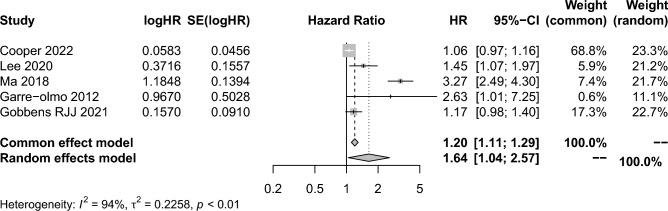 Figure 1
Peer Reviews
No public reviews on file for this paper yet. If you reviewed it on a platform where reviews are public (OpenReview, ICLR, NeurIPS, ICML), you can paste yours below so the community can read it here.
Videos
No videos yet. Explain this paper in a talk, walkthrough, or lecture? Add one.
Taxonomy
TopicsFrailty in Older Adults · Nutrition and Health in Aging · Health Systems, Economic Evaluations, Quality of Life
Dear Editor:
The concept of social frailty, a burgeoning subtype of frailty prevalent amongst the elderly, has increasingly captivated the attention of geriatric medical researchers [1]. A plethora of studies has delved into the ramifications of social frailty on this demographic. A recent meta-analysis divulged that the prevalence of social frailty in the elderly is an alarming 22% (95% CI:18% 26%), underscoring the substantial burden it imposes [2]. With keen interest, we perused the publication by Li et al., which investigates the repercussions of social frailty on adverse clinical outcomes, revealing that elderly individuals afflicted with social frailty face heightened risks of disability, mortality, and depressive manifestations [3]. The study is commendable for its pioneering exploration of the linkage between social frailty and negative health outcomes, employing a robust methodology encompassing meta-analysis, assessment of publication bias, and sensitivity analysis. We laud the authors for their commendable effort, yet there are several aspects that merit further discussion.
Primarily, the search methodology and inclusion/exclusion criteria employed in Li’s analysis appear to overlook a pivotal study conducted by Gobbens in 2021 [4], which utilized the Tilburg Frailty Indicator to gauge social frailty in community-dwelling elders. This study indicated that social frailty does not exacerbate mortality risk post-adjustment for age and sex, presenting a Hazard Ratio (HR) of 1.17 (95% CI: 0.97–1.40). This omission suggests that this study warrants incorporation into their systematic review and meta-analysis.
Furthermore, we observe a discrepancy in the original study by Lee [5], which demonstrated that individuals with high levels of social frailty exhibited a significantly increased mortality risk compared to their non-socially frail counterparts, evidenced by an HR of 1.45 (95% CI: 1.07–1.97). However, Li et al. extracted the data HR of 3.14 (95% CI: 1.81–5.46), pertaining to individuals with both high levels of social and physical frailty, thereby conflating the effects. It is essential that the impact of social frailty in isolation be discerned and analyzed. Therefore, Li and their colleague should better to use the data of 1.45 not 3.14 regarding the association between social frailty and mortality in their meta-analysis.
Re-evaluation of the original data, considering these factors, yielded a pooled HR for the association between social frailty and all-cause mortality in community-dwelling elders of 1.64 (95% CI: 1.04–2.57), as illustrated in Fig. 1.Fig. 1. Meta-analysis for the association between social frailty and mortality among community-dwelling older people
Lastly, Li's study posits an inclusion criterion limiting the sample population to community dwellers. However, prior research indicates that social frailty prevalence is significantly higher among hospitalized elderly individuals compared to their community-dwelling counterparts (40% versus 17%, respectively) [2]. This discrepancy prompts an inquiry into whether the impact of social frailty on mortality is more pronounced within the hospitalized demographic. Consequently, we advocate for the execution of a subgroup analysis to elucidate this critical aspect.
In conclusion, while Li and colleagues have significantly contributed to the understanding of social frailty’s impact on mortality among the elderly residing in communities, addressing the aforementioned concerns could substantially enhance the validity and comprehensiveness of their systematic review and meta-analysis.
The reference list from the paper itself. Each links out to its DOI / PubMed record.
- 1Zhang XM Cao S Gao M The prevalence of social frailty among older adults: a systematic review and meta-analysis J Am Med Dir Assoc 2023242937.e 910.1016/j.jamda.2022.10.00736402197 · doi ↗ · pubmed ↗
- 2Yu S Wang J Zeng L The prevalence of social frailty among older adults: a systematic review and meta-analysis Geriatr Nurs (New York, NY)20234910110810.1016/j.gerinurse.2022.11.00936470103 · doi ↗ · pubmed ↗
- 3Li X Gao L Qiu Y Social frailty as a predictor of adverse outcomes among older adults: a systematic review and meta-analysis Aging Clin Exp Res 2023351417142810.1007/s 40520-023-02421-y 37219756 · doi ↗ · pubmed ↗
- 4Gobbens RJJ Van Assen M Augustijn H Prediction of mortality by the tilburg frailty indicator (TFI)J Am Med Dir Assoc 202122607.e 1607.e 610.1016/j.jamda.2020.07.03332883597 · doi ↗ · pubmed ↗
- 5Lee Y Chon D Kim J The predictive value of social frailty on adverse outcomes in older adults living in the community J Am Med Dir Assoc 20202114641469.e 210.1016/j.jamda.2020.03.01032362535 · doi ↗ · pubmed ↗