Evidence of pial synagiosis through ventriculoperitoneal shunt entry site in a patient who manifested Moyamoya syndrome later in childhood: A case report and historical perspective
Awn AlEssa, Alaa AlSahli, Tariq AlJared

TL;DR
A child with a history of spinal surgery and a shunt later showed signs of Moyamoya syndrome, suggesting revascularization through the shunt site.
Contribution
First reported case of Moyamoya syndrome linked to revascularization via a ventriculoperitoneal shunt entry site.
Findings
A two-year-old girl developed Moyamoya syndrome later in childhood after shunt insertion.
The case suggests revascularization occurred through the shunt's burr hole.
This is the first documented case of such a connection between shunt and Moyamoya syndrome.
Abstract
The term Moyamoya , or “puff of smoke” in Japanese , was first used in 1969 by Suzuki and Takaku to describe the classical appearance of collateral blood vessels in response to progressive vascular stenosis of distal internal carotid artery (ICA). Such condition may result in various clinical presentations ranging from strokes to developmental delays. In order to cease the progression of such stenotic vasculopathy, several means of revascularization have been developed over the years. In this paper we present a case of a two-year-old girl with history of myelomeningocele repair and ventriculoperitoneal shunt insertion followed by manifestation of Moyamoya syndrome later in childhood as an evidence of revascularization through a burr hole. To our knowledge, this paper is the first of its kind to report such findings in one patient. Moreover, this paper provides a historical perspective…
Genes, proteins, chemicals, diseases, species, mutations and cell lines named across the full text — each resolved to its canonical identifier and authoritative record.
Click any figure to enlarge with its caption.
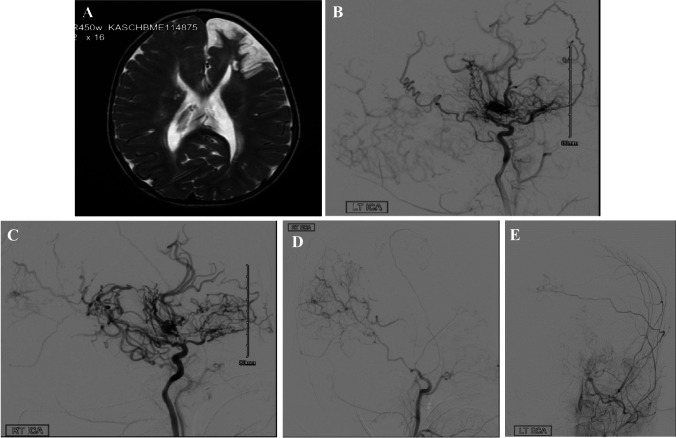 Figure 1
Peer Reviews
No public reviews on file for this paper yet. If you reviewed it on a platform where reviews are public (OpenReview, ICLR, NeurIPS, ICML), you can paste yours below so the community can read it here.
Videos
No videos yet. Explain this paper in a talk, walkthrough, or lecture? Add one.
Taxonomy
TopicsMoyamoya disease diagnosis and treatment · Neurological Complications and Syndromes · Intracranial Aneurysms: Treatment and Complications