Transitioning to adulthood: Are conventional benchmarks as protective today as they were in the past?
Christal Hamilton, Zachary Parolin, Jane Waldfogel, Christopher Wimer

TL;DR
This study examines whether traditional markers of success, like education and stable jobs, still help reduce poverty among young adults in the U.S. today as they did in the past.
Contribution
The study compares the effectiveness of conventional benchmarks across two generations and identifies demographic and economic factors influencing poverty rates.
Findings
Benchmarks of success are as predictive of reduced poverty today as in the past.
Achieving more benchmarks increases the likelihood of reduced young adult poverty.
Economic changes over time contribute to higher poverty rates for young adults today.
Abstract
More young adults in the United States are studying beyond high school and working full-time than in the past, yet young adults continue to have high poverty rates as they transition to adulthood. This study uses longitudinal data on two cohorts of young adults from the 1979 and 1997 National Longitudinal Study of Youth to assess whether conventional benchmarks associated with economic success—gaining an education, finding stable employment, and delaying childbirth until after marriage—are as predictive of reduced poverty today as they were in the past. We also explore differences in the protective effect of the benchmarks by race/ethnicity, gender, and poverty status while young. We find that, on average, the benchmarks associated with economic success are as predictive of reduced poverty among young adults today as they were for the prior generation; however, demographics and features…
Genes, proteins, chemicals, diseases, species, mutations and cell lines named across the full text — each resolved to its canonical identifier and authoritative record.
Click any figure to enlarge with its caption.
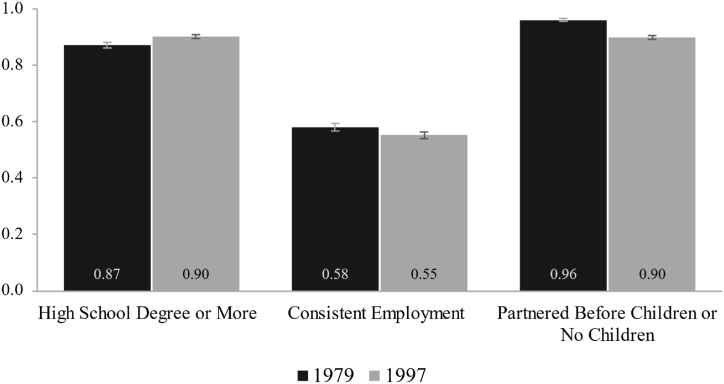 Figure 1
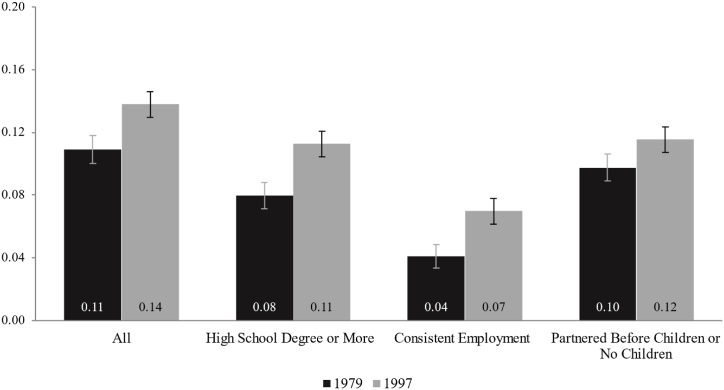 Figure 2
Peer Reviews
No public reviews on file for this paper yet. If you reviewed it on a platform where reviews are public (OpenReview, ICLR, NeurIPS, ICML), you can paste yours below so the community can read it here.
Videos
No videos yet. Explain this paper in a talk, walkthrough, or lecture? Add one.
Taxonomy
TopicsYouth Education and Societal Dynamics · Intergenerational and Educational Inequality Studies · Financial Literacy, Pension, Retirement Analysis