Sex as a risk factor regarding presbyopia in the rhesus monkey
Mary Ann Croft, Jared P. Mcdonald, Julie Kiland, Julie A. Mattison, George S. Roth, Don Ingram, Paul L. Kaufman

TL;DR
This study found that presbyopia, or age-related loss of focusing ability, occurs similarly in male and female rhesus monkeys.
Contribution
The study demonstrates that sex does not significantly influence the progression of presbyopia in rhesus monkeys.
Findings
Accommodative amplitude decreased with age in both male and female rhesus monkeys.
There was no significant difference in the rate of accommodative decline between sexes (p = 0.827).
Presbyopia progression is consistent and predictable, regardless of sex.
Abstract
To determine the effect of sex as a risk factor regarding presbyopia. Maximum accommodation was pharmacologically induced (40% cabachol corneal iontophoresis) in 97 rhesus monkeys (49 males and 48 females) ranging in age from 8 to 36 years old. Accommodation was measured by Hartinger coincidence refractometry. Accommodative amplitude measured refractometrically decreased with age, and the rate of change was not different between males and females (p = 0.827). Presbyopia is essentially sex neutral, and no one is spared. There may be modest variations between different populations for various reasons, but essentially it is monotonously predictable. At present there is no biological therapeutic.
Genes, proteins, chemicals, diseases, species, mutations and cell lines named across the full text — each resolved to its canonical identifier and authoritative record.
Click any figure to enlarge with its caption.
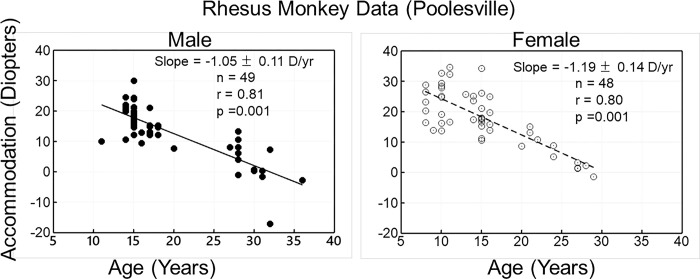 Figure 1
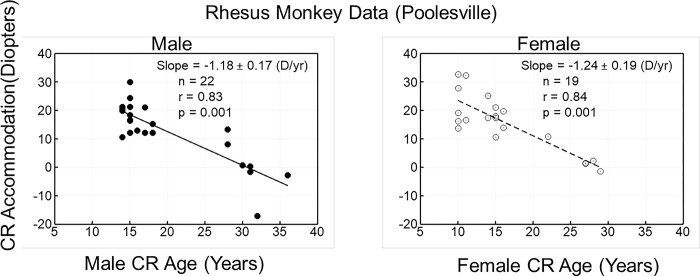 Figure 2
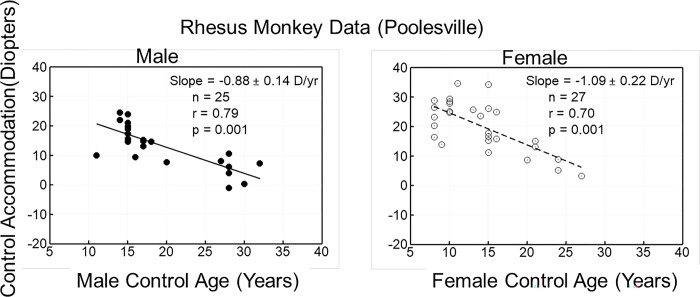 Figure 3
Peer Reviews
No public reviews on file for this paper yet. If you reviewed it on a platform where reviews are public (OpenReview, ICLR, NeurIPS, ICML), you can paste yours below so the community can read it here.
Videos
No videos yet. Explain this paper in a talk, walkthrough, or lecture? Add one.
Taxonomy
TopicsOphthalmology and Visual Impairment Studies · Glaucoma and retinal disorders · Leaf Properties and Growth Measurement