A review of Bruton’s tyrosine kinase inhibitors in multiple sclerosis
Laura Airas, Robert A. Bermel, Tanuja Chitnis, Hans-Peter Hartung, Jin Nakahara, Olaf Stuve, Mitzi J. Williams, Bernd C. Kieseier, Heinz Wiendl

TL;DR
This review explores the potential of Bruton’s tyrosine kinase inhibitors as a new treatment for multiple sclerosis, focusing on their safety and effectiveness in ongoing clinical trials.
Contribution
The paper provides a comprehensive review of second-generation BTK inhibitors for MS, highlighting their improved selectivity and safety insights from ongoing trials.
Findings
Phase II trials showed BTK inhibitors reduce new brain lesions in MS patients.
Second-generation BTK inhibitors demonstrate improved selectivity and safety compared to first-generation drugs.
Safety profiles for long-term use and effects on female reproductive health are under investigation.
Abstract
Bruton’s tyrosine kinase (BTK) inhibitors are an emerging class of therapeutics in multiple sclerosis (MS). BTK is expressed in B-cells and myeloid cells, key progenitors of which include dendritic cells, microglia and macrophages, integral effectors of MS pathogenesis, along with mast cells, establishing the relevance of BTK inhibitors to diverse autoimmune conditions. First-generation BTK inhibitors are currently utilized in the treatment of B-cell malignancies and show efficacy in B-cell modulation. B-cell depleting therapies have shown success as disease-modifying treatments (DMTs) in MS, highlighting the potential of BTK inhibitors for this indication; however, first-generation BTK inhibitors exhibit a challenging safety profile that is unsuitable for chronic use, as required for MS DMTs. A second generation of highly selective BTK inhibitors has shown efficacy in modulating…
Genes, proteins, chemicals, diseases, species, mutations and cell lines named across the full text — each resolved to its canonical identifier and authoritative record.
Click any figure to enlarge with its caption.
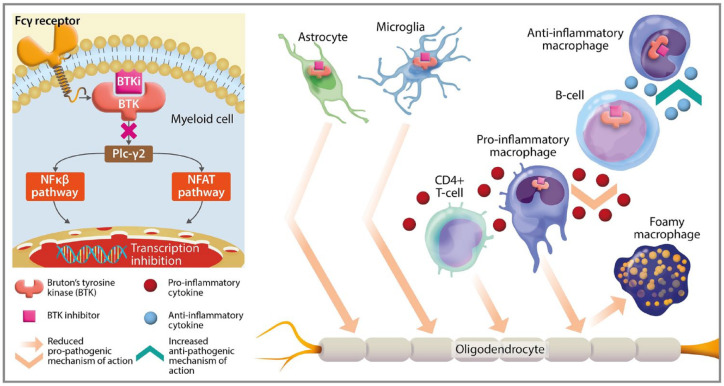 Figure 1
 Figure 2
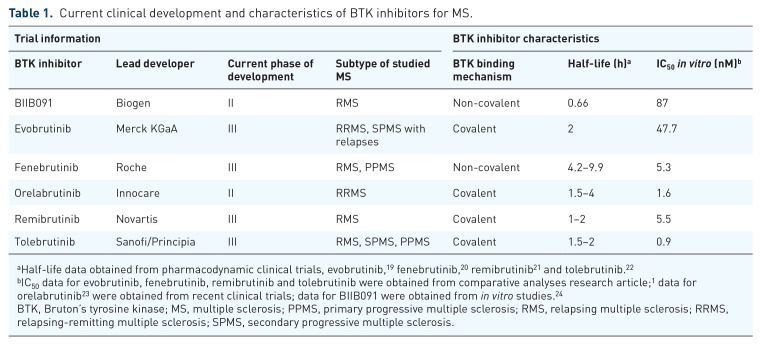 Figure 3
 Figure 4
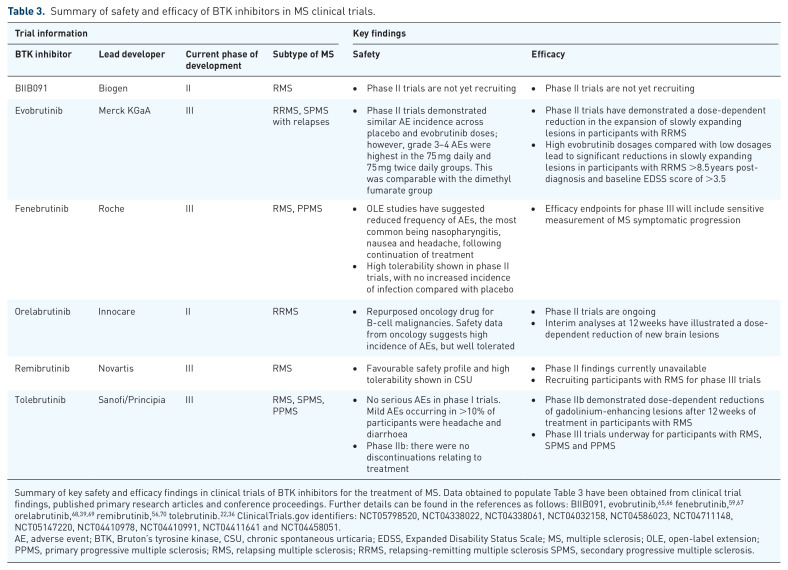 Figure 5
Peer Reviews
No public reviews on file for this paper yet. If you reviewed it on a platform where reviews are public (OpenReview, ICLR, NeurIPS, ICML), you can paste yours below so the community can read it here.
Videos
No videos yet. Explain this paper in a talk, walkthrough, or lecture? Add one.
Taxonomy
TopicsImmune Cell Function and Interaction · Immune Response and Inflammation · T-cell and B-cell Immunology