780 Usage of Botulinum Toxin a in Acute Burn Care: A Case Study
Ariel J Rodgers, Sarah Barth, Lily DuRose, Irma D Fleming, Giavonni M Lewis, Callie M Thompson, Christopher R LaChapelle

TL;DR
This case study explores using botulinum toxin A in acute burn care to reduce joint contractures and scarring.
Contribution
The first reported use of botulinum toxin A in acute burns to prevent contractures.
Findings
BTA injections were safely administered without complications in an acute burn patient.
The patient actively participated in therapy post-injection, showing potential for improved range of motion.
The case highlights the need for range of motion benchmarks and further research on BTA in burn care.
Abstract
Burn scar contractures over joints can be challenging for everyone, from patient to therapist to burn surgeon. They can be managed in a multitude of ways; however, the use of botulinum toxin A (BTA) in acute burns has not been described. We describe a case report introducing the possibility of the use of BTA in the acute setting to minimize scarring and reduce contracture formation. This is a case study on a 16-year-old male with a 48% TBSA full thickness flame burn from an electrical arc, most significantly to his torso and bilateral upper extremities. The patient underwent excisional debridement and allografting within the first 72 hours after injury. Seven days later, at the time of autografting, BTA was injected under ultrasound guidance into the bilateral sternocleidomastoid (20 units each), bilateral pectoralis major (20 units each), and platysma muscles (20 units) for a total of…
Click any figure to enlarge with its caption.
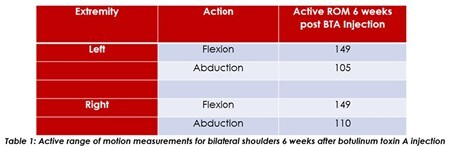 Figure 1
Peer Reviews
No public reviews on file for this paper yet. If you reviewed it on a platform where reviews are public (OpenReview, ICLR, NeurIPS, ICML), you can paste yours below so the community can read it here.
Videos
No videos yet. Explain this paper in a talk, walkthrough, or lecture? Add one.
Taxonomy
TopicsBotulinum Toxin and Related Neurological Disorders · Laser Applications in Dentistry and Medicine