118 Retrospective Analysis of Pathogens for Guided Creation of an EMPIRic Antibiotic PrEscribing Pathway (EMPIRE)
Lorraine A Todor, David M Hill

TL;DR
This study analyzes pathogens in burn unit patients to optimize empiric antibiotic regimens, finding that vancomycin and cefepime cover most infections within the first week of admission.
Contribution
The study proposes a refined empiric antibiotic prescribing pathway tailored to infection sources and patient risk factors.
Findings
Vancomycin and cefepime cover 98% of Gram-positive and 90% of Gram-negative pathogens in the first week of admission without healthcare-associated risk factors.
Narrower beta-lactams plus vancomycin cover 83% of respiratory pathogens, but broader coverage is needed for pneumonia.
Difficult-to-treat pathogens are rarely isolated from wound cultures within one week of admission.
Abstract
Mortality from infection due to P. aeruginosa is remarkably high; therefore empiric regimens include its coverage. In a prior study, we showed manual inclusion of bedside prescribing considerations heavily reduced antibiogram-based, empiric recommendations (i.e, double Gram-negative [GN] coverage to a single agent + vancomycin [VAN]). The purpose of this study is to determine if empiric regimens in the burn unit may be optimized further per suspected infection source. We hypothesized an initial regimen of VAN and cefepime (C4) will still adequately cover 90% of definitive pathogens isolated within one week of admission in absence of healthcare-associated infection risk factors (HAIRF). For suspected pneumonia, a narrower beta-lactam can be used with adequate coverage. Lastly, difficult to treat pathogens (DTp) are rarely the cause of wound infection within one week of admission. This…
Genes, proteins, chemicals, diseases, species, mutations and cell lines named across the full text — each resolved to its canonical identifier and authoritative record.
Click any figure to enlarge with its caption.
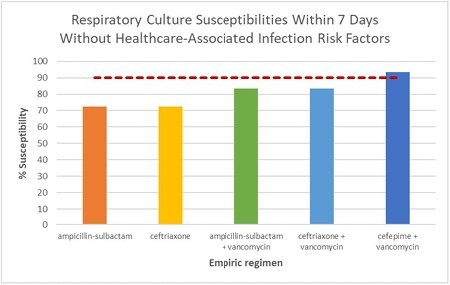 Figure 1
Peer Reviews
No public reviews on file for this paper yet. If you reviewed it on a platform where reviews are public (OpenReview, ICLR, NeurIPS, ICML), you can paste yours below so the community can read it here.
Videos
No videos yet. Explain this paper in a talk, walkthrough, or lecture? Add one.
Taxonomy
TopicsBiosimilars and Bioanalytical Methods