511 Hydroxocobalamin Not the Clear Culprit of Nephrotoxicity After Cyanide Poisoning
Elise M Mann, Allison N Boyd, Todd A Walroth, Jessica Whitten, Allyson M McIntire, Serena Dine, Molly M Howell, Taylor Rhew, Brett C Hartman

TL;DR
This study found that hydroxocobalamin, used to treat cyanide poisoning, does not clearly cause kidney damage in patients with inhalation injury.
Contribution
This is the first study to control for hydroxocobalamin administration in both burn and non-burn inhalation injury patients.
Findings
No difference in acute kidney injury incidence between patients who received hydroxocobalamin and those who did not.
Hydroxocobalamin recipients had higher median injury grade and CRRT initiation at 7 days.
Findings suggest hydroxocobalamin alone is not the main cause of nephrotoxicity in inhalation injury patients.
Abstract
Inhalation injury (IHI) and cyanide poisoning are often observed in burn patients, but they may also present without cutaneous injury. If cyanide toxicity is suspected, the antidote, hydroxocobalamin, is indicated. Although a lifesaving drug, hydroxocobalamin has been associated with acute kidney injury (AKI) and oxalate nephropathy in recent literature. It remains unclear whether the renal issues observed after hydroxocobalamin administration are due to the drug itself or are influenced by other confounding variables. The objective of this study was to compare patients with IHI who either do or do not receive hydroxocobalamin and to assess whether there is a difference in incidence of nephrotoxicity. This single-center, retrospective, matched, cohort study included adults 18 years or older admitted to the Medical ICU or Burn ICU for at least 72 hours between 10/2016 and 12/2022 with a…
Genes, proteins, chemicals, diseases, species, mutations and cell lines named across the full text — each resolved to its canonical identifier and authoritative record.
Click any figure to enlarge with its caption.
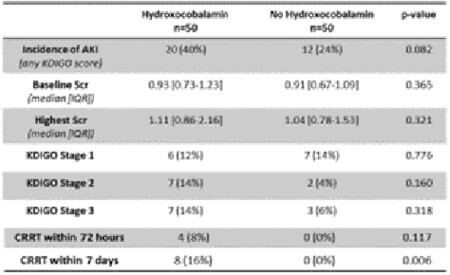 Figure 1
Peer Reviews
No public reviews on file for this paper yet. If you reviewed it on a platform where reviews are public (OpenReview, ICLR, NeurIPS, ICML), you can paste yours below so the community can read it here.
Videos
No videos yet. Explain this paper in a talk, walkthrough, or lecture? Add one.
Taxonomy
TopicsCassava research and cyanide