17 Fluid Resuscitation Effects Endothelial Glycocalyx Shedding in a Swine Model of Severe Burn Injury
Eriks Ziedins, Edward J Kelly, Babita Parajuli, Bonnie C Carney, Jeffrey W Shupp, Lauren T Moffatt, David M Burmeister

TL;DR
This study shows that fluid resuscitation in severe burns affects endothelial glycocalyx damage, with under-resuscitation causing more harm.
Contribution
The study demonstrates how different resuscitation levels impact endothelial glycocalyx shedding in a swine burn model.
Findings
Under-resuscitation led to higher plasma SDC1 and sGAG levels, indicating more endothelial glycocalyx damage.
Over-resuscitation increased fluid and urine output but did not cause elevated SDC1 or sGAG levels.
Under-resuscitated pigs showed signs of kidney damage and lower MAP compared to other groups.
Abstract
Severe burn injury is associated with altered hemodynamics and inflammation that can lead to reduced organ perfusion with subsequent organ dysfunction. While this may be mitigated with aggressive IV fluid administration, both over and under resuscitation can lead to poor outcomes. Confounding matters is endothelial glycocalyx (EGL) damage, which has also shown to be affected by crystalloid administration and is normally represented with syndecan-1 (SDC1) levels. The aim of this study was to examine EGL damage with respect to the amount of fluid administered in a swine model of burn resuscitation. Yorkshire pigs were anesthetized and subjected to 40% total body surface area burn and 15% total blood volume-controlled hemorrhage to combat splenic autoresuscitation. Pigs were randomly selected to receive: decision support driven (adequate), fluid withholding (under), and high constant…
Genes, proteins, chemicals, diseases, species, mutations and cell lines named across the full text — each resolved to its canonical identifier and authoritative record.
Click any figure to enlarge with its caption.
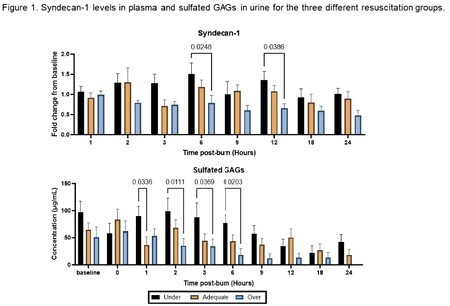 Figure 1
Peer Reviews
No public reviews on file for this paper yet. If you reviewed it on a platform where reviews are public (OpenReview, ICLR, NeurIPS, ICML), you can paste yours below so the community can read it here.
Videos
No videos yet. Explain this paper in a talk, walkthrough, or lecture? Add one.
Taxonomy
TopicsTrauma, Hemostasis, Coagulopathy, Resuscitation