577 Understanding Drivers of Fire Risk with People Experiencing Homelessness
Caitlin M Orton, Mark Gannon, Aldina Mesic, Mona Chambers, Tam N Pham, Barclay T Stewart

TL;DR
This study explores fire risks faced by people experiencing homelessness and identifies ways to prevent burn injuries through harm reduction strategies.
Contribution
The study identifies specific fire hazards and prevention opportunities unique to people experiencing homelessness using harm reduction theory.
Findings
Common fire sources among participants included propane, hand sanitizer, and alcohol-based liquids.
Environmental, social, and behavioral factors interplay to increase fire risks for people experiencing homelessness.
Prevention strategies like safe stove dissemination and education on storage were suggested as harm reduction measures.
Abstract
Burn injuries among people experiencing homelessness (PEH) are a major and escalating public health problem affecting a population facing issues of socioeconomic disparities, racism, comorbidities (e.g., disabilities, substance use disorders), and inequitable housing policies. Given the intensifying issue of burn injuries among PEH, it is crucial to Identify key drivers of fire risk in this already marginalized population to inform injury prevention and control initiatives. Key informant interviews (KII) with PEH who experienced burn injuries were conducted to identify fire risks and opportunities to mitigate hazards. Transcripts were coded using deductive and inductive strategies grounded in harm reduction theory. For the deductive component, an established conceptual model was applied to group factors into the following categories: weather conditions, neighborhood characteristics,…
Genes, proteins, chemicals, diseases, species, mutations and cell lines named across the full text — each resolved to its canonical identifier and authoritative record.
Click any figure to enlarge with its caption.
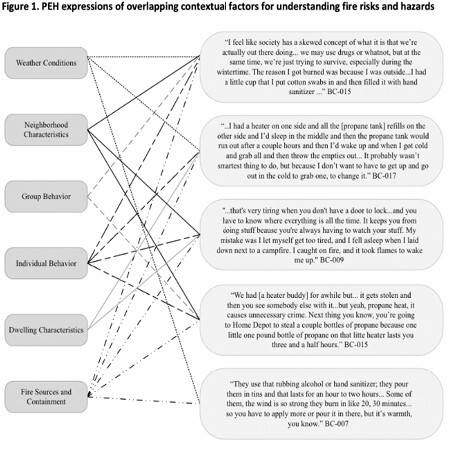 Figure 1
Peer Reviews
No public reviews on file for this paper yet. If you reviewed it on a platform where reviews are public (OpenReview, ICLR, NeurIPS, ICML), you can paste yours below so the community can read it here.
Videos
No videos yet. Explain this paper in a talk, walkthrough, or lecture? Add one.
Taxonomy
TopicsUrban Transport and Accessibility