126 Predictors of Lengthened Admission in Adult Burn Patients, a Secondary Analysis of 1796 Cases
Xi Ming Zhu, Diana Tedesco, Lucas Gallo, Shahriar Shahrokhi, Marc G Jeschke

TL;DR
This study identifies patient and injury factors that predict longer hospital stays for adult burn patients beyond the standard TBSA ratio.
Contribution
The study provides new insights into factors beyond TBSA that influence length of stay in adult burn patients.
Findings
Greater age, female sex, inhalation injury, psychiatric illness, and in-hospital complications increase likelihood of prolonged LOS.
Diabetes was not a statistically significant contributor in multivariate analysis.
Findings help physicians better assess and coordinate care for burn patients.
Abstract
Existing research has examined the relationship between the amount of total body surface area (TBSA) burn and length of stay (LOS). As a result, the conventional ratio of 1day LOS/1% TBSA ratio has been updated to 1.5days LOS/1% TBSA. In this study, we aim to elucidate patient and injury characteristics that affect our prognostic indicator, leading to a prolonged LOS. This was a secondary analysis of a cohort study of surviving patients admitted to a tertiary adult burn center between January 1, 2006, and June 30, 2021. Adult patients less than 60 years of age were stratified into expected LOS ( < 1.5 days/%TBSA) and greater than expected LOS (>1.5 days days/%TBSA). Patient demographics, TBSA, burn etiology, inhalation injury, pre-admission co-morbidities, and in-hospital complications were tabulated Logistic regression was performed using IBM SPSS Statistics 29 and Stata Statistical…
Genes, proteins, chemicals, diseases, species, mutations and cell lines named across the full text — each resolved to its canonical identifier and authoritative record.
Click any figure to enlarge with its caption.
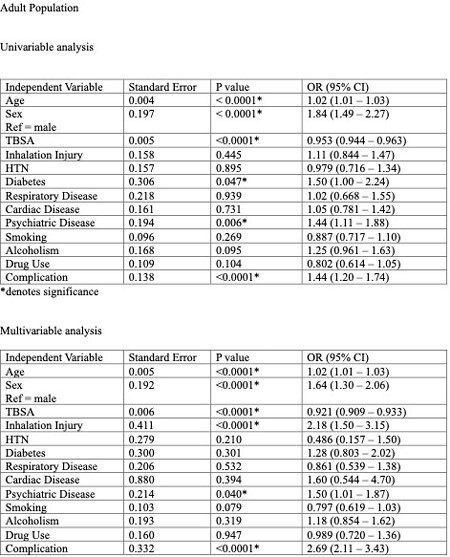 Figure 1
Peer Reviews
No public reviews on file for this paper yet. If you reviewed it on a platform where reviews are public (OpenReview, ICLR, NeurIPS, ICML), you can paste yours below so the community can read it here.
Videos
No videos yet. Explain this paper in a talk, walkthrough, or lecture? Add one.
Taxonomy
TopicsWound Healing and Treatments