20 Large Burn Injury Leads to Pathological Alteration of Hematopoietic Stem and Progenitor Cell Lineage Commitment
Ryan M Johnson, Kevin E Galicia, Huashan Wang, Mashkoor A Choudhry, John Kubasiak

TL;DR
Large burn injuries alter blood cell development, leading to increased myeloid cells and reduced lymphoid cells, which may contribute to sepsis.
Contribution
This study reveals how large burns affect hematopoietic stem cell lineage commitment, particularly in septic patients.
Findings
Absolute HSPC frequencies were similar between small and large burn groups in the first 72 hours.
Septic patients with large burns showed increased megakaryocyte and myeloid progenitors and reduced lymphoid progenitors.
These changes in HSPC lineage commitment correlate with the development of sepsis.
Abstract
Hematopoiesis follows a hierarchical differentiation process that begins with hematopoietic stem and progenitor cells (HSPC). This cascade culminates in the generation of erythroid, myeloid, and lymphoid lineages. Under pathological conditions, lineage commitment can be altered, and these changes are currently poorly understood in the setting of burn injury. This study seeks to provide a more comprehensive characterization of circulating HSPC in individuals who have sustained burn injuries with respect to burn size and the occurrence of sepsis. Flow Cytometry was utilized to analyze blood samples. Gating was performed with lineage markers CD3, CD14, CD19, CD41, CD56, and CD66c to determine all live, lineage-negative populations. Further gating was performed with markers CD34, CD38, CD45RA, CD49f, and CD135 to determine HSPC subpopulations. Patients were categorized into two groups…
Genes, proteins, chemicals, diseases, species, mutations and cell lines named across the full text — each resolved to its canonical identifier and authoritative record.
Click any figure to enlarge with its caption.
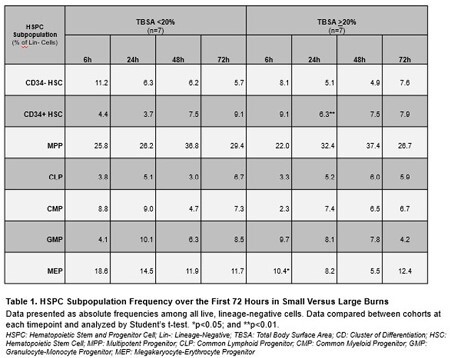 Figure 1
Peer Reviews
No public reviews on file for this paper yet. If you reviewed it on a platform where reviews are public (OpenReview, ICLR, NeurIPS, ICML), you can paste yours below so the community can read it here.
Videos
No videos yet. Explain this paper in a talk, walkthrough, or lecture? Add one.
Taxonomy
TopicsWound Healing and Treatments