8 Burn Shock: What Defines a Failing Fluid Resuscitation?
Abigail Plum, Ryan M Johnson, Kevin E Galicia, John Kubasiak

TL;DR
This study explores how defining failing fluid resuscitation in burn shock can improve patient survival by guiding timely interventions.
Contribution
The study introduces a framework for identifying failing resuscitation indicators and evaluates their impact on patient outcomes.
Findings
Patients with ≥1000 mL/hr resuscitation who received interventions showed a 46% higher survival likelihood.
Patients with ≥1500 mL/hr resuscitation who received interventions had a 50% lower survival likelihood.
Urine output <30 mL over two hours with intervention was associated with a 6% lower survival likelihood.
Abstract
Major burn injuries often elicit burn shock requiring acute fluid resuscitation for patient survival. Successful resuscitation is a significant challenge for patient management as under-resuscitation and over-resuscitation can lead to greater adverse events. At the ABA-State of the Science in 2021, proposed definitions included >1,500ml IVF per hour, although no clear clinical data supported this expert consensus. A clear definition of a failing resuscitation may better guide physician decision-making for additional interventions. The primary objective of this study was to examine the association between intervention provided within three hours following a defined indication of failing resuscitation and patient survival. The study utilized the Acute Burn ResUscitation Multicenter Prospective Trial (ABRUPT), consisting of patients ≥18 years with burns ≥20% of total body surface area…
Click any figure to enlarge with its caption.
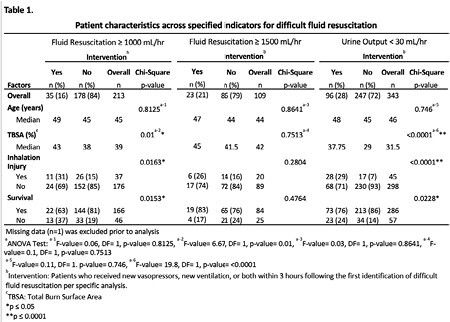 Figure 1
Peer Reviews
No public reviews on file for this paper yet. If you reviewed it on a platform where reviews are public (OpenReview, ICLR, NeurIPS, ICML), you can paste yours below so the community can read it here.
Videos
No videos yet. Explain this paper in a talk, walkthrough, or lecture? Add one.
Taxonomy
TopicsBurn Injury Management and Outcomes