745 Old Dog, New Tricks? Applying the Causal Hazard Chain Model to Burn Prevention and Injuries
Randy D Kearns, Jeffrey E Carter, Ernest Grant, William L Hickerson

TL;DR
This paper applies the Causal Hazard Chain model to understand and prevent burn injuries by analyzing the sequence of events leading to burns.
Contribution
The novel application of the Causal Hazard Chain model to burn prevention and injury analysis is presented.
Findings
A predictable sequence of events leading to burn injuries can be mapped using the CHS model.
The model highlights opportunities for intervention at each stage of the hazard chain to reduce burn risks.
Abstract
From burn injuries to widespread catastrophe and calamity, fire has been associated with unexpected death and destruction. Worldwide, 8,378,122 were hospitalized in 2019 with a burn injury.1 Approximately 180,000 die as a result of a burn injury annually.2 There is a known or predictable sequence of events that precede injury and death with most burn injuries. Understanding the risks, causality, and nature of burn injury prevention is essential to prevent catastrophic events in the workplace,3,4 following a natural disaster,5 or in the home. For this work, we applied the Causal Hazard Sequence (CHS)6-9 relying on the standard CHS series of events: 1. Human Needs 2. Human Wants 3. Choice of Technology 4. Malfunction 5. Outcomes 6. Consequences 7. Higher Order Consequences For each of the seven steps in the series of events, the "Control Stage" of the CHS model requires that you…
Click any figure to enlarge with its caption.
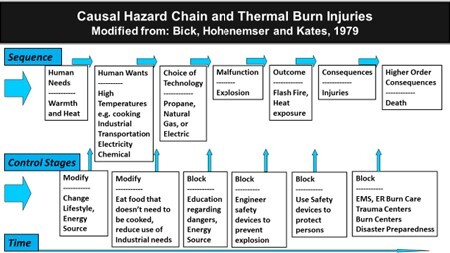 Figure 1
Peer Reviews
No public reviews on file for this paper yet. If you reviewed it on a platform where reviews are public (OpenReview, ICLR, NeurIPS, ICML), you can paste yours below so the community can read it here.
Videos
No videos yet. Explain this paper in a talk, walkthrough, or lecture? Add one.
Taxonomy
TopicsBurn Injury Management and Outcomes