700 Early Heart Rate Trend Predicts Burn Mortality
Arushi Biswas, Keith T Kuo, Shanmuga Priya Rajagopalan, Terrence Tsou, Tomer Lagziel, Madhu Subramanian, Carisa M M Cooney, Julie A Caffrey

TL;DR
This study shows that a small increase in heart rate in the first 48 hours after a severe burn is linked to higher mortality risk, helping clinicians identify high-risk patients early.
Contribution
The study introduces heart rate trend in the first 48 hours as a novel, accessible predictor of mortality in burn patients.
Findings
Patients who died had a 9% heart rate increase in 48 hours, compared to 20% in survivors.
Heart rate trend was a significant predictor of 90-day mortality after adjusting for key confounders.
Early heart rate trends can guide resource allocation and clinical focus in burn care.
Abstract
During post-burn hypermetabolism, tachycardia is considered a compensatory response to sustain cardiac output and oxygenation to essential organs. Although heart rate variability predicts mortality in burn patients, many centers lack access to non-invasive measurement methods. We hypothesized that heart rate trend in the first 48 hours of admission (measured via vital signs monitor) could predict mortality in burn patients. We performed a retrospective review of 128 patients treated for burns with TBSA ≥ 20% at a single institution between 2016 and 2021. We extracted demographics, burn characteristics (e.g. location, mechanism, depth, presence of inhalation injury), complications (surgical and hospital-acquired), and hourly vital signs for the first 48 hours of admission. We performed bivariate analyses to determine associations between mortality within 90 days of discharge and patient…
Genes, proteins, chemicals, diseases, species, mutations and cell lines named across the full text — each resolved to its canonical identifier and authoritative record.
Click any figure to enlarge with its caption.
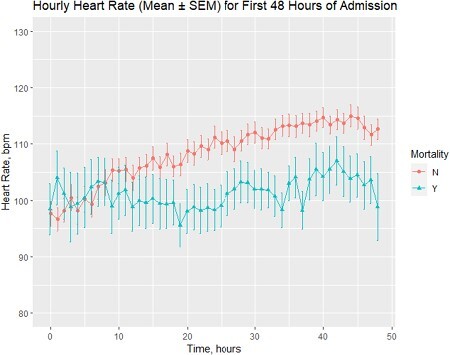 Figure 1
Peer Reviews
No public reviews on file for this paper yet. If you reviewed it on a platform where reviews are public (OpenReview, ICLR, NeurIPS, ICML), you can paste yours below so the community can read it here.
Videos
No videos yet. Explain this paper in a talk, walkthrough, or lecture? Add one.
Taxonomy
TopicsHealthcare Systems and Public Health