24 Bleeding Money: Improving Triage and Documentation for Burn Patients in the Emergency Department
Stacey Richerbach, Tiffany Hockenberry, Kevin N Foster

TL;DR
This paper describes a quality improvement project aimed at improving triage documentation and care prioritization for burn patients in the emergency department.
Contribution
A multidisciplinary approach was used to reduce undocumented triage acuity and improve documentation of burn patient acuity levels.
Findings
Undocumented triage acuity for burn patients was reduced by 9.6% following the quality improvement project.
Emergent and urgent acuity assignments increased by 11.3% for each category.
Education and EHR modifications were key interventions in improving triage documentation.
Abstract
Triage acuity is a critical factor in determining resource allocation and prioritizing patient care. Additionally, documented triage acuities are correlated with professional charges and billing codes. Within the emergency department (ED), burn patients comprise a unique population. For a patient with a burn the insult is apparent, however, the resultant physiologic response may be overlooked by ED clinicians. For example, patients with burns may present with severe pain or elevated heart rate, yielding a high acuity level. In 2020, our Burn Center observed an increase in undocumented triage acuity for burn patients to 11.6%. As a result, we instituted a multidisciplinary quality improvement (QI) approach to improve triage related documentation and charge capture, and prioritization of care for patients with burns. The purposes of this project were to pinpoint education needs of nursing…
Click any figure to enlarge with its caption.
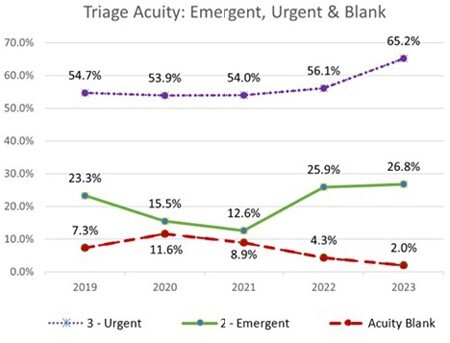 Figure 1
Peer Reviews
No public reviews on file for this paper yet. If you reviewed it on a platform where reviews are public (OpenReview, ICLR, NeurIPS, ICML), you can paste yours below so the community can read it here.
Videos
No videos yet. Explain this paper in a talk, walkthrough, or lecture? Add one.
Taxonomy
TopicsTrauma and Emergency Care Studies · Emergency and Acute Care Studies · Disaster Response and Management