Analyzing lumbar vertebral shape and alignment in female patients with degenerative spondylolisthesis: Comparisons with spinal stenosis and risk factor exploration
Tomohito Yoshihara, Tadatsugu Morimoto, Masatsugu Tsukamoto, Yu Toda, Hirohito Hirata, Takaomi Kobayashi, Satoshi Takashima, Masaaki Mawatari, Holakoo Mohsenifar, Holakoo Mohsenifar, Holakoo Mohsenifar

TL;DR
This study compares spinal shape and alignment in women with degenerative spondylolisthesis and spinal stenosis to identify risk factors for the condition.
Contribution
The study identifies specific vertebral and spinal alignment features as potential independent predictors of degenerative spondylolisthesis in females.
Findings
The DS group had significantly larger lumbar lordosis, pelvic incidence, and L4 ha/hp compared to the LSS group.
L4 cross-sectional area was smaller in the DS group, and ha/hp ratio and pelvic incidence were identified as independent predictors of DS.
Correlations between lumbar lordosis and vertebral body shape varied between DS and LSS groups.
Abstract
This study aimed to examine the vertebral body shape characteristics and spondylopelvic alignment in L4 degenerative spondylolisthesis (DS) as well as the risk factors for the development of DS. This cross-sectional study compared vertebral morphology and sagittal spinopelvic alignment in female patients with lumbar DS and lumbar spinal stenosis (LSS). The degree of lumbar lordosis (LL), pelvic incidence (PI), cross-sectional area (CSA), and vertebral body height ratio (ha/hp) of the lumbar spine were compared using full-length spine radiographs and computed tomography in 60 females with DS and in 60 women with LSS. No significant differences in age or body mass index were observed between the two groups; however, the DS and LSS groups significantly differed in PI (mean, 58.9±10.8 vs. 47.2±11.6, P < 0.001), L4 CSA (mean, 1,166.2 m2 vs. 1,242.0 m2, P = 0.002) and ha/hp (mean, 1.134 vs.…
Genes, proteins, chemicals, diseases, species, mutations and cell lines named across the full text — each resolved to its canonical identifier and authoritative record.
Click any figure to enlarge with its caption.
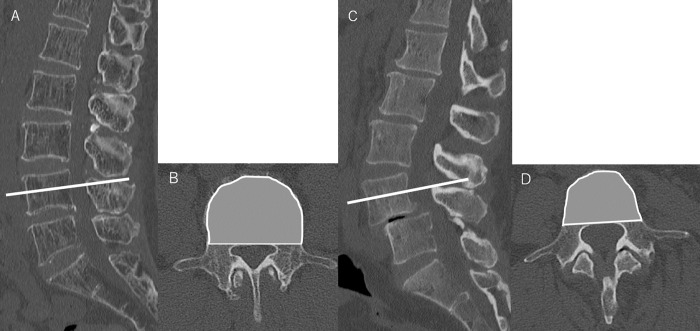 Figure 1
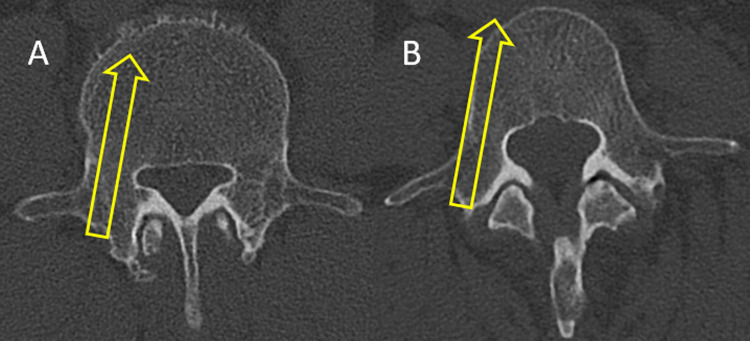 Figure 2
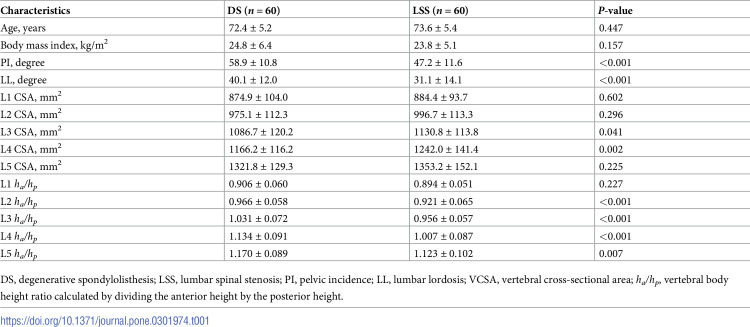 Figure 3
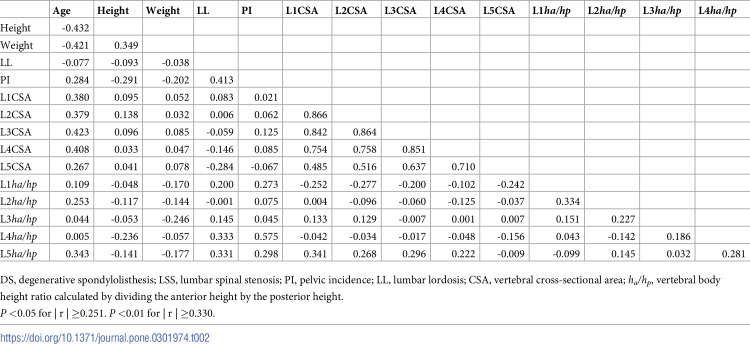 Figure 4
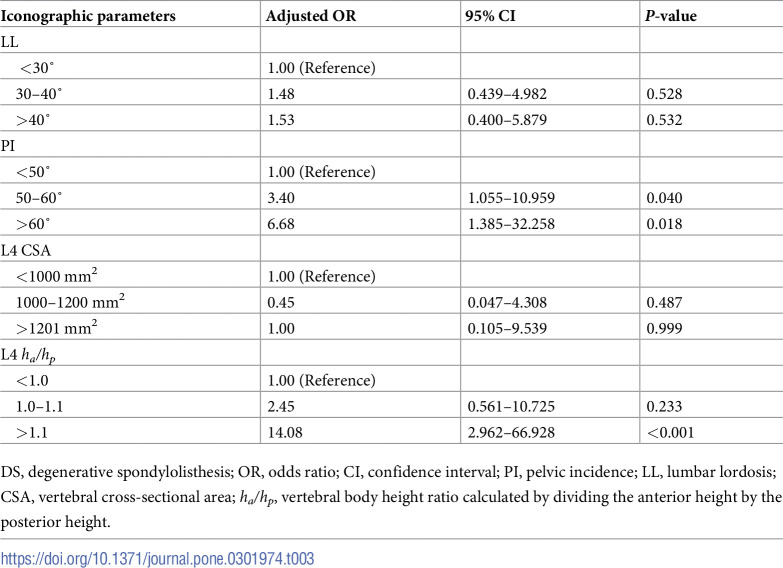 Figure 5
Peer Reviews
No public reviews on file for this paper yet. If you reviewed it on a platform where reviews are public (OpenReview, ICLR, NeurIPS, ICML), you can paste yours below so the community can read it here.
Videos
No videos yet. Explain this paper in a talk, walkthrough, or lecture? Add one.
Taxonomy
TopicsScoliosis diagnosis and treatment · Spine and Intervertebral Disc Pathology · Spinal Fractures and Fixation Techniques