Assessment of infection of Stomoxys calcitrans larvae by entomopathogenic nematodes Heterorhabditis amazonensis NEPT11
Américo de Castro Monteiro, Ana Caroline Ferreira de Souza, Danielle Pereira da Silva, Gabriela Pereira Salça de Almeida, Vinícius Teixeira de Souza, João Luiz Lopes Monteiro, Melissa Carvalho Machado do Couto Chambarelli, Avelino José Bittencourt

TL;DR
This study tested how well a type of nematode can kill fly larvae and found it has potential for pest control.
Contribution
The study evaluates the effectiveness of Heterorhabditis amazonensis NEPT11 against Stomoxys calcitrans larvae.
Findings
200 EPNs/larva caused 48% mortality, the highest among tested concentrations.
All treatments showed higher mortality than the control group.
The nematode shows potential for controlling stable fly larvae but needs further study.
Abstract
This study aimed to evaluate the virulence of Heterorhabditis amazonenses NEPT11 against larvae of Stomoxys calcitrans. Groups of 10 third-instar fly larvae were deposited in Petri dishes, to which were added 50, 100 and 200 EPNs/larva in 4ml of distilled water. The volume of the control group was the same as the treated group, but without EPNs. Larval mortality was observed daily, until larvae died or adults emerged. The Petri dishes were kept on laboratory shelves at 27 ± 1 °C and 70 ± 10% RH. The experiment was replicated six times. A regression analysis revealed quadratic behavior with increasing concentrations, indicating that the concentration of 200 EPNs/larva (48%) was the most efficient among the tested concentrations, while concentrations of 50 and 100 EPNs/larva killed 26.6 and 40% of larvae, respectively. In general, none of the treatments resulted in a mortality rate of…
Genes, proteins, chemicals, diseases, species, mutations and cell lines named across the full text — each resolved to its canonical identifier and authoritative record.
Click any figure to enlarge with its caption.
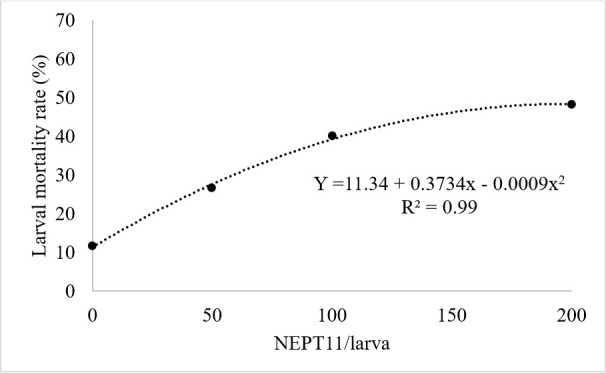 Figure 1
Peer Reviews
No public reviews on file for this paper yet. If you reviewed it on a platform where reviews are public (OpenReview, ICLR, NeurIPS, ICML), you can paste yours below so the community can read it here.
Videos
No videos yet. Explain this paper in a talk, walkthrough, or lecture? Add one.
Taxonomy
TopicsEntomopathogenic Microorganisms in Pest Control · Insect Pest Control Strategies · Insect Resistance and Genetics
Introduction
Stomoxys calcitrans is a hematophagous dipteran whose life cycle is directly related to the environmental and climatic characteristics of the region where it occurs (Bittencourt, 2012). Its parasitism causes many problems for livestock farming in Brazil, leading to heavy economic losses (Grisi et al., 2014).
The recently reported outbreaks of S. calcitrans in Brazil are closely tied to the expansion of the sugarcane agroindustry (Souza et al., 2021). Due to the resistance of pests to chemical pesticides (Barros et al., 2019), allied to the global demand for pesticide-free foods, a variety of microorganisms have been studied to ascertain their possible application in the control of parasites of economic importance.
Entomopathogenic nematodes (EPNs) have emerged as alternatives for use in biological pest control (Kaya & Gaugler, 1993), and these microorganisms have already proved their ability to kill stable fly larvae (Leal et al., 2017; Monteiro Sobrinho et al., 2021), even when the latter are in substrates originating from the sugar and alcohol industry (Monteiro Sobrinho et al., 2016, 2023). Therefore, new species of EPNs must be tested and evaluated in order to increase the alternatives for controlling S. calcitrans.
The purpose of this study was to evaluate the virulence of the EPN Heterorhabditis amazonensis NEPT11 against third-instar larvae of S. calcitrans.
Material and methods
The S. calcitrans colony used in this study was benchtop raised in a laboratory environment (27 ± 1 °C and 70-80% relative humidity – RH), employing an adapted version of the method described by Macedo et al. (2005) and Mello & Garcia (1983).
The EPN colony was raised according to the method described by Lindegren et al. (1993), and it was maintained and multiplied in vivo in Galleria mellonella (Lepidoptera: Pyralidae). Infective juveniles (IJs) were placed in a 40mL cell culture flask and stored in an Eletrolab EL 202/4 BOD incubator at 16 ± 1 °C and 70-80% RH for less than 7 days.
To calculate the concentrations used in this study, the IJs were counted in twelve 10μL aliquots taken from an aqueous suspension of EPN. After counting the IJs in the 12 aliquots, the highest and lowest number of EPNs/aliquot were discarded and the average number of IJs in the remaining 10 aliquots was calculated. Based on this calculation, the concentration of suspensions was adjusted to IJs/mL (Taylor et al., 1998).
Groups of 10 third-instar stable fly larvae were placed on Petri dishes (with 2 sheets of filter paper), to which were added 50, 100 and 200 EPNs/larva, diluted in 4ml of distilled water. The volume of water added to the control group was the same as the experimental groups, but without EPNs. Larval mortality was monitored daily, until the death of the larvae or emergence of adult flies. The dishes were kept on laboratory shelves at 27 ± 1 °C and 70 ± 10% RH. The experiment was carried out in a completely randomized design (CRD), with six replications.
The data were subjected to the Shapiro-Wilk normality test and the Bartlett homogeneity of variance test. Once these assumptions were observed, analysis of variance was applied to verify the effects of EPN concentrations, followed by linear regression analysis with the aid of the statistical program SISVAR version 5.1 (Ferreira, 2011).
Results and discussion
A regression analysis revealed quadratic behavior in response to increasing concentrations, that is, with larval mortality increasing as the concentration of EPNs/larva increased. In which the concentration of 200 NEPs/larva (48%) was the most efficient among the concentrations tested, the concentrations of 50 and 100 NEPs/larva were lower, killing on average 26.6 and 40% of the fly larvae, respectively. In general, no treatment provided mortality greater than 50%, even at the highest concentrations. However, all treated groups presented higher mortality than that observed in the control group (15%) (Figure 1).
Larval mortality rate of Stomoxys calcitrans caused by the EPN Heterorhabditis amazonensis NEPT11.
A comparison of the results of this study with those of Leal et al. (2017) indicated that the aforementioned authors obtained far superior results than those achieved here. They used a concentration of 200 EPNs/larva of H. bacteriophora HP88, which caused a stable fly larvae mortality rate of more than 90%, in contrast to our study, in which the mortality rate at the same concentration did not even reach 50%.
Monteiro Sobrinho et al. (2021), and Leal et al. (2017) reported mortality rates above 90% using H. bacteriophora HP88 (200 EPNs/larva) to control S. calcitrans larvae. This demonstrates that the nematode H. bacteriophora HP88 is considerably more virulent than H. amazonensis NEPT11 against stable fly larvae, even when S. calcitrans is on other substrates.
Monteiro Sobrinho et al. (2023) reported larvae mortality rates of 73.3% in sugarcane bagasse ash. Studies involving H. bacteriophora HP88 and H. baujardi LPP7 to control S. calcitrans larvae in vinasse, filter cake and sugarcane bagasse (Monteiro Sobrinho et al., 2023) also showed higher mortality rates than those found in the present study, even this not using sugarcane substrate that could interfere in the action of H. amazonensis NEPT11. Although the nematode NEPT11 does not cause fly larvae mortality rates above 50%, these results are still superior to those presented in other studies aimed at the biological control of stable fly larvae (Alves et al., 2012; Moraes et al., 2015).
Conclusions
It is concluded that the EPN H. amazonensis NEPT11 showed promise in controlling third-instar larvae of S. calcitrans. However, further studies in different situations are needed to better understand the activity of this organism against the immature stages of the stable fly S. calcitrans.
The reference list from the paper itself. Each links out to its DOI / PubMed record.
- 1Alves P. S. Moraes A. P. R. Salles C. M. C. Bittencourt V. R. E. P. Bittencourt A. J. 2012 Lecanicillium lecanii no controle de estágios imaturos de Stomoxys calcitrans.Revista Brasileira de Medicina Veterinária 34Suppl S 16672
- 2Barros A. T. M. Rodrigues V. D. Cançado P. H. D. Domingues L. N. 2019 Resistance of the stable fly, Stomoxys calcitrans (Diptera: Muscidae), to cypermethrin in outbreaks areas in Midwestern Brazil Revista Brasileira de Parasitologia Veterinária 28480280610.1590/s 1984-2961201908931691737 · doi ↗ · pubmed ↗
- 3Bittencourt A. J. 2012 Avaliação de surtos e medidas de controle ambiental de Stomoxys calcitrans (Diptera: Muscidae) na Região Sudeste do Brasil Revista Brasileira de Medicina Veterinária 3417382
- 4Ferreira D. F. 2011 Sisvar: A computer statistical analysis system Ciência e Agrotecnologia 3561039104210.1590/S 1413-70542011000600001 · doi ↗
- 5Grisi L. Leite R. C. Martins J. R. Barros A. T. M. Andreotti R. Cançado P. H. D. Léon A. A. P. Pereira J. P. Villela H. S. 2014 Reassessment of the potential economic impact of cattle parasites in Brazil Revista Brasileira de Parasitologia Veterinária 23215015610.1590/S 1984-2961201404225054492 · doi ↗ · pubmed ↗
- 6Kaya H. K. Gaugler R. 1993 Entomopathogenic nematodes Annual Review of Entomology 38118120610.1146/annurev.en.38.010193.001145 · doi ↗
- 7Leal L. C. S. R. Monteiro C. M. O. Mendonça A. E. Bittencourt V. R. E. P. Bittencourt A. J. 2017 Potential of entomopathogenic nematodes of the genus Heterorhabditis for the control of Stomoxys calcitrans (Diptera: Muscidae)Revista Brasileira de Parasitologia Veterinária 26445145610.1590/s 1984-2961201706529160358 · doi ↗ · pubmed ↗
- 8Lindegren J. E. Valero K. A. Mackey B. E. 1993 Simple in vivo production and storage methods for Steinernema carpocapsae infective juveniles Journal of Nematology 25219319719279758 PMC 2619376 · pubmed ↗