Cartilage Warping in Rhinoplasty: An Assessment of Temperature, Carving, and Suturing Conditions
Yasmine Ibrahim, Sumun Khetpal, Wayne Ozaki, Jason Roostaeian

TL;DR
This paper reviews how different carving and suturing techniques, along with temperature, affect cartilage warping in rhinoplasty to help surgeons achieve better results.
Contribution
The study is the first systematic analysis of conditions affecting cartilage warping in rhinoplasty.
Findings
Central and concentric carving patterns reduce cartilage warping.
Oppositional suturing helps minimize warping in cartilage grafts.
Peripheral and eccentric cuts increase the risk of warping over time.
Abstract
Rhinoplasty is often contingent on the successful harvesting and allocation of cartilage in order to build the nasal framework. While autologous and cadaveric cartilage grafts have been utilized, it remains unclear how factors, such as suturing and carving techniques, as well as temperature, impact its short- and long-term warping potential. Our systematic review seeks to objectively assess how various carving (i.e. peripheral versus central, eccentric versus concentric), suture patterns (i.e. counter-balancing, oppositional), and temperature conditions impact the warping potential of cartilage grafts in rhinoplasty. In conducting this study, we hope to determine the optimal conditions for stable cartilage constructs in rhinoplasty. A systematic literature review was conducted using a combination of terms including, “warp,” “rhinoplasty,” “cartilage,” “suture,” “temperature,”…
Click any figure to enlarge with its caption.
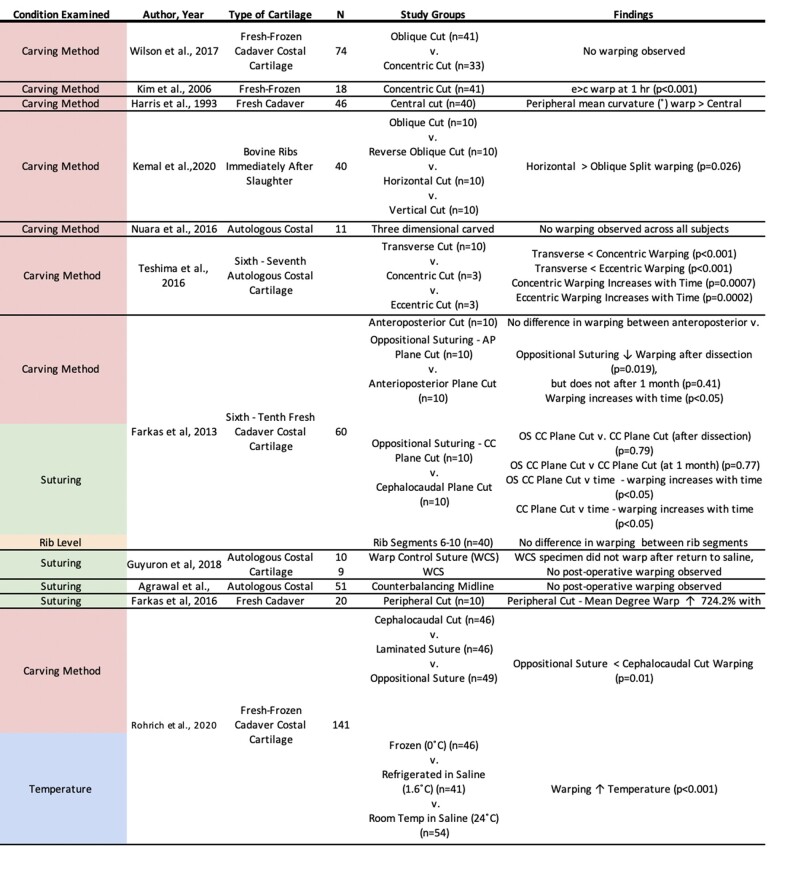 Figure 1
Peer Reviews
No public reviews on file for this paper yet. If you reviewed it on a platform where reviews are public (OpenReview, ICLR, NeurIPS, ICML), you can paste yours below so the community can read it here.
Videos
No videos yet. Explain this paper in a talk, walkthrough, or lecture? Add one.
Taxonomy
TopicsNasal Surgery and Airway Studies · Reconstructive Facial Surgery Techniques · Olfactory and Sensory Function Studies