The Relationship between Selected Parameters and the Occurrence of Premyopia in a Group of 1155 Children Aged 8 in Northwestern Poland
Monika Modrzejewska, Magdalena Durajczyk

TL;DR
This study found that 60.9% of 8-year-old children in Poland showed signs of pre-myopia, highlighting the need for early interventions to prevent myopia progression.
Contribution
The study provides new insights into the prevalence of pre-myopia in early school children and emphasizes the importance of understanding its underlying mechanisms.
Findings
Pre-myopia was diagnosed in 60.9% of the 1155 children studied.
The frequency of pre-myopia was similar between girls and boys.
The study underscores the need for targeted interventions to slow myopia progression in early school children.
Abstract
Background: Determination of the number of pupils at risk of developing pre-myopia and selected ophthalmic parameters in a group of 1155 children aged 8. Material: Ophthalmic examinations were performed in Polish 8-year-old, /1518 individuals/; 1155 of whom presented complete data for analysis. There was a total of 554 (47.9%) girls and 602 (52.1%) boys. Examination of the anterior and posterior segment of the eye, evaluation of accommodation, convergence, heterophoria, alignment of the eyeball, muscular balance with ocular mobility in 9 directions of gaze, and spatial vision were tested. Refraction was obtained under cycloplegia. Refractions (spherical equivalent, SE). were categorized as pre-myopia (−0.50 D–+0.75 D), myopia (≤−0.5 D), emmetropia (>−0.5 D to ≤+0.5 D), mildly hyperopia (>+0.5 D to ≤+2.0 D) and hyperopia (>+2.0 D). Data analysis was performed using Statistica 13.5…
Genes, proteins, chemicals, diseases, species, mutations and cell lines named across the full text — each resolved to its canonical identifier and authoritative record.
Click any figure to enlarge with its caption.
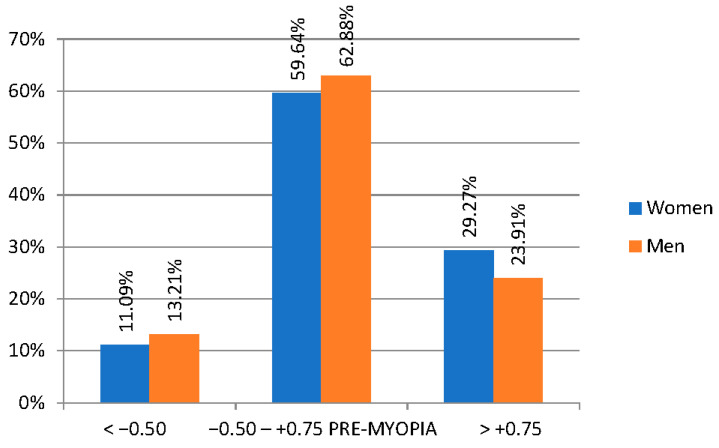 Figure 1
 Figure 2
 Figure 3
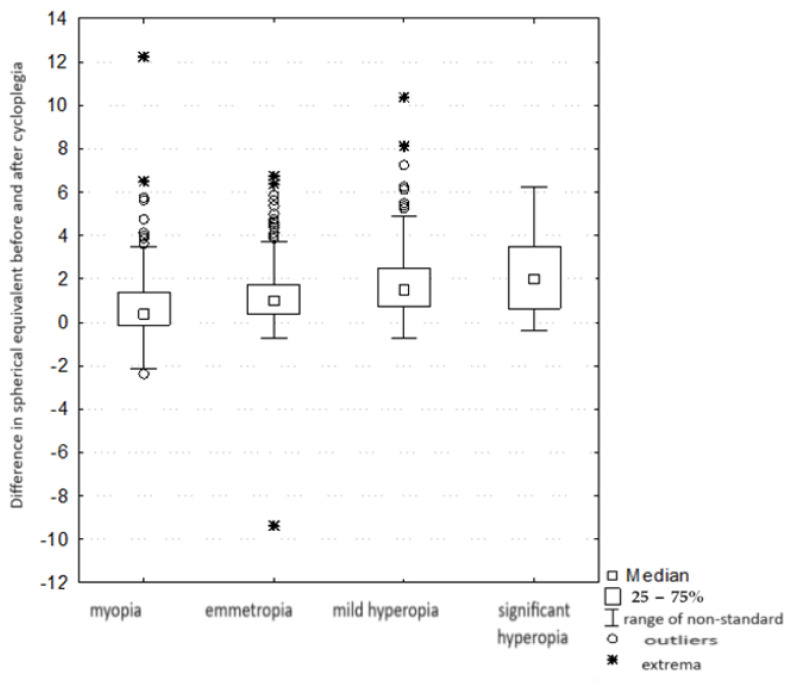 Figure 4
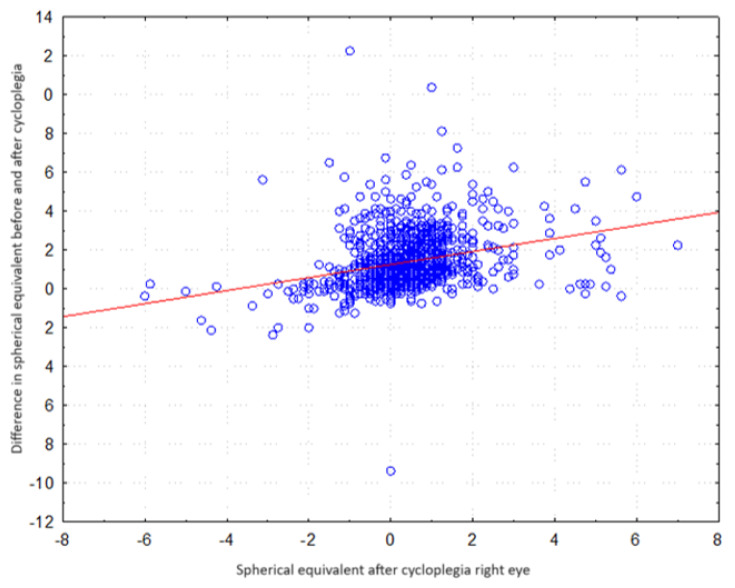 Figure 5
Peer Reviews
No public reviews on file for this paper yet. If you reviewed it on a platform where reviews are public (OpenReview, ICLR, NeurIPS, ICML), you can paste yours below so the community can read it here.
Videos
No videos yet. Explain this paper in a talk, walkthrough, or lecture? Add one.
Taxonomy
TopicsOphthalmology and Visual Impairment Studies · Corneal surgery and disorders · Retinopathy of Prematurity Studies