Evaluation of the Value of Histological Examination for the Prediction of Genetic Thoracic Proximal Aortopathies
Adrian Mahlmann, Roman N. Rodionov, Christian-Alexander Behrendt, Jennifer Lynne Leip, Helmut Karl Lackner, Mohamed Eraqi, Nesma Elzanaty, Tamer Ghazy

TL;DR
This study examines whether histological exams can predict genetic thoracic aortopathies, finding that genetic testing is more reliable than histology for diagnosing heritable connective tissue disorders.
Contribution
The study demonstrates that histopathological findings lack diagnostic accuracy for heritable connective tissue disorders in thoracic aortopathy patients.
Findings
No certain correlation was found between histological findings and genetic diagnostics in TAAD patients.
Patients with both histopathologic and genetic evidence of connective tissue disorders were 11.6 years younger than those without.
Genetic testing is more useful than histology for defining the genotype in cases with non-specific histological features.
Abstract
Background: Heritable connective tissue disorders are often accompanied by an increased risk for thoracic aortic aneurysm and dissection (TAAD). Profound knowledge of the underlying pathology may have an impact on individual treatment, systematic follow-up, and early detection by the screening of offspring. The aim of this study, based in a single high-volume tertiary center, was an analysis of the diagnostic validity of histopathologic findings in patients with TAAD due to these findings’ accuracy in diagnosing heritable connective tissue disorders. Methods: Therefore, genetic testing by next-generation sequencing (NGS) was performed to evaluate the correlations. In total, 65 patients with TAAD undergoing surgical treatment before the age of 60 years or with age up to 80 years if they had offspring at the time of the procedure were included in the analysis. Results: In our cohort, no…
Genes, proteins, chemicals, diseases, species, mutations and cell lines named across the full text — each resolved to its canonical identifier and authoritative record.
Click any figure to enlarge with its caption.
 Figure 1
 Figure 2
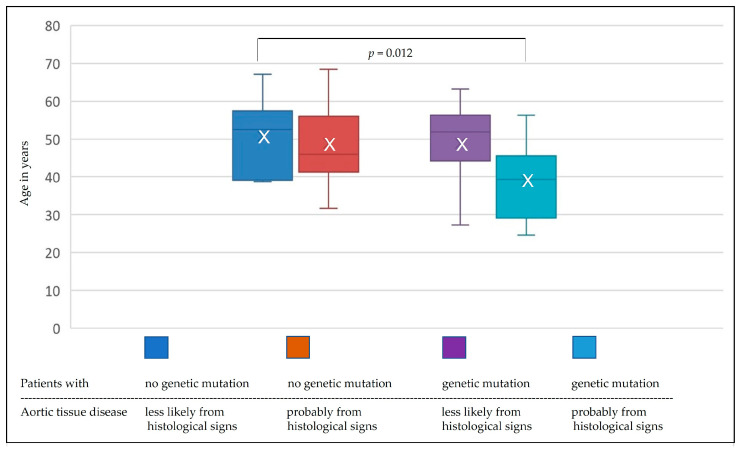 Figure 3
Peer Reviews
No public reviews on file for this paper yet. If you reviewed it on a platform where reviews are public (OpenReview, ICLR, NeurIPS, ICML), you can paste yours below so the community can read it here.
Videos
No videos yet. Explain this paper in a talk, walkthrough, or lecture? Add one.
Taxonomy
TopicsAortic Disease and Treatment Approaches · Aortic aneurysm repair treatments · Cardiac Valve Diseases and Treatments