Epistaxis Rates and Health Care Utilization in Patients With a Ventricular Assist Device
Eric Rohe, Sarah Schmoker, Kaeli Samson, Kristy Carlson, Jayme Dowdall

TL;DR
This study finds that nearly 30% of ventricular assist device patients seek medical care for nosebleeds, with GI bleeding and kidney disease increasing the risk.
Contribution
The study identifies epistaxis rates and healthcare utilization patterns in VAD patients and links GI bleeding and kidney disease to increased epistaxis risk.
Findings
29% of ventricular assist device (VAD) patients received medical attention for epistaxis.
GI bleeding and kidney disease are associated with increased odds of developing epistaxis.
Most epistaxis events occurred inpatient (59%) or in the emergency department (32.8%).
Abstract
Identify baseline epistaxis rates and epistaxis‐related health care utilization trends in the ventricular assist device (VAD) population. Single center, retrospective cohort study consisting of chart review of adult VAD patients. Analysis of descriptive statistics was assessed using χ 2 tests, independent sample t tests, or Fisher's exact when expected counts were low. Logistic regression was used to assess associations between epistaxis and variables of interest. Two hundred ninety patients were included in the analysis. Ninety‐eight (33.8%) patients developed epistaxis and 84 (29.0%) received medical attention. Patients with gastrointestinal (GI) bleeding had increased rates of epistaxis (42.4% vs 29.0%). Logistic regression analysis found GI bleeding to have an adjusted odds of developing epistaxis of 1.94 (95% confidence interval [CI]: 1.12‐3.37) and kidney disease to have an…
Genes, proteins, chemicals, diseases, species, mutations and cell lines named across the full text — each resolved to its canonical identifier and authoritative record.
Click any figure to enlarge with its caption.
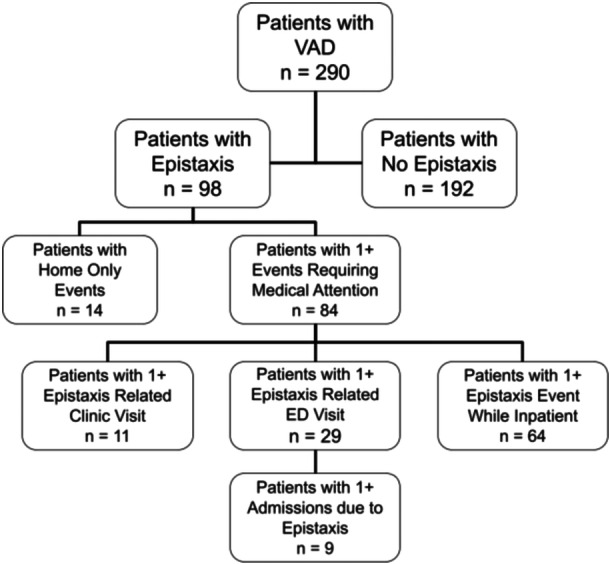 Figure 1
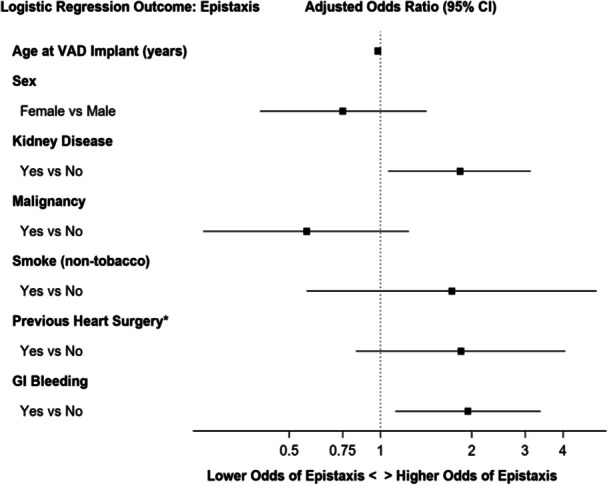 Figure 2
Peer Reviews
No public reviews on file for this paper yet. If you reviewed it on a platform where reviews are public (OpenReview, ICLR, NeurIPS, ICML), you can paste yours below so the community can read it here.
Videos
No videos yet. Explain this paper in a talk, walkthrough, or lecture? Add one.
Taxonomy
TopicsVascular Anomalies and Treatments · Mechanical Circulatory Support Devices · Tracheal and airway disorders