Lake Erie ice is a repository of organisms
Opeoluwa F. Iwaloye, Brenna Michaud, Tessa Alloy, Nigel D'Souza, R. Michael L. McKay, Paul Morris, Colby Gura, Scott O. Rogers

TL;DR
This paper explores the variety of organisms found in ice from Lake Erie using genetic data.
Contribution
The study reveals the diversity of organisms trapped in Lake Erie ice through metagenomic and metatranscriptomic analysis.
Findings
Lake Erie ice contains a high abundance of bacterial organisms.
Eukaryotic and archaeal organisms were also identified in the ice samples.
The analysis identified organisms from 32 bacterial, 8 eukaryotic, and 2 archaeal taxonomic groups.
Abstract
Organism abundance and diversity were assessed in Lake Erie ice samples using sequences derived from a combined metagenomic and metatranscriptomic analysis. The 68,417 unique sequences were from Bacteria (77.5%), Eukarya (22.3%), and Archaea (0.2%) and indicated diverse species of organisms from 32 bacterial, 8 eukaryotic, and 2 archaeal taxonomic groups.
Genes, proteins, chemicals, diseases, species, mutations and cell lines named across the full text — each resolved to its canonical identifier and authoritative record.
Click any figure to enlarge with its caption.
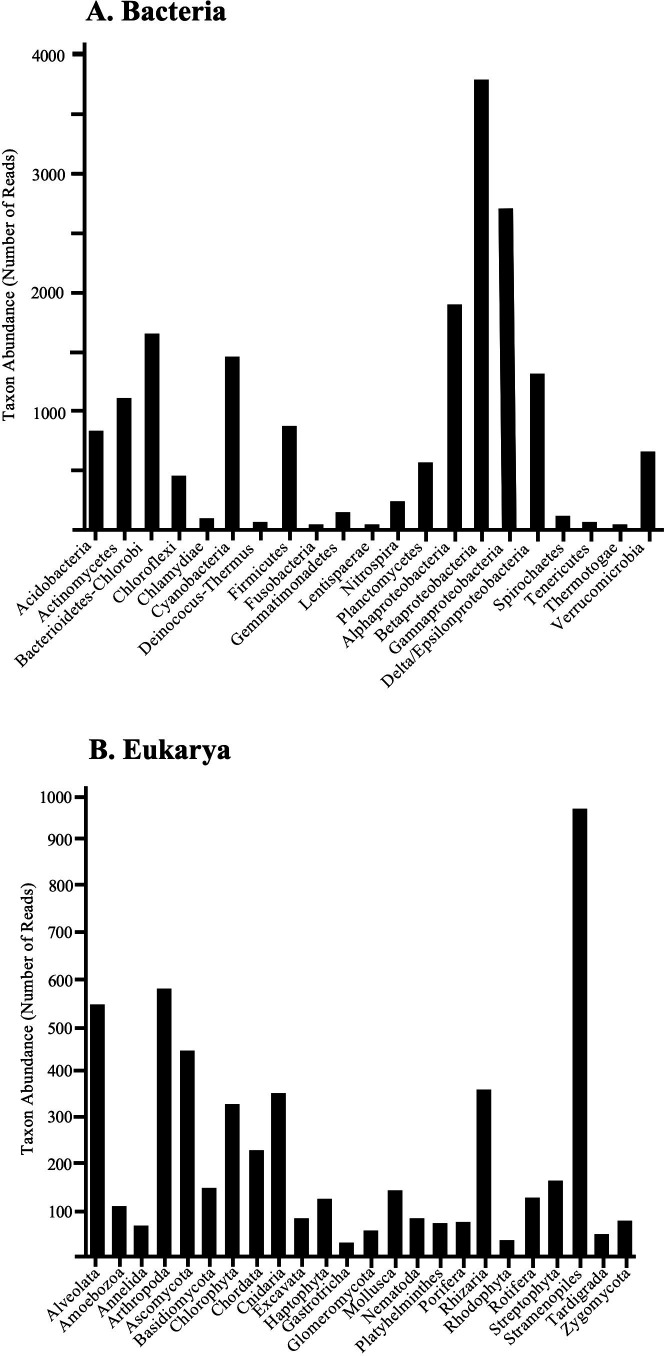 Fig 1
Fig 1| Domain | Major taxon | Number of species |
|---|---|---|
| Archaea | Euryarchaeota | 19 |
| Thaumarchaeota | 5 | |
| Bacteria | Acidobacteria | 16 |
| Actinomycetes | 228 | |
| Armatimonadetes | 2 | |
| Aquificae | 7 | |
| Bacteroidetes | 157 | |
| Caldisericia | 1 | |
| Chlorobi | 2 | |
| Chlorochromatium | 1 | |
| Chloroflexi | 16 | |
| Chlamydia | 14 | |
| Chrysiogenetes | 1 | |
| Cloacimonetes | 1 | |
| Cyanobacteria | 170 | |
| Deferribacteres | 3 | |
| Deinococcus-Thermus | 14 | |
| Elusimicrobia | 1 | |
| Endomicrobia | 1 | |
| Fibrobacteres | 1 | |
| Firmicutes | 270 | |
| Fusobacter | 9 | |
| Gemmatimonadetes | 1 | |
| Lentisphaerae | 2 | |
| Nitrospira | 6 | |
| Planctomycetes | 22 | |
| Proteobacteria | ||
| Alphaproteobacteria | 282 | |
| Betaproteobacteria | 270 | |
| Deltaproteobacteria | 98 | |
| Gammaproteobacteria | 427 | |
| Zetaproteobacteria | 1 | |
| Solibacteres | 3 | |
| Spirochaetia | 25 | |
| Synergistia | 5 | |
| Tenericutes | 24 | |
| Thermodesulfobacteria | 3 | |
| Thermotogae | 18 | |
| Verrucomicrobia | 18 | |
| Eukarya | Amoebozoa | 19 |
| Apusozoa | 5 | |
| Archaeplastida | ||
| Anthrocerotophyta | 1 | |
| Bryophyta | 8 | |
| Chlorophyta | 90 | |
| Gnetophyta | 1 | |
| Lycophyta | 1 | |
| Marchantiophyta | 2 | |
| Polypodiophyta | 2 | |
| Rhodophyta | 10 | |
| Streptophyta | 43 | |
| Excavata | 28 | |
| Hacrobia | ||
| Centroheliozoa | 1 | |
| Cryptophyta | 9 | |
| Opisthokonta | ||
| Fungi | ||
| Ascomycota | 72 | |
| Basidiomycota | 37 | |
| Blastoclatiomycetes | 1 | |
| Chytridiomycota | 10 | |
| Crisidiscoidea | 1 | |
| Glomeromycota | 4 | |
| Kickxellomycota | 1 | |
| Microsporidia | 1 | |
| Mucoromycota | 4 | |
| Zygomycota | 6 | |
| Animalia | ||
| Annelida | 12 | |
| Arthropoda | 87 | |
| Brachiopoda | 1 | |
| Bryozoa | 2 | |
| Choanoflagellates | 6 | |
| Chordata | 41 | |
| Cnidaria | 68 | |
| Ctenophora | 2 | |
| Echinodermata | 1 | |
| Filasterea | 1 | |
| Gastrotrichia | 3 | |
| Kinorhyncha | 1 | |
| Mollusca | 44 | |
| Nematoda | 16 | |
| Nematomorpha | 2 | |
| Nemertea | 3 | |
| Phoronida | 1 | |
| Platyhelminthes | 21 | |
| Porifera | 9 | |
| Priapulida | 2 | |
| Rotifera | 17 | |
| Sipuncula | 1 | |
| Tardigrada | 4 | |
| Xenacoelomorpha | 4 | |
| SAR | ||
| Alveolata | 34 | |
| Rhizaria | 35 | |
| Stamenopiles | 96 |
Peer Reviews
No public reviews on file for this paper yet. If you reviewed it on a platform where reviews are public (OpenReview, ICLR, NeurIPS, ICML), you can paste yours below so the community can read it here.
Videos
No videos yet. Explain this paper in a talk, walkthrough, or lecture? Add one.
Taxonomy
TopicsIsotope Analysis in Ecology · Geology and Paleoclimatology Research · Aquatic Invertebrate Ecology and Behavior
ANNOUNCEMENT
Lake ice entraps enormous numbers of microbes, many of which remain viable (1–8). As the ice melts, the organisms are released into the water, potentially adding to the biodiversity in the lakes. Dead organisms provide carbon sources for the living organisms in the lake water. While lake water has been studied extensively (9–20), few such studies have been conducted on lake ice. Here, we report details of DNA and RNA sequences from Lake Erie ice.
A full-thickness surface ice sample (30 × 30 × 45 cm) was collected from Station 84 (42.05 N, −81.55 W) in the central basin of Lake Erie in January 2010. A subsample (8 × 8 × 15 cm) was immersed in 5% sodium hypochlorite, then rinsed with 2.0 L of sterile reverse osmosis purified water (18 MΩ, <1 ppm total organic carbon) followed by melting at room temperature in a sterile funnel and collected in sterile 50 mL screwcap tubes that were immediately frozen at −20°C. A total of 250 mL was thawed and subjected to ultracentrifugation (100,000 × g for 16 h at 4°C) to concentrate cells and nucleic acids. Pellets were rehydrated in 50 µL of sterile 0.1× TE [1 mM Tris (pH 7.5), 0.1 mM EDTA, 4°C], details described previously (3, 7, 8).
Nucleic acid extraction was performed using MinElute Spin Columns (QIAGEN, Valencia, CA, USA). The eluted nucleic acids were precipitated in ethanol, pelleted, dried, and rehydrated in 10 µL of 0.1× TE. DNA copies of the RNA were produced with a cDNA kit using random hexamer primers (Invitrogen SuperScript Choice System, Invitrogen, Grand Island, NY, USA). The resulting solution contained both DNA (metagenomic portion) and cDNA (metatranscriptomic portion). Adapters (AATTCGCGGCCGCGTCGAC, dsDNA) were ligated to each end of the cDNA and DNA using T4 DNA ligase. For pyrosequencing, 454-specific primers, one with 454 sequence A (underlined): CGTATCGCCTCCCTCGCGCCATCAGAATTCGCGGCCGCGTCGAC and the other with 454 sequence B (underlined): CTATGCGCCTTGCCAGCCCGCTCAGAATTCGCGGCCGCGTCGAC, were added to the nucleic acids using PCR (4 min at 94°C, followed by 40 cycles of 1 min at 94°C, 2 min at 55°C, 72°C, followed by 10 min at 72°C). The amplified nucleic acids were quantified on agarose gels and subjected to sequencing using a 454 GS Junior System (Roche Corporation, Indianapolis, IN, USA) by Roche staff, who also performed sequence filtering to extract high-quality reads (eliminating duplicates, reads < 20 nt, and reads > 20% ambiguous nucleotides). This reduced the reads from a total of 122,460 to 68,417 high-quality reads, with mean lengths of 390 nt. High-quality reads were subjected to MegaBLAST analysis, using a cut-off e-value of 10^−10^. Default parameters were used for all software. Taxonomic assignments were made based on the top BLAST matches. When the top BLAST match was taxonomically unknown, the next sequence within the top 10 that had a taxonomic designation was chosen. The number of sequences and the species abundances in each major taxonomic group were determined (Fig. 1; Table 1). Additional details were reported elsewhere (21).
Abundance of Bacteria and Eukarya. (A) Total numbers of unique sequences (DNA and RNA) from each major taxon of Bacteria. Those with fewer than 20 sequences (not shown in the figure) were from Aquificae, Armatimonadetes, Caldisericia, Chlorochromatium, Chrysiogenetes, Cloacimonetes, Deferribacderes, Elusimicrobia, Fibrobacteres, Synergistota, Thermodesulfobacteriota, and Zetaproteobacteria. (B) Total numbers of unique sequences (DNA and RNA) from each major taxon of Eukarya. Those with fewer than 20 sequences (not shown in the figure) were from Acanthocephala, Blastocladiomycota, Brachiopoda, Bryozoa, Ctenophora, Echinodermata, Entorrhizomycota, Glaucophyta, Kinorhyncha, Nemertea, Placozoa, Phoronida, Pripulida, Spinuncula, and Xenacoelomorpha.
The reference list from the paper itself. Each links out to its DOI / PubMed record.
- 1D’Elia T, Veerapaneni R, Rogers SO. 2008. Isolation of microbes from Lake Vostok accretion ice. Appl Environ Microbiol 74:4962–4965. doi:10.1128/AEM.02501-0718552196 PMC 2519340 · doi ↗ · pubmed ↗
- 2D’Elia T, Veerapaneni R, Theraisnathan V, Rogers SO. 2009. Isolation of fungi from Lake Vostok accretion ice. Mycologia 101:751–763. doi:10.3852/08-18419927741 · doi ↗ · pubmed ↗
- 3Gura C, Rogers SO. 2020. Metatranscriptomic and metagenomic analysis of biological diversity in subglacial Lake Vostok (Antarctica). Biology (Basel) 9:55. doi:10.3390/biology 903005532188079 PMC 7150893 · doi ↗ · pubmed ↗
- 4Knowlton C, Veerapaneni R, D’Elia T, Rogers SO. 2013. Analysis of ancient ice core sections from Greenland and Antarctica. Biology (Basel) 2:206–232. doi:10.3390/biology 201020624832659 PMC 4009855 · doi ↗ · pubmed ↗
- 5Ma L-J, Rogers SO, Catranis CM, Starmer WT. 2000. Detection and characterization of ancient fungi entrapped in glacial ice. Mycologia 92:286–295. doi:10.1080/00275514.2000.12061156 · doi ↗
- 6Rivkina EM, Friedmann EI, Mc Kay CP, Gilichinsky DA. 2000. Metabolic activity of permafrost bacteria below the freezing point. Appl Environ Microbiol 66:3230–3233. doi:10.1128/AEM.66.8.3230-3233.200010919774 PMC 92138 · doi ↗ · pubmed ↗
- 7Rogers SO, Shtarkman YM, Koçer ZA, Edgar R, Veerapaneni R, D’Elia T. 2013. Ecology of subglacial Lake Vostok (Antarctica) based on metagenomic/metatranscriptomic analyses of accretion ice. Biology (Basel) 2:629–650. doi:10.3390/biology 202062924832801 PMC 3960894 · doi ↗ · pubmed ↗
- 8Shtarkman YM, Koçer ZA, Edgar R, Veerapaneni RS, D’Elia T, Morris PF, Rogers SO. 2013. Subglacial Lake Vostok (Antarctica) accretion ice contains a diverse set of sequences from aquatic, marine and sediment-inhabiting bacteria and eukarya. P Lo S One 8:e 67221. doi:10.1371/journal.pone.006722123843994 PMC 3700977 · doi ↗ · pubmed ↗