Isolation and genomic characterization of Staphylococcus aureus bacteriophages from Chennai, India
Shankaregowdanakopalu Jagadeesh Deepak, Porteen Kannan, Wilfred Ruban Savariraj, Anbazhagan S, Elango Ayyasamy, Senthil Kumar Tuticorin Maragatham Alagesan, Narendra Babu Ravindran, Sureshkannan Sundaram, Nithya Quintoil Mohanadasse, Teresa D. Shippy, Charley A. Cull

TL;DR
This paper describes the isolation and genomic analysis of two new bacteriophages from India that target Staphylococcus aureus.
Contribution
The study introduces two novel lytic bacteriophages with detailed genomic and structural characterization.
Findings
Two lytic bacteriophages, TANUVAS_MVC-VPHSA1 and TANUVAS_MVC-VPHSA2, were isolated and characterized.
The phages belong to the Caudoviricetes and have nearly identical genome sizes of 50,505 and 50,516 base pairs.
Both phages exhibit a GC content of 41.4% in their genomes.
Abstract
We isolated and characterized two lytic bacteriophages against Staphylococcus aureus named TANUVAS_MVC-VPHSA1 and TANUVAS_MVC-VPHSA2, with the aim of investigating their genomic and structural features. The bacteriophages belong to the Caudoviricetes, and their genomes have sizes of 50,505 and 50,516 base pairs with a GC content of 41.4%.
Genes, proteins, chemicals, diseases, species, mutations and cell lines named across the full text — each resolved to its canonical identifier and authoritative record.
Click any figure to enlarge with its caption.
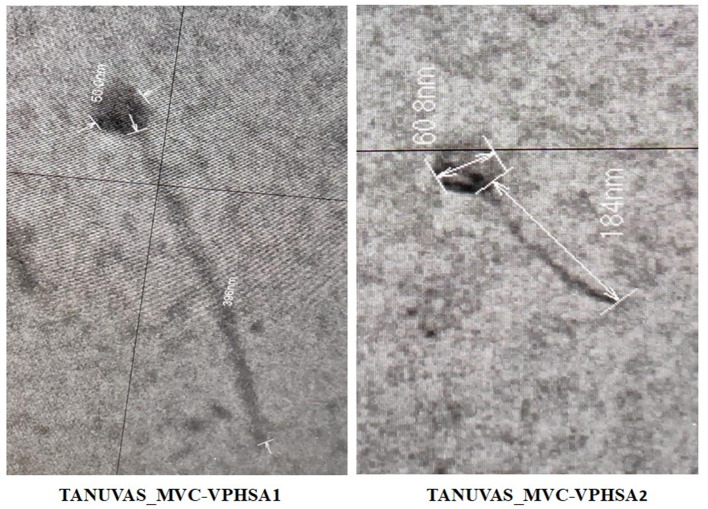 Fig 1
Fig 1| Bacteriophage name | TANUVAS_MVC-VPHSA1 | TANUVAS_MVC-VPHSA2 |
|---|---|---|
| Sample origin | Hospital treatment plant | Slaughter house treatment plant |
| Tail length | 375–410 nm | 175–198 nm |
| Head diameter | 50–55nm | 60–65nm |
| Length (bp) | 50,505 bp | 50,516 bp |
| GC content (%) | 41.4% | 41.4% |
| Total reads | 1694 | 2246 |
| Reads > 1,000 bp with overlaps | 597 | 978 |
| Read N50 | 3,428 bp | 3,424 bp |
| Coverage | 33.96× | 55.08× |
| No. of CDS (GenBank) | 109 | 92 |
| No. of genes with predicted function (Pharokka) | 49 | 43 |
| Genes with unknown function (Pharokka) | 63 | 50 |
| No. of tRNAs and tmRNAs | 0 | 0 |
| Head and packaging genes | 11 | 10 |
| DNA, RNA, and nucleotide metabolism genes | 21 | 16 |
| Connector genes | 2 | 2 |
| Moron, auxiliary metabolic gene and host takeover, and tail | 12 | 11 |
| Temperate marker genes (integration and excision) | 0 | 0 |
| Transcription regulation genes | 1 | 2 |
| Lytic genes | 2 | 2 |
| Antibiotic resistance genes | 0 | 0 |
| Virulence genes | 0 | 0 |
| CRISPRs | 0 | 0 |
- —USDA National Institute of Food and Agriculture
- —HHS | NIH | OSC | Common Fund (NIH Common Fund)
- —National Science Foundation (NSF)
- —Institutional Development Award (IDeA)| National Institute of General Medical Sciences| NIH| Kansas| INBRE
Peer Reviews
No public reviews on file for this paper yet. If you reviewed it on a platform where reviews are public (OpenReview, ICLR, NeurIPS, ICML), you can paste yours below so the community can read it here.
Videos
No videos yet. Explain this paper in a talk, walkthrough, or lecture? Add one.
Taxonomy
TopicsBacteriophages and microbial interactions · Genomics and Phylogenetic Studies · Microbial infections and disease research
ANNOUNCEMENT
The increased antimicrobial resistance in Staphylococcus aureus (1) and the Food and Drug Adminstration (FDA) (2) stringent regulations on the use of antimicrobials in food led the search for safer alternatives. The bacteriophages have emerged as promising candidates due to their specificity (3) and their potential applications in food safety and therapy (4, 5).
We isolated the bacteriophages from effluent waters of treatment plants in hospitals and slaughterhouses, Chennai, India (13.0827° N, 80.2707° E). The 50-mL effluent water was left undisturbed overnight. The 10 mL supernatant in 40 mL 5× LB broth, and exponentially grown culture of Staphylococcus aureus strain ATCC 25923 was incubated overnight at 37°C using shaker incubator. Later, Staphylococcus aureus strain ATCC 25923 was centrifugated at 7,000 g, 10 min at 4°C, and supernatant was collected and filtered through a pre-sterilized 0.45/0.22-µm PVDF filter and plated using the double agar overlay method against Staphylococcus aureus (6). A single irregular corrugated (TANUVAS_MVC-VPHSA1) and clear round (TANUVAS_MVC-VPHSA2) plaque was picked and passaged twice on double agar overlay. Phages were precipitated from lysates with PEG/NaCl and resuspended with SM buffer (6). For transmission electron microscopy, precipitated phage suspensions were coated on carbon-coated formvar grids and stained with phosphotungstic acid (6) and images were captured (n = 5 particle) (HITACHI Ltd., HT7700, Japan) at 80 kV (Fig. 1).
Transmission electron microscopic image of bacteriophages showing icosahedral-shaped heads and non-contractile, flexible tails against S. aureus from Chennai, India (TANUVAS_MVC-VPHSA1 and TANUVAS_MVC-VPHSA2).
The DNA was extracted using the phenol-chloroform method (7). The DNA library and barcoding were prepared with end-repair/dA tailing using Ultra II End prep enzyme mix (NEBNext Ultra II, NEB) and DNA barcode adapter (2X ligation MasterMix, NEB); finally, barcode-ligated fragments were purified using AMPureXP beads. The genome sequencing with MinION sequencer coupled SpotON flow cell, where 75 µL of pooled library (430 ng) was added through SpotON sample port. Using the MinKNOW interface, sequencing was run in FAST5 mode for 48 hr and basecalling was performed with Guppy 6.1.1. Canu v1.9 (8) which was employed for assembly with a genome size set to 50 kb and stopOnReadQuality = false and BLAST+ v2.14 (9) was used for genome comparisons. Assembly of selected reads (longer than 1,000 bp with overlaps) produced single contigs for each genome (see Table 1 for statistics). The tRNA prediction was done with tRNAscan-SE 2.0 (10), and genomes were annotated using Pharokka v1.4.1 (11). Predicted genes were compared with PHROGS (12), VFDB (13), and CARD (14) using MMseqs2 (15) and PyHMMER (16) within Pharokka (11). A few predicted genes that did not meet GenBank criteria were removed from the annotation during the submission process. All tools were run with default parameters unless otherwise mentioned.
The phages exhibited direct terminal repeats in their double-stranded DNA genomes. MegaBLAST (17) alignment showed 99.90% nucleotide identity between TANUVAS_MVC-VPHSA1 and TANUVAS_MVC-VPHSA2. Functional annotation revealed putative endolysin genes [OR670591.1 (FBHYGVHD_CDS0041) and OR670592.1 (YTCETSXE_CDS0086)], suggesting for bacterial lysis. BLASTp against the NCBI nr databases indicated that the putative endolysin protein sequences share 72% identity and 100% coverage with the N-acetylmuramoyl-L-alanine amidase (WNL49492) of Bacillus phage DZ1. BLASTn (9) against the GenBank nr/nt database identified Bacillus cereus DZ1 phage as the closest genome match with 90% query coverage and 90% identity, consistent with the assignment of these genomes to the Caudoviricetes.
The reference list from the paper itself. Each links out to its DOI / PubMed record.
- 1Torres G, Vargas K, Reyes-Vélez J, Jiménez N, Blanchard A, Olivera-Angel M. 2023. High genetic diversity and zoonotic potential of Staphylococcus aureus strains recovered from bovine intramammary infections in Colombians dairy herds. Comp Immunol Microbiol Infect Dis 93:101940. doi:10.1016/j.cimid.2022.10194036603241 · doi ↗ · pubmed ↗
- 2Food and Drug Administration, HHS. 2016. Food additives permitted for direct addition to food for human consumption; folic acid final rule. Fed Regist 81:22176–22183.27101640 · pubmed ↗
- 3Ali Gharieb RM, Saad MF, Mohamed AS, Tartor YH. 2020. Characterization of two novel lytic bacteriophages for reducing biofilms of zoonotic multidrug-resistant Staphylococcus aureus and controlling their growth in milk. LWT 1:109145. doi:10.1016/j.lwt.2020.109145 · doi ↗
- 4Sillankorva SM, Oliveira H, Azeredo J. 2012. Bacteriophages and their role in food safety. Int J Microbiol 2012:863945. doi:10.1155/2012/86394523316235 PMC 3536431 · doi ↗ · pubmed ↗
- 5Bai J, Kim YT, Ryu S, Lee JH. 2016. Biocontrol and rapid detection of food-borne pathogens using bacteriophages and endolysins. Front Microbiol 7:474. doi:10.3389/fmicb.2016.0047427092128 PMC 4824769 · doi ↗ · pubmed ↗
- 6Anand T, Bera Bc, Virmani N, Vaid RK, Vashisth M, Tripathi BN. 2018. Isolation and characterization of a novel, T 7-like phage against Aeromonas veronii. Virus Genes 54:160–164. doi:10.1007/s 11262-017-1517-029116575 · doi ↗ · pubmed ↗
- 7Li L, Zhang Z. 2014. Isolation and characterization of a virulent bacteriophage SPW specific for Staphylococcus aureus isolated from bovine mastitis of lactating dairy cattle. Mol Biol Rep 41:5829–5838. doi:10.1007/s 11033-014-3457-224981924 · doi ↗ · pubmed ↗
- 8Koren S, Walenz BP, Berlin K, Miller JR, Bergman NH, Phillippy AM. 2017. Canu: scalable and accurate long-read assembly via adaptive k-mer weighting and repeat separation. Genome Res 27:722–736. doi:10.1101/gr.215087.11628298431 PMC 5411767 · doi ↗ · pubmed ↗