Whole-genome sequencing of Aminobacterium sp. strain MB27-C1, isolated from the wastewater treatment plant of a steel mill
Junlin Huang, Chih-Hung Wu, Chao-Jen Shih, Yen-Chi Wu, Shu-Jung Lai, Yi-Ting You, Sheng-Chung Chen

TL;DR
Scientists sequenced the genome of a new Aminobacterium strain from a steel mill wastewater treatment plant in China.
Contribution
The complete genome sequence of Aminobacterium sp. strain MB27-C1 is reported for the first time.
Findings
The genome is a single contig of 2,427,830 base pairs.
The GC content of the genome is 41.58%.
Abstract
Here, we report the complete genome sequence of Aminobacterium sp. strain MB27-C1, which was isolated from sewage sludge collected at the wastewater treatment plant of Sanming Steel Co. Ltd. in Fujian, China. The resulting genome of strain MB27-C1 is a single contig of 2,427,830 bp with 41.58% GC content.
Genes, proteins, chemicals, diseases, species, mutations and cell lines named across the full text — each resolved to its canonical identifier and authoritative record.
Click any figure to enlarge with its caption.
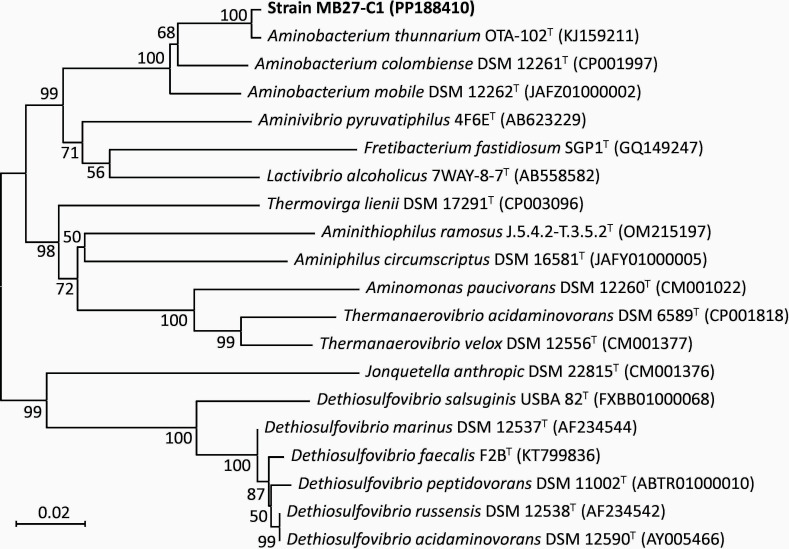 Fig 1
Fig 1| Item | Description |
|---|---|
| MIGS data | |
|
| |
|
| |
|
| |
| Sewage sludge of wastewater treatment plant of Sanming Steel Co. Ltd., Sanming, Fujian, China | |
| 26.2649 N, 117.6245 E | |
| 25 June 2021 | |
| DNBSEQ-T7 and Oxford Nanopore MinION | |
| Canu v. 2.2 | |
| 1,018.0× | |
| Complete | |
| General features of strain | |
| Domain: | |
| Positive | |
| Rod-shaped | |
| Anaerobic | |
| 40°C | |
| 7 | |
| 1.0% | |
| Genomic features | |
| 2,427,830 bp | |
| 41.58 | |
| 2,272 | |
| 48 | |
| 3, 3, 3 (5S, 16S, 23S) | |
| One RiPP-like gene cluster |
- —Fujian Provincial Department of Science and Technology (福建省科技厅)
- —Department of Education, Fujian Province (福建省教育厅)
- —Sanming University (SMU)
- —Sanming University (SMU)
- —福建省教育厅 | Distinguished Young Scientific Research Talents Plan in Universities of Fujian Province
- —Ministry of Science and Technology of Taiwan
Peer Reviews
No public reviews on file for this paper yet. If you reviewed it on a platform where reviews are public (OpenReview, ICLR, NeurIPS, ICML), you can paste yours below so the community can read it here.
Videos
No videos yet. Explain this paper in a talk, walkthrough, or lecture? Add one.
Taxonomy
TopicsGenomics and Phylogenetic Studies · Microbial Community Ecology and Physiology · Molecular Biology Techniques and Applications
ANNOUNCEMENT
Strain MB27-C1 was isolated from sewage sludge collected from the wastewater treatment plant of Sanming Steel Co. Ltd., located in Fujian, China, on 25 June 2021. Approximately 1 mL of sludge was directly inoculated into liquid anaerobic modified DSM924 media without acetate and formate. After incubation at room temperature (~25°C) for 2 weeks, the isolation, purification as well as 16S rRNA amplification and sequencing were conducted on the enrichment culture according to the methods described in our previous study (1). Based on the analysis using Nucleotide BLAST (2), one of the isolates, designated as strain MB27-C1, showed the highest similarities to three validly characterized strains: Aminobacterium thunnarium OTA 102^T^ (NR_178662.1, 98.47%) (3), Aminobacterium colombiense ALA-1^T^ (NR_074624.1, 95.92%) (4), and Aminobacterium mobile ILE-3^T^ (NR_024925.1, 91.25%) (5). In addition, phylogenetic analysis of 16S rRNA gene sequences performed by MEGA11 (6) for strain MB27-C1 and related taxa indicates that strain MB27-C1 belongs to the genus Aminobacterium (Fig. 1). The genome of strain MB27-C1 was sequenced for species delineation and comparative genomic analysis.
Neighbor-joining tree based on 16S rRNA gene sequences of strain MB27-C1 and related taxa. The phylogenetic tree was constructed using MEGA11 software (6). Bar, 0.02 substitutions per nucleotide position. Bootstrap values were expressed as percentages of 1,000 replications.
Strain MB27-C1 was cultured in modified DSM 924 medium at 35°C for 2 days. The genomic DNA was extracted from a cell pellet collected from a 1-L culture using the NucleoBond HMW DNA kit (Macherey-Nagel, Germany) following the manufacturer’s instructions. The genome was sequenced at the Sangon Biotech (Shanghai) Co., Ltd. using the DNBSEQ-T7 platform (MGI Tech Co., Ltd.) and the MinION sequencer (Oxford Nanopore Technology).
For the DNBSEQ-T7 platform, sheared genomic DNA fragments of approximately 300 bp were employed to construct a 150-bp paired-end DNA library. The library preparation was performed using Hieff NGS MaxUp II DNA Library Prep Kit for Illumina from Yeasen Biotechnology (Shanghai) Co., Ltd. Subsequently, the constructed library underwent sequencing using MGISEQ-2000RS High-throughput Sequencing Set (PE150 format), generating a total of 11,227,458 reads, which were then trimmed using Trimmomatic v0.36 (7). In the case of the MinION sequencer, the sheared DNA fragments underwent a series of processing steps, including end repair, 3′ adenylation (NEBNext End Repair/dA-Tailing Module), and ligation to adaptors pre-loaded with motor proteins (NEBNext Quick Ligation Module). The resulting product was then purified using Agencourt AMPure XP Beads (Beckman, A63881). Subsequently, fragments larger than 1 kb were subjected to single-molecule nanopore DNA sequencing using the Multiplex Ligation Sequencing Kit (SQK-MLK111.96-XL) on a MinION Flow Cell (R9.4.1). Basecalling was performed using Guppy version 6.5.6 with the default model, yielding a total of 115,526 reads and N50 of 6,328 bp. Trimming of the reads was carried out using Porechop v0.2.4 (8), and filtering was executed with NanoFilt v2.8.0 (9). DNBSEQ-T7 and MinION reads were hybrid de novo assembled using Canu v2.2 (10), producing a circularized contig of 2,427,830 bp with 41.58% GC content. Gene predictions and annotations were performed using NCBI Prokaryotic Genome Annotation Pipeline v6.5 (11). The antibiotics and secondary metabolite analysis shell (antiSMASH) was used to mine biosynthetic gene clusters in the genome (12). Default parameters were used for all bioinformatics analyses. Table 1 provides the basic characteristics of this strain and genome.
The reference list from the paper itself. Each links out to its DOI / PubMed record.
- 1Zhu J, Chen X, Chen SC, Qiu W, Yu J, Guo T, Wang X. 2023. Diversity and community composition of strictly anaerobic and culturable bacteria from the feces of styrofoam-fed Tenebrio molitor larvae: a culturomics-based study. Front Microbiol 14:1309806. doi:10.3389/fmicb.2023.130980638116533 PMC 10728288 · doi ↗ · pubmed ↗
- 2Altschul SF, Gish W, Miller W, Myers EW, Lipman DJ. 1990. Basic local alignment search tool. J Mol Biol 215:403–410. doi:10.1016/S 0022-2836(05)80360-22231712 · doi ↗ · pubmed ↗
- 3Hamdi O, Ben Hania W, Postec A, Bouallagui H, Hamdi M, Bonin P, Ollivier B, Fardeau M-L. 2015. Aminobacterium thunnarium sp. nov., a mesophilic, amino acid-degrading bacterium isolated from an anaerobic sludge digester, pertaining to the phylum Synergistetes. Int J Syst Evol Microbiol 65:609–614. doi:10.1099/ijs.0.068965-025406236 · doi ↗ · pubmed ↗
- 4Baena S, Fardeau ML, Labat M, Ollivier B, Garcia JL, Patel BK. 1998. Aminobacterium colombiense gen. nov. sp. nov., an amino acid-degrading anaerobe isolated from anaerobic sludge. Anaerobe 4:241–250. doi:10.1006/anae.1998.017016887649 · doi ↗ · pubmed ↗
- 5Baena S, Fardeau ML, Labat M, Ollivier B, Garcia JL, Patel BK. 2000. Aminobacterium mobile sp. nov., a new anaerobic amino-acid-degrading bacterium. Int J Syst Evol Microbiol 50 Pt 1:259–264. doi:10.1099/00207713-50-1-25910826812 · doi ↗ · pubmed ↗
- 6Tamura K, Stecher G, Kumar S. 2021. MEGA 11: molecular evolutionary genetics analysis version 11. Mol Biol Evol 38:3022–3027. doi:10.1093/molbev/msab 12033892491 PMC 8233496 · doi ↗ · pubmed ↗
- 7Bolger AM, Lohse M, Usadel B. 2014. Trimmomatic: a flexible trimmer for Illumina sequence data. Bioinformatics 30:2114–2120. doi:10.1093/bioinformatics/btu 17024695404 PMC 4103590 · doi ↗ · pubmed ↗
- 8Wick RR. 2017. Porechop: adapter trimmer for Oxford Nanopore reads. Github. Available from: https://github.com/rrwick/Porechop/