Genome sequencing of severe acute respiratory syndrome COVID-19 EF.1 variant strain obtained from a Moroccan patient
Lahcen Ouchari, Mouhssine Hemlali, Hamza Ghammaz, Taha Chouati, Marouane Melloul, Sanaâ Alaoui Amine, Safaa Rhoulam, Hicham Elannaz, Nadia Touil, Khalid Ennibi, Elmostafa El Fahime

TL;DR
This paper reports the genome sequence of a SARS-CoV-2 strain from a Moroccan patient, identified as the EF.1 subvariant of BA.5 Omicron.
Contribution
The study provides a new genome sequence of the EF.1 subvariant of the BA.5 Omicron variant of SARS-CoV-2.
Findings
The identified strain EF.1 belongs to the BQ1.1 subvariant of the BA.5 Omicron variant.
The complete coding genome sequence of the strain was obtained from a Moroccan patient.
Abstract
Here, we report the identification and coding-complete genome sequence of a severe acute respiratory syndrome COVID-19 (SARS-CoV-2) strain obtained from a Moroccan patient. The detected strain EF.1 belongs to the BQ1.1 subvariant of the BA.5 Omicron variant.
Genes, proteins, chemicals, diseases, species, mutations and cell lines named across the full text — each resolved to its canonical identifier and authoritative record.
Click any figure to enlarge with its caption.
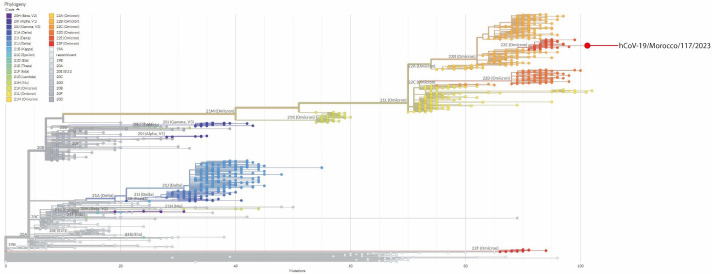 Fig 1
Fig 1| Protein | Amino acids changes |
|---|---|
|
| S135R |
|
| Q376K |
|
| T24I, G489S |
|
| L264F, T327I, T492I |
|
| P132H |
|
| F108del, G107del, L260F, S106del |
|
| P323L, Y273H |
|
| M233I, N268S, R392C |
|
| I42V |
|
| T112I |
|
| A27S, D405N, D614G, D796Y, E484A, F486V, G142D, G339D, H69del, H655Y, K417N, K444T, L24del, L452R, N440K, N460K, N679K, N764K, N969K, P25del, P26del, P681H, Q954H, S371F, S373P, S375F, S477N, T19I, T376A, T478K, V70del, V213G, Y144del |
|
| A72T, T223I |
|
| T9I, V62F |
|
| A63T, D3N, Q19E |
|
| E31del, E136D, G204R, P13L, R32del, R203K, S33del, S413R |
Peer Reviews
No public reviews on file for this paper yet. If you reviewed it on a platform where reviews are public (OpenReview, ICLR, NeurIPS, ICML), you can paste yours below so the community can read it here.
Videos
No videos yet. Explain this paper in a talk, walkthrough, or lecture? Add one.
Taxonomy
TopicsSARS-CoV-2 and COVID-19 Research · vaccines and immunoinformatics approaches · COVID-19 Clinical Research Studies
ANNOUNCEMENT
Severe acute respiratory syndrome COVID-19 (SARS-CoV-2 virus; genus: Betacoronavirus; family: Coronaviridae), responsible for COVID-19 pandemic, remains a substantial concern due to the mutations in variants that could cause a resurgence (1, 2). Two prominent variants, BQ.1 and BQ.1.1, were initially detected in Nigeria in July 2022 and quickly considered variants of interest (VOIs) (3) due to their increasing complexity of spike mutations which enhance their ability to evade neutralizing antibodies, even in individuals who have received a bivalent mRNA booster or have previously encountered breakthrough Omicron infections (4).
In the evolution monitoring of the SARS-CoV-2 virus, a sample was obtained from an asymptomatic patient from Rabat (Morocco) on 2023-05-01. The viral RNA was extracted using a MagPurix viral RNA extraction kit (Zinexts Life Science, China). Reverse transcription (SARS-CoV-2-specific primers) was performed using SuperScript VILO cDNA synthesis kit (Invitrogen, Thermo Fisher Scientific, USA) and a library was prepared according to the instruction of Ion AmpliSeq SARS-CoV-2 research panel (Thermo Fisher, USA). Template preparation and chip loading were performed using the Ion Chef system, and sequenced by the Ion S5 sequencer (Thermo-fisher Scientific, USA). In all, 1,927,688 reads (Average length: 188.38 bp; GC content: 37.83%) were obtained and aligned to the Wuhan-Hu-1 reference sequence (GenBank accession number NC_045512.2) using Unipro UGENE V.45 to generate a consensus sequence. Default parameters were used.
The obtained genome (hCoV-19/Morocco/117/2023) presented a length of 29,841 bp, which covered 99.6288% of the reference genome (average coverage depth: 11916.9×). The missing portions were the 5′ and 3′ UTRs. Sequence quality check was performed using Nextclade web tool v2.14.0 (https://clades.nextstrain.org) and mutation identification was carried out using the web application Cov-GLUE (http://cov-glue.cvr.gla.ac.uk/). Lineage and sublineage were obtained using the Pangolin web application v4.0 (https://pangolin.cog-uk.io/).
According to the Pangolin web application, the sample belongs to the sublineage BQ1.1 of the Omicron variant. According to Nextclade, on the other hand, it was part of the clade 22E. The viral genome presented a total of 74 mutations (Table 1), and their locations in the global diversity of SARS-CoV-2 are illustrated in Fig. 1. Notably, 27 of the total mutations were located at the level of the S Protein gene, and contained well-known mutations such as D614G, which is also present in most variants including alpha and delta (5). Other substitutions observed were characteristic of BQ1.1, such as E484A (6). This latter mutation is extensively investigated for its impact on the binding affinity of the spike to the ACE2 receptor, whose increase helps viral entry into host cells (2, 7). Moreover, it was linked to a reduction in the neutralization potency of antibodies, suggesting a potential immune evasion mechanism (2).
Phylogenetic tree displaying the sequenced SARS-CoV-2 strain (with reference to the global GISAID data set), according to the clades assigned to the virus in the phylogenetic analysis using the Augur toolkit (with default settings) run by the Nextstrain server. The red dot marking the location of the strain hCoV-19/Morocco/117/2023 is part of the 22E Omicron clade. However, it shows a high number of mutations compared to the closely related strains.
Other interesting mutations were observed, such as S477N of the Receptor-Binding Domain (RBD) of the Spike protein (8), N679K and P681H between the S1 and S2 subunits (9, 10), as well as G142D in the NTD region (a crucial binding site for antibody 4A8) (11, 12).
The subvariant BQ1.1 and its emergence is a significant challenge in the fight against COVID-19. It shows an ability to evade immune responses and alter the virus biology, which raises concerns about vaccine effectiveness and current control measures. This only helps emphasize the importance of continued research and a better understanding of the prevalence, transmissibility, and clinical impact of the Omicron EF.1 variant.
The reference list from the paper itself. Each links out to its DOI / PubMed record.
- 1Liu L, Iketani S, Guo Y, Chan J-W, Wang M, Liu L, Luo Y, Chu H, Huang Y, Nair MS, Yu J, Chik K-H, Yuen T-T, Yoon C, To K-W, Chen H, Yin MT, Sobieszczyk ME, Huang Y, Wang HH, Sheng Z, Yuen K-Y, Ho DD. 2022. Striking antibody evasion manifested by the Omicron variant of SARS-Co V-2. Nature 602:676–681. doi:10.1038/s 41586-021-04388-035016198 · doi ↗ · pubmed ↗
- 2Planas D, Saunders N, Maes P, Guivel-Benhassine F, Planchais C, Buchrieser J, Bolland W-H, Porrot F, Staropoli I, Lemoine F, et al.. 2022. Considerable escape of SARS-Co V-2 Omicron to antibody neutralization. Nature 602:671–675. doi:10.1038/s 41586-021-04389-z 35016199 · doi ↗ · pubmed ↗
- 3Callaway E. 2022. COVID ’variant soup’ is making winter surges hard to predict. Nature 611:213–214. doi:10.1038/d 41586-022-03445-636307585 · doi ↗ · pubmed ↗
- 4Wang Q, Iketani S, Li Z, Liu L, Guo Y, Huang Y, Bowen AD, Liu M, Wang M, Yu J, Valdez R, Lauring AS, Sheng Z, Wang HH, Gordon A, Liu L, Ho DD. 2023. Alarming antibody evasion properties of rising SARS-Co V-2 BQ and XBB subvariants. Cell 186:279–286. doi:10.1016/j.cell.2022.12.01836580913 PMC 9747694 · doi ↗ · pubmed ↗
- 5Hou YJ, Chiba S, Halfmann P, Ehre C, Kuroda M, Dinnon KH, Leist SR, Schäfer A, Nakajima N, Takahashi K, et al.. 2020. SARS-Co V-2 D 614G variant exhibits efficient replication ex vivo and transmission in vivo. Science 370:1464–1468. doi:10.1126/science.abe 849933184236 PMC 7775736 · doi ↗ · pubmed ↗
- 6La Rosa G, Brandtner D, Bonanno Ferraro G, Veneri C, Mancini P, Iaconelli M, Lucentini L, Del Giudice C, Orlandi L, Suffredini E, SARI network. 2023. Wastewater surveillance of SARS-Co V-2 variants in October–November 2022 in Italy: detection of XBB.1, BA.2.75 and rapid spread of the BQ.1 lineage. Sci Total Environ 873:162339. doi:10.1016/j.scitotenv.2023.16233936813191 · doi ↗ · pubmed ↗
- 7Iketani S, Liu L, Guo Y, Liu L, Chan J-W, Huang Y, Wang M, Luo Y, Yu J, Chu H, Chik K-H, Yuen T-T, Yin MT, Sobieszczyk ME, Huang Y, Yuen K-Y, Wang HH, Sheng Z, Ho DD. 2022. Antibody evasion properties of SARS-Co V-2 Omicron sublineages. Nature 604:553–556. doi:10.1038/s 41586-022-04594-435240676 PMC 9021018 · doi ↗ · pubmed ↗
- 8Singh A, Steinkellner G, Köchl K, Gruber K, Gruber CC. 2021. Serine 477 plays a crucial role in the interaction of the SARS-Co V-2 spike protein with the human receptor ACE 2. Sci Rep 11:4320. doi:10.1038/s 41598-021-83761-533619331 PMC 7900180 · doi ↗ · pubmed ↗