Genome assembly of Pseudomonas sp. strain SED1T, a psychrotolerant bacterium isolated from Deception Glacier (Washington, USA)
Daniel H. Shain, Eric A. Klein

TL;DR
This paper reports the genome assembly of a new Pseudomonas species isolated from a glacier in Washington, USA.
Contribution
The study provides the genome sequence of a novel psychrotolerant Pseudomonas strain from a glacial environment.
Findings
The genome has a G + C content of 60.4 mol% and encodes 6,125 predicted proteins.
Analysis confirms the isolate represents a previously undescribed species in the genus Pseudomonas.
Abstract
Strain SED1T was isolated from glacial samples collected on Mount Deception, Washington, USA. Genome sequencing and assembly identified a DNA G + C content of 60.4 mol% with 6,125 predicted proteins. Analysis by the Type Strain Genome Server is consistent with the isolate representing a previously undescribed species in the genus Pseudomonas.
Genes, proteins, chemicals, diseases, species, mutations and cell lines named across the full text — each resolved to its canonical identifier and authoritative record.
Click any figure to enlarge with its caption.
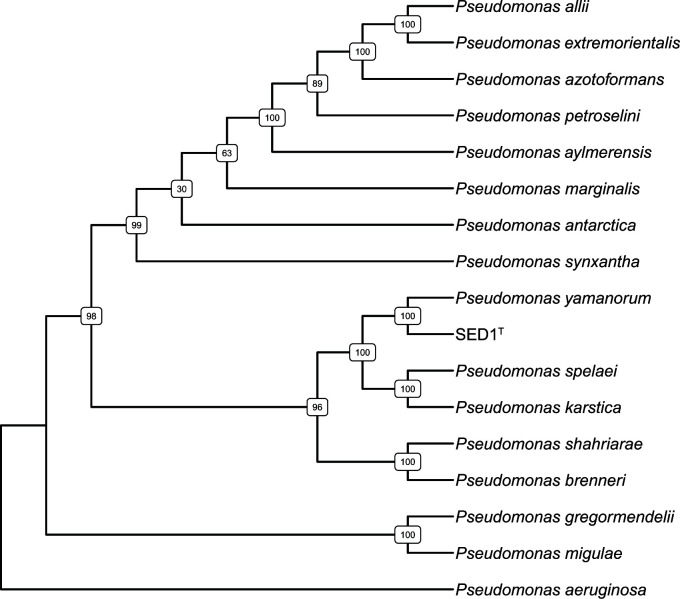 Fig 1
Fig 1| Subject strain | dDDH | C.I. | G + C difference (%) |
|---|---|---|---|
| 58.2 | (55.4–60.9) | 0.06 | |
| 32.4 | (30.0–34.9) | 1.04 | |
| 31.2 | (28.8–33.7) | 0.23 | |
| 31 | (28.6–33.5) | 1.24 | |
| 30.9 | (28.5–33.4) | 1.51 | |
| 30.8 | (28.4–33.3) | 0.33 | |
| 30.7 | (28.3–33.2) | 0.19 | |
| 30.7 | (28.3–33.2) | 0.47 | |
| 30.6 | (28.2–33.1) | 0.01 | |
| 30.6 | (28.2–33.1) | 0.26 | |
| 30.5 | (28.1–33.0) | 0.19 | |
| 30.5 | (28.1–33.0) | 0.88 | |
| 30.4 | (28.0–32.9) | 0.58 | |
| 30.4 | (28.0–32.9) | 0.53 | |
| 29.7 | (27.3–32.2) | 0.74 | |
| 25.8 | (23.5–28.3) | 1.28 | |
| 25.6 | (23.3–28.1) | 1.9 | |
| 25.6 | (23.3–28.1) | 0.79 |
- —National Science Foundation (NSF)
- —National Science Foundation (NSF)
Peer Reviews
No public reviews on file for this paper yet. If you reviewed it on a platform where reviews are public (OpenReview, ICLR, NeurIPS, ICML), you can paste yours below so the community can read it here.
Videos
No videos yet. Explain this paper in a talk, walkthrough, or lecture? Add one.
Taxonomy
TopicsGenomics and Phylogenetic Studies · Microbial Community Ecology and Physiology · Bacteriophages and microbial interactions
ANNOUNCEMENT
Samples from Mount Deception, Olympic National Park, Washington, USA (47°48′47″N 123°14′01″W) were collected in September 2016 using a small spade to transfer surface snow/ice into plastic containers. Samples were melted and grown on Hutner-imidazole-glucose-glutamate minimal media agar plates at 4°C to isolate psychrotolerant oligotrophic bacteria (1). Three distinct colony morphologies were observed; 16S rRNA sequencing identified one Janthinobacterium and two Pseudomonads, one of which (SED1^T^) is further characterized in this study. The 16S rRNA sequence was PCR-amplified using Q5 polymerase (New England Biolabs) and primers 27F (AGAGTTTGATCMTGGCTCAG) and 1492R (GGTTACCTTGTTACGACTT), followed by Sanger sequencing. BLAST identified the closest sequence match as Pseudomonas yamanorum (GenBank accession no: CP012400). Species of the genus Pseudomonas are rod-shaped, motile, aerobic, Gram-negative gammaproteobacteria. Pseudomonads inhabit a variety of environmental niches, including soil, water, and plant and animal hosts. A number of Pseudomonads are psychrotolerant (2–6), and these organisms provide an excellent model system for studying the mechanisms of cold tolerance.
Bacteria were grown in tryptic soy broth overnight at 22°C, genomic DNA was extracted (Qiagen Blood and Tissue Kit), and samples were sent to SeqCenter (Pittsburgh, PA, USA) for library preparation and sequencing. The DNA library was prepared using the Illumina DNA Prep kit and IDT 10 bp UDI indices. Sequencing was performed using the Illumina NextSeq2000 platform to produce 2 × 151-bp reads. Demultiplexing, quality control, and adapter trimming of the reads were performed with bcl-convert (v3.9.3) (Illumina). The total number of read pairs was 2,965,170 with a Q30 value of 92.27%. The reads were assembled using the NCBI RAPT pipeline (https://www.ncbi.nlm.nih.gov/rapt) using default settings. Gene annotation was performed using the NCBI Prokaryotic Genome Annotation Pipeline (v6.6) with the Best-placed reference protein set GeneMarkS-2+ (NCBI BioProject PRJNA1036626). The resulting assembly had 240 contigs with a total length of 6,739,787 bp, 132× mean coverage, and an N50 of 49,757. DNA G + C content was 60.4 mol%, and the number of predicted proteins was 6,125. Genome completeness was estimated as 99.86% by assessing the presence of single-copy essential genes using CheckM (v1.0.18) (7). The concatenated sequences of 16S rRNA, dnaK, gyrB, recA, rpoD, and trpB (8) from 16 species of the Pseudomonas gessardii subgroup were aligned using MUSCLE aligner (9), and phylogenetic trees were prepared using Randomized Axelerated Maximum Likelihood (RAxML) (v8.2.12) (10) with 100 bootstraps and a maximum-likelihood search. This analysis showed that SED1^T^ is most closely related to P. yamanorum (Fig. 1). The scaffolds were analyzed by the Type Strain Genome Server (TYGS) (11), which uses Genome BLAST Distance Phylogeny and digital DNA-DNA hybridization (dDDH) values to perform species and sub-species clustering. The GGDC platform uses high-scoring segment pairs (HSPs) between related species to calculate the d4 value, which is the ratio between all identities found in HSPs and total HSP length (Table 1) (12). Pairwise comparisons with d4 < 70% are presumed to indicate that the genomes are from distinct species. The d4 value for SED1^T^ and P. yamanorum, the most closely related bacterium, was 58.2%, consistent with isolate SED1^T^ representing a previously undescribed species of the genus Pseudomonas.
Multi-locus maximum-likelihood phylogenetic analysis of SED1T. The concatenated sequences of 16S rRNA, dnaK, gyrB, recA, rpoD, and trpB (8) from the indicated species of the P. gessardii subgroup were aligned using MUSCLE aligner (9), and phylogenetic trees were prepared using RAxML (version 8.2.12) with 100 bootstraps (10). Bootstrap percentages are indicated at the nodes.
The reference list from the paper itself. Each links out to its DOI / PubMed record.
- 1Poindexter JS. 1978. Selection for nonbuoyant morphological mutants of Caulobacter crescentus. J Bacteriol 135:1141–1145. doi:10.1128/jb.135.3.1141-1145.1978690072 PMC 222491 · doi ↗ · pubmed ↗
- 2Arnau VG, Sánchez LA, Delgado OD. 2015. Pseudomonas yamanorum sp. nov., a psychrotolerant bacterium isolated from a subantarctic environment. Int J Syst Evol Microbiol 65:424–431. doi:10.1099/ijs.0.065201-025385990 · doi ↗ · pubmed ↗
- 3Carrión O, Miñana-Galbis D, Montes MJ, Mercadé E. 2011. Pseudomonas deceptionensis sp. nov., a psychrotolerant bacterium from the antarctic. Int J Syst Evol Microbiol 61:2401–2405. doi:10.1099/ijs.0.024919-021062736 · doi ↗ · pubmed ↗
- 4Ma Y, Wang L, Shao Z. 2006. Pseudomonas, the dominant polycyclic aromatic hydrocarbon-degrading bacteria isolated from antarctic soils and the role of large plasmids in horizontal gene transfer. Environ Microbiol 8:455–465. doi:10.1111/j.1462-2920.2005.00911.x 16478452 · doi ↗ · pubmed ↗
- 5Nevot M, Deroncele V, López-Iglesias C, Bozal N, Guinea J, Mercade E. 2006. Ultrastructural analysis of the extracellular matter secreted by the psychrotolerant bacterium Pseudoalteromonas antarctica NF 3. Microb Ecol 51:501–507. doi:10.1007/s 00248-006-9065-516645922 · doi ↗ · pubmed ↗
- 6Reddy GSN, Matsumoto GI, Schumann P, Stackebrandt E, Shivaji S. 2004. Psychrophilic pseudomonads from antarctica: Pseudomonas antarctica sp. nov., Pseudomonas meridiana sp. nov. and Pseudomonas proteolytica sp. nov. Int J Syst Evol Microbiol 54:713–719. doi:10.1099/ijs.0.02827-015143013 · doi ↗ · pubmed ↗
- 7Parks DH, Imelfort M, Skennerton CT, Hugenholtz P, Tyson GW. 2015. Check M: assessing the quality of microbial genomes recovered from isolates, single cells, and metagenomes. Genome Res 25:1043–1055. doi:10.1101/gr.186072.11425977477 PMC 4484387 · doi ↗ · pubmed ↗
- 8Liu Y, Lai Q, Shao Z. 2017. A multilocus sequence analysis scheme for phylogeny of thioclava bacteria and proposal of two novel species. Front Microbiol 8:1321. doi:10.3389/fmicb.2017.0132128751885 PMC 5508018 · doi ↗ · pubmed ↗