The complete genome of Vibrio sp. 16 unveils two circular chromosomes and a distinctive 46-kb plasmid
Xiaofen Wu, Anca M. Segall, Carmela Giglione, Thierry Meinnel

TL;DR
This paper reports the full genome of Vibrio sp. 16, revealing two circular chromosomes and a unique 46-kb plasmid with genes possibly related to phage infection.
Contribution
The study provides the complete genome sequence of Vibrio sp. 16 and identifies a novel plasmid with toxin/antitoxin systems.
Findings
The Vibrio sp. 16 genome is 4.6-Mb and contains 4,270 genes.
A 46-kb plasmid (pVDT1) contains parAB/repB partition genes and three toxin/antitoxin systems.
The genome structure includes two circular chromosomes and a plasmid.
Abstract
The entire 4.6-Mb genome of Vibrio sp. 16, encoding 4,270 genes, best matches with Vibrio rotiferianus. A 46-kb plasmid (pVDT1), alongside two circular chromosomes, showcases parAB/repB partition genes and three toxin/antitoxin systems potentially linked to phage infection.
Genes, proteins, chemicals, diseases, species, mutations and cell lines named across the full text — each resolved to its canonical identifier and authoritative record.
Click any figure to enlarge with its caption.
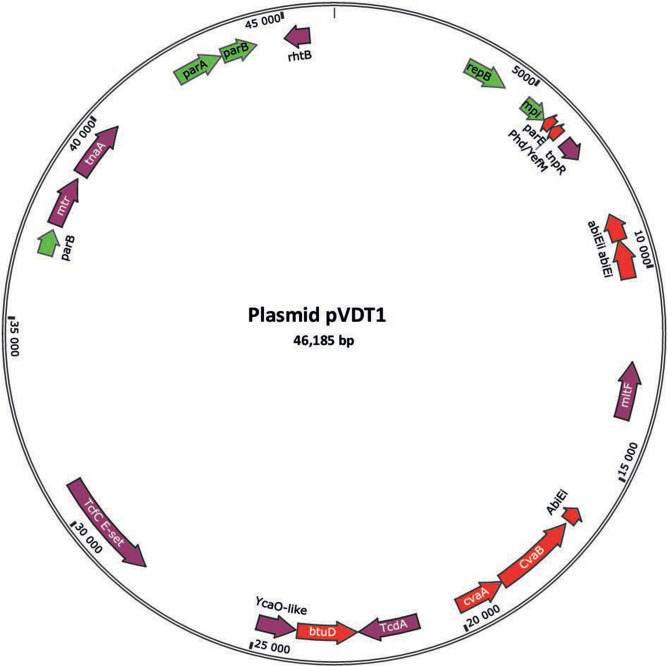 Fig 1
Fig 1| Data | Complete genome | Partial genome |
|---|---|---|
| Contigs | 3 | 178 |
| Bases (bp) | 4,658,079 | 4,488,436 |
| CheckM completeness (%) | 99.65 | 93.25 |
| Total gene number | 4,270 | 4,186 |
| CoDing Sequences | 4,092 | 3,963 |
| Total RNA genes | 157 | 106 |
| ncRNA genes | 1 | 1 |
| rRNA genes | 34 | 27 |
| tRNA genes | 119 | 75 |
| Other RNA genes | 3 | 3 |
| Pseudogenes | 21 | 117 |
- —Agence Nationale de la Recherche (ANR)
- —European Cooperation in Science and Technology (COST)
- —Philippe Foundation (Philippe Foundation, Inc.)
Peer Reviews
No public reviews on file for this paper yet. If you reviewed it on a platform where reviews are public (OpenReview, ICLR, NeurIPS, ICML), you can paste yours below so the community can read it here.
Videos
No videos yet. Explain this paper in a talk, walkthrough, or lecture? Add one.
Taxonomy
TopicsBacteriophages and microbial interactions · Vibrio bacteria research studies · Genomics and Phylogenetic Studies
ANNOUNCEMENT
Vibrio sp. 16, also known as Vibrio parahaemolyticus strain 16 (1), is an unclassified Vibrio species (NCBI-Taxonomy #391586). It was isolated from surface waters in Tampa Bay, USA (latitude 27.96; longitude −82.46) and cultivated after streak isolation on marine agar. Serving as a host for numerous vibriophages, it contributes to modeling phage and bacterial evolution (1, 2). These phages play a crucial role in investigating the functions of peptide deformylase phage genes (3–6). Partial sequencing data are available (https://gold.jgi.doe.gov/analysis_project?id=Ga0031464).
Vibrio sp. 16 was provided by John Paul (University of South Florida). VDT1, a streptomycin-resistant isolate, was cultured overnight at 30°C with shaking (170 rpm) in liquid broth comprising 1% tryptone, 0.5% yeast extract, 3% NaCl, and 100 µg/mL streptomycin. DNA was extracted using the GenElute Bacterial Genomic DNA Kit (Sigma). Long-read sequencing libraries were prepared using the Native Barcoding kit SQK NBD114.24 (Oxford Nanopore Technologies) and sequenced on a Flo-Min114 Flow Cell (R10.4.1) on a GridION instrument (version GXB02022-23.07.5). Data analysis involved base calling and demultiplexing with Dorado 7.0.9 (https://github.com/nanoporetech/dorado), and long-read hierarchical assembly utilized Canu 2.1.1 (7). Genome display, circularization, format conversion, and curation were performed with SnapGene 7.0.3. Raw reads numbered 797,022 (4,511,949,794 bases) with N_50_ value of 8,256 bp. Genome annotation utilized PGAP 6.6 (8). Completeness used CheckM 1.2.2 (9). Default parameters were used for all software.
Four contigs were generated. Circularization of chromosomes 1 and 2 was proposed by the Canu pipeline, suggesting repeat sequences on both ends (7). Trimming 22,073 and 23,485 bp, respectively, resulted in circular chromosomes of 3,080,496 bp and 1,531,398 bp. Circularization of contig 3 (89,403 bp) was indicated by BLAST alignment of the sequence against itself and dot plot analysis, revealing duplication of 43,218 bp. Validation involved comparing the overlap at the circularization end with partial genomic data (Table 1). The unique matching contig (scf_1108854221939; 47,116 bp) comprised a 931-bp overlap on each end. Trimming yielded the final 46,185-bp circular plasmid DNA, named pVDT1 (Fig. 1). The fourth contig, representing a linear 35-kb duplication of chromosome 2, was discarded. The complete genome size totaled 4,658,079 bp with a GC content of 46.3% (pVDT1 45%). The mean read depth for genome coverage was 945.
Simplified gene map of pVDT1. The circular map emphasizes 21 of the 53 coding sequences with homologies to known genes. Genes associated with toxin/antitoxin systems are marked in red, while those related to replication are highlighted in green. Twenty-four percent of the sequence exhibited 85.3% identity with regions near the replication origin, including parAB and repB, of an unnamed plasmid from Vibrio campbellii strain LJC014 (83.4 kb; GenBank ID CP050469.1).
Average nucleotide identity analysis (11) revealed 99.99% identity of the partial sequence with the complete genome (see details in Table 1) and Vibrio rotiferianus as best match type-strain (85.19%). V. rotiferianus is a member of the Harveyi clade, which includes V. parahaemolyticus (12, 13). Only one peptide deformylase gene on chromosome 1 (def1) was observed, unlike other Vibrionaceae that display a def2 gene on chromosome 2 (4, 10, 14). Several pVDT1 genes displayed strong sequence identity with Vibrio toxin/antitoxin systems genes (15), such as colicin V secretion CvaA/CvaB (99%/66%), type IV system AbiEi/AbiEii (87%/73%), or type II system YefM/ParE (98%/96%) family (Fig. 1). Toxin/antitoxin genes are implicated in bacterial virulence by inducing death of infected cells (16, 17) or in phage toxicity mediation (14). Thus, plasmid pVDT1 may play a role in controlling phage infectivity in Vibrio sp. 16.
The reference list from the paper itself. Each links out to its DOI / PubMed record.
- 1Kellogg C, Rose J, Jiang S, Thurmond J, Paul J. 1995. Genetic diversity of related vibriophages isolated from marine environments around Florida and Hawaii, USA. Mar. Ecol. Prog. Ser 120:89–98. doi:10.3354/meps 120089 · doi ↗
- 2Seguritan V, Feng IW, Rohwer F, Swift M, Segall AM. 2003. Genome sequences of two closely related Vibrio parahaemolyticus phages. J Bacteriol 185:6434–6447. doi:10.1128/JB.185.21.6434-6447.200314563879 PMC 219397 · doi ↗ · pubmed ↗
- 3Frank JA, Lorimer D, Youle M, Witte P, Craig T, Abendroth J, Rohwer F, Edwards RA, Segall AM, Burgin AB. 2013. Structure and function of a cyanophage-encoded peptide deformylase. ISME J 7:1150–1160. doi:10.1038/ismej.2013.423407310 PMC 3660681 · doi ↗ · pubmed ↗
- 4Grzela R, Nusbaum J, Fieulaine S, Lavecchia F, Bienvenut WV, Dian C, Meinnel T, Giglione C. 2017. The C-terminal residue of phage Vp 16 PDF, the smallest peptide deformylase, acts as an offset element locking the active conformation. Sci Rep 7:11041. doi:10.1038/s 41598-017-11329-328887476 PMC 5591237 · doi ↗ · pubmed ↗
- 5Grzela R, Nusbaum J, Fieulaine S, Lavecchia F, Desmadril M, Nhiri N, Van Dorsselaer A, Cianferani S, Jacquet E, Meinnel T, Giglione C. 2018. Peptide deformylases from Vibrio parahaemolyticus phage and bacteria display similar deformylase activity and inhibitor binding clefts. Biochim Biophys Acta Proteins Proteom 1866:348–355. doi:10.1016/j.bbapap.2017.10.00729101077 · doi ↗ · pubmed ↗
- 6Sharon I, Battchikova N, Aro E-M, Giglione C, Meinnel T, Glaser F, Pinter RY, Breitbart M, Rohwer F, Béjà O. 2011. Comparative metagenomics of microbial traits within oceanic viral communities. ISME J 5:1178–1190. doi:10.1038/ismej.2011.221307954 PMC 3146289 · doi ↗ · pubmed ↗
- 7Koren S, Walenz BP, Berlin K, Miller JR, Bergman NH, Phillippy AM. 2017. Canu: scalable and accurate long-read assembly via adaptive k-mer weighting and repeat separation. Genome Res 27:722–736. doi:10.1101/gr.215087.11628298431 PMC 5411767 · doi ↗ · pubmed ↗
- 8Tatusova T, Di Cuccio M, Badretdin A, Chetvernin V, Nawrocki EP, Zaslavsky L, Lomsadze A, Pruitt KD, Borodovsky M, Ostell J. 2016. NCBI prokaryotic genome annotation pipeline. Nucleic Acids Res 44:6614–6624. doi:10.1093/nar/gkw 56927342282 PMC 5001611 · doi ↗ · pubmed ↗