Draft genome sequence of halotolerant plant growth-promoting Bacillus paralicheniformis MHN12
Priyanka Dahiya, Pradeep Kumar, Simran Rani, Amita Suneja Dang, Pooja Suneja

TL;DR
This paper presents the genome sequence of a salt-tolerant bacteria that can promote plant growth in salty soils.
Contribution
The study provides a new genome sequence for Bacillus paralicheniformis MHN12 with potential agricultural applications.
Findings
The genome of MHN12 is 4,245,453 base pairs with 45.9% G + C content.
MHN12 has high salinity tolerance and plant growth-promoting abilities.
The genome includes 4,418 predicted coding sequences and 80 tRNA genes.
Abstract
Bacillus paralicheniformis MHN12 possesses a 4,245,453-base pair genome with 45.9% G + C content, including 1 CRISPR, 80 tRNA, 8 rRNA genes, and 4,418 predicted coding sequences . MHN12 exhibits high salinity tolerance and plant growth-promoting abilities, making it a promising bioinoculant for enhancing plant growth in saline soils.
Genes, proteins, chemicals, diseases, species, mutations and cell lines named across the full text — each resolved to its canonical identifier and authoritative record.
Click any figure to enlarge with its caption.
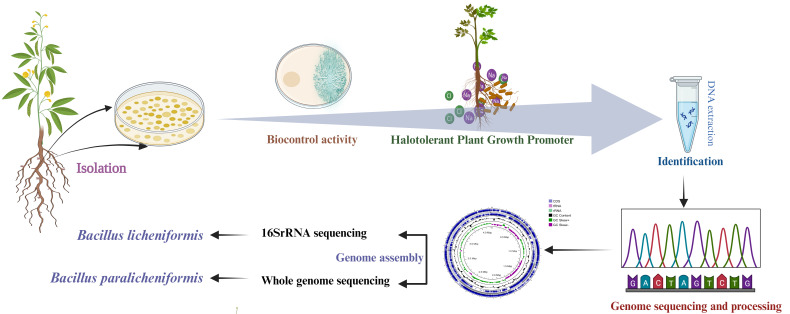 Fig 1
Fig 1Peer Reviews
No public reviews on file for this paper yet. If you reviewed it on a platform where reviews are public (OpenReview, ICLR, NeurIPS, ICML), you can paste yours below so the community can read it here.
Videos
No videos yet. Explain this paper in a talk, walkthrough, or lecture? Add one.
Taxonomy
TopicsPlant-Microbe Interactions and Immunity · Plant tissue culture and regeneration · Legume Nitrogen Fixing Symbiosis
ANNOUNCEMENT
Legumes are crucial to global food security due to their high protein and nutrient content. However, climate change, abiotic stresses like salinity, and diseases like Fusarium wilt caused by Fusarium oxysporum impact their yield consistency. Current management methods involve synthetic fungicides, leading to environmental issues (1, 2). Stress-resilient plant growth-promoting endophytic bacteria offer an eco-friendly solution for sustainable plant growth and protection (3). The use of beneficial native microbes for promoting plant growth and protection is favored, as foreign strains often struggle to colonize and benefit host plants (4).
The isolation of Bacillus paralicheniformis MHN12 was conducted from Vigna radiata nodules collected from Hisar, Haryana, India (29.25°N, 76.05°E) with the aim to identify a stress-resilient plant growth-promoting endophyte. The nodules were surface sterilized (5), crushed, and streaked onto Tryptic Soya Agar plates. The streaked plates were kept for 3 days at 28°C ± 2°C to allow bacterial growth. Non-macerated sterilized nodules served as a control to validate the effectiveness of the sterilization process. Genomic DNA from selected pure colonies was extracted by a modified cetyltrimethylammonium bromide protocol (6). The extracted DNA was then amplified by 16S rRNA universal primers (1541R, 8F) (7) followed by sequencing. The obtained sequences were compared using the BLAST server and submitted to GenBank (MH298522). Based on 16S rRNA sequence similarity, MHN12 showed the highest affiliation to Bacillus licheniformis. The isolate exhibited plant growth-promoting traits, including phosphate solubilization, 1-aminocyclopropane-1-carboxylic acid deaminase activity, hydrogen cyanide, siderophore, and indole-3-acetic acid production. It demonstrated high salinity tolerance (15%) and antifungal activity against Fusarium oxysporum and Aspergillus niger (8, 9). Therefore, it prompted us to look deeper into its whole genome (Fig. 1) .
Genome sequencing of halotolerant plant growth-promoting Bacillus paralicheniformis MHN12.
The paired-end sequencing library was constructed using the Illumina TruSeq Nano DNA Library Prep Kit and sequenced on an Illumina NextSeq500 platform with 2 × 150 bp chemistry. The whole-genome sequencing generated 1,437,736,607 bases, providing around 100× genome coverage. For genome analysis and annotation Galaxy server tools, Prokka v1.14.5 (10), Shovill v1.0.4 (11), and Fastp v0.201 (12) with default parameters were utilized. The filtering and trimming using Fastp v0.201 yielded 5,043,632 paired ends, assembled into 32 contigs by Shovill v1.0.4, generating an assembly of 4,245,453 bp with N50 of 503,829 bp. Genome annotation by Prokka v1.14.5 revealed genome harbors 1 CRISPR gene, 80 tRNA genes, 8 rRNA genes, and 45.9% GC content. Additional rapid annotation subsystem technology (13) annotation identified 4,418 predicted coding sequences (CDS) across 480 subsystems. Abundant subsystems included carbohydrates (598 CDS), amino acids and derivatives (484 CDS), and cofactors, vitamins, prosthetic groups, and pigments (246 CDS). AntiSMASH v6.0 (14) analysis revealed secondary metabolite regions (fengycin, bacitracin) in MHN12’s genome. Despite initial identification as licheniformis, subsequent sequencing and annotation supported its reclassification as paralicheniformis, confirmed by the presence of specific secondary metabolite operons as reported in previous studies (15).
The draft genome of Bacillus paralicheniformis MHN12 provides crucial insights, serving as a foundation to explore the mechanisms for diverse plant growth promoting and stress resilience. Also, this knowledge contributes to the development of eco-friendly strategies for enhanced legume cultivation and improved yields.
The reference list from the paper itself. Each links out to its DOI / PubMed record.
- 1Mousavi-Derazmahalleh M, Bayer PE, Hane JK, Valliyodan B, Nguyen HT, Nelson MN, Erskine W, Varshney RK, Papa R, Edwards D. 2019. Adapting legume crops to climate change using genomic approaches. Plant Cell Environ 42:6–19. doi:10.1111/pce.1320329603775 PMC 6334278 · doi ↗ · pubmed ↗
- 2Sampaio AM, Araújo S de S, Rubiales D, Vaz Patto MC. 2020. Fusarium wilt management in legume crops. Agronomy 10:1073. doi:10.3390/agronomy 10081073 · doi ↗
- 3Maheshwari DK, Saraf M, Dheeman S. 2019. Plant growth-promoting rhizobacteria (PGPR) as protagonists of ever-sustained agriculture: an introduction, p 1–10. In Maheshwari DK, Dheeman S (ed), Field crops: sustainable management by PGPR. Springer International Publishing, Cham.
- 4Dal Cortivo C, Ferrari M, Visioli G, Lauro M, Fornasier F, Barion G, Panozzo A, Vamerali T. 2020. Effects of seed-applied biofertilizers on rhizosphere biodiversity and growth of common wheat (Triticum aestivum L.) in the field. Front Plant Sci 11:72. doi:10.3389/fpls.2020.0007232174929 PMC 7054350 · doi ↗ · pubmed ↗
- 5Vincent JM. 1970. A manual for the practical study of the root-nodule bacteria
- 6Jones AS. 1953. The isolation of bacterial nucleic acids using cetyltrimethylammonium bromide (Cetavlon). Biochim Biophys Acta 10:607–612. doi:10.1016/0006-3002(53)90304-713059024 · doi ↗ · pubmed ↗
- 7Weisburg WG, Barns SM, Pelletier DA, Lane DJ. 1991. 16S ribosomal DNA amplification for phylogenetic study. J Bacteriol 173:697–703. doi:10.1128/jb.173.2.697-703.19911987160 PMC 207061 · doi ↗ · pubmed ↗
- 8Bhutani N, Maheshwari R, Kumar P, Suneja P. 2021. Bioprospecting of endophytic bacteria from nodules and roots of Vigna radiata, Vigna unguiculata and Cajanus cajan for their potential use as bioinoculants. Plant Gene 28:100326. doi:10.1016/j.plgene.2021.100326 · doi ↗