Complete sequence of the closed circular extrachromosomal element of Naegleria pringsheimi De Jonckheere (strain Singh)
Brian T. Nguyen, Nora M. Chapman, Niklas Johnson, Holly A. F. Stessman, Steven Tracy, Kristen M. Drescher

TL;DR
This paper presents the full DNA sequence of a circular genetic element in the organism Naegleria pringsheimi.
Contribution
The complete sequence of the CERE in Naegleria pringsheimi (strain Singh) is reported for the first time.
Findings
The CERE contains the DNA encoding ribosomal RNA.
The sequence is closed and circular, as found in the nucleolus.
Abstract
The DNA encoding the ribosomal RNA in Naegleria is encoded on closed circular extrachromosomal ribosomal DNA-containing elements (CERE) in the nucleolus. In this report, we describe the sequence of the CERE of Naegleria pringsheimi De Jonckheere (strain Singh).
Genes, proteins, chemicals, diseases, species, mutations and cell lines named across the full text — each resolved to its canonical identifier and authoritative record.
Click any figure to enlarge with its caption.
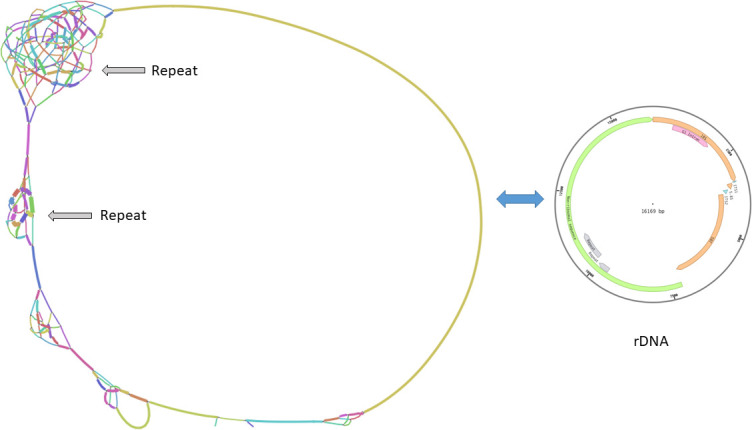 Fig 1
Fig 1| Characteristics | Value |
|---|---|
| Genome size (bp) | 16,164 |
| GC content (%) | 41.1 |
| Contigs | 101 (pre-filtering) |
| Blast alignment to | 39 |
| Average read length (bp) | 2,624 |
| Total reads (PacBio) | 78,826 |
| Total reads (ONT) | 1,922 |
| 8,599 | |
| 15,793 | |
| Mean read depth (Pac Bio) | 5,427.8 |
| GenBank accession |
|
| SRA accession (raw reads, PacBio) |
|
| SRA accession (raw reads, ONT) |
|
| BioProject |
|
| BioSample |
|
Peer Reviews
No public reviews on file for this paper yet. If you reviewed it on a platform where reviews are public (OpenReview, ICLR, NeurIPS, ICML), you can paste yours below so the community can read it here.
Videos
No videos yet. Explain this paper in a talk, walkthrough, or lecture? Add one.
Taxonomy
TopicsLegionella and Acanthamoeba research · Antibiotic Resistance in Bacteria · Mycobacterium research and diagnosis
ANNOUNCEMENT
Naegleria encode all their ribosomal DNA (rDNA) in the nucleolus on closed circular extrachromosomal elements [CERE (1–3)], similar to unrelated species including Entamoeba histolytica (4). Naegleria can exist as cysts, trophozoites, or flagellates (5). The trophozoites are the best-studied life-cycle stage, as the one human pathogenic Naegleria, Naegleria fowleri, infects when trophozoites enter the nasal cavity and invade the brain (5). One trophozoite has been estimated to contain approximately ~4,000 copies of the CERE (2). Only one study has examined the CERE origin of replication (ori) in Naegleria, with a single ori identified in the large non-ribosomal sequence (NRS) of the CERE (6). The NRS between Naegleria species are highly variable despite the conservation of their rDNA cistrons (1, 7–10). Naegleria pringsheimi De Jonckheere (Singh) was originally classified as Naegleria gruberi but has been reclassified as a unique species (11).
N. pringsheimi (Singh; ATCC, Manassas, VA, USA) trophozoites were cultured in modified PYNFH (peptone/yeast extract/nucleic acid/folic acid/heme with 10% fetal calf serum) medium at 25°C. CERE DNA was isolated using the Plasmid Mini Kit per the manufacturer’s instructions (Qiagen, Germantown, PA, USA). Supercoiled CERE was isolated from samples electrophoresed on 0.8% agarose gels using the Monarch DNA Gel Extraction Kit (NEB) per the manufacturer’s instructions and digested with BamHI (NEB). Agarose gel electrophoresis indicated the CERE was approximately 16–17 kbp in size. This band was isolated with the Monarch DNA Gel Extraction Kit. No additional size selection was performed.
The Roy J. Carver Biotechnology Center (University of Illinois–Urbana Champaign) performed the sequencing of unsheared DNA using standard Pacific Biosciences protocols. The Agilent Femto Pulse System was used to determine DNA quality. The library was prepared using the PacBio SMRTbell Express Template Prep Kit 3.0 (Pacific Biosciences), and sequencing was performed on the PacBio Sequel IIe (2.0 chemistry, CCS mode, 30-hour movies).
The N. gruberi mitochondrial sequences (GenBank accession no.: NC_002573.1) with at least 65% sequence identity were removed from the 102,563 raw reads (23,737/102,563; 23.1%) (E-value 1e-50; remaining settings “default”). The remaining reads (78,826) were separated into FASTA files with reads greater than 5 kbp and less than 17 kbp (11,199/78,826; 14.2% of reads). Reads were assembled using the SPADES Assembler 3.15.5 into contigs and a consensus (options: “—isolate,” “—plasmid—only-assembler”; remaining parameters “default”). CERE characteristics are presented in Table 1. Additional undigested, unsheared CERE DNA was sequenced using Oxford Nanopore Technology (ONT) (plasmidsaurus.com, GridION, V10 Chemistry Library Prep Kit, ligation protocol, R9.4.1 flow cell) to verify the PacBio consensus sequence. No size selection was performed. Bases were called using Guppy (version 6.3.8; SUP). The consensus sequence in GenBank was assembled using PacBio sequences. The ONT sequences were used to resolve repeat sequence regions in the NRS. The overlap of the circular element was identified based on reads with the 5′ and 3′ BamHI digestion site ends. No genome rotation was performed. Figure 1 illustrates the location of the rDNA, NRS, and the repetitive sequences located within the NRS as generated by Bandage (Bioinformatics Application for Navigating De novo Assembly Graphs Easily).
Bandage image of the genome of N. pringsheimi as determined using PacBio generated sequences. The location of the rDNA subunits of N. pringsheimi is shown in the inset (note that the first nucleotide of the genome is the first nucleotide of the 18S rDNA subunit). The NRS begins at nucleotide 7,187. Repeat regions, characteristic of Naegleria species’ CERE, are indicated by the red arrows.
The reference list from the paper itself. Each links out to its DOI / PubMed record.
- 1Nguyen BT, Chapman NM, Tracy S, Drescher KM. 2021. The extrachromosomal elements of the Naegleria amoebae: how little we know. Plasmid 115:102567. doi:10.1016/j.plasmid.2021.10256733617907 · doi ↗ · pubmed ↗
- 2Clark CG, Cross GAM. 1987. r RNA genes of Naegleria gruberi are carried exclusively on a 14-kilobase-pair plasmid. Mol Cell Biol 7:3027–3031. doi:10.1128/mcb.7.9.3027-3031.19872823115 PMC 367933 · doi ↗ · pubmed ↗
- 3Clark CG, Cross GAM. 1988. Circular ribosomal RNA genes are a general feature of Schizopyrenid amoebae. J Protozool 35:326–329. doi:10.1111/j.1550-7408.1988.tb 04352.x 2840492 · doi ↗ · pubmed ↗
- 4Huber M, Koller B, Gitler C, Mirelman D, Revel M, Rozenblatt S, Garfinkel L. 1989. Entamoeba histolytica ribosomal RNA genes are carried on palindromic circular DNA molecules. Mol Biochem Parasitol 32:285–296. doi:10.1016/0166-6851(89)90077-72538748 · doi ↗ · pubmed ↗
- 5Grace E, Asbill S, Virga K. 2015. Naegleria fowleri: pathogenesis, diagnosis, and treatment options. Antimicrob Agents Chemother 59:6677–6681. doi:10.1128/AAC.01293-1526259797 PMC 4604384 · doi ↗ · pubmed ↗
- 6Mullican JC, Chapman NM, Tracy S. 2019. Mapping the single origin of replication in the Naegleria gruberi extrachromosal DNA element. Protist 170:141–152. doi:10.1016/j.protis.2019.02.00130954840 · doi ↗ · pubmed ↗
- 7Mullican JC, Chapman NM, Tracy S. 2018. Complete genome sequence of the circular extrachromosal element of Naegleria gruberi strain EGB ribosomal DNA. Genome Announc 6:e 00020–e 00021. doi:10.1128/genome A.00020-1829439032 PMC 5805870 · doi ↗ · pubmed ↗
- 8Mullican JC, Drescher KM, Chapman NM, Tracy S. 2020. Complete genome sequence of the Naegleria fowleri (strain LEE) closed circular extrachromosomal ribosomal DNA element. Microbiol Resour Announc 9:e 01055-20. doi:10.1128/MRA.01055-2033272991 PMC 7714845 · doi ↗ · pubmed ↗