Draft genome sequence of Bacillus velezensis strain 3TSA-3, a potential probiotic for Pacific white shrimp Penaeus vannamei postlarvae isolated from commercial hatchery tanks
Guillermo Reyes, Irma Betancourt, Martha Borbor, Bonny Bayot

TL;DR
This paper presents the genome of a Bacillus strain that could act as a probiotic for shrimp larvae in aquaculture.
Contribution
The study provides a draft genome of a Bacillus velezensis strain with probiotic potential for shrimp hatcheries.
Findings
The strain 3TSA-3 lacks virulence genes and contains bacteriocin-encoding genes.
It was isolated from a hatchery with high shrimp survival despite Vibrio presence.
Abstract
We report the draft genome of Bacillus velezensis strain 3TSA-3, isolated from Pacific white shrimp Penaeus vannamei postlarvae collected from a hatchery tank with high survival despite the presence of pathogenic Vibrio. The strain possesses genes encoding bacteriocins and lacks virulence factor genes, characteristics for a potential aquaculture probiotic.
Genes, proteins, chemicals, diseases, species, mutations and cell lines named across the full text — each resolved to its canonical identifier and authoritative record.
Click any figure to enlarge with its caption.
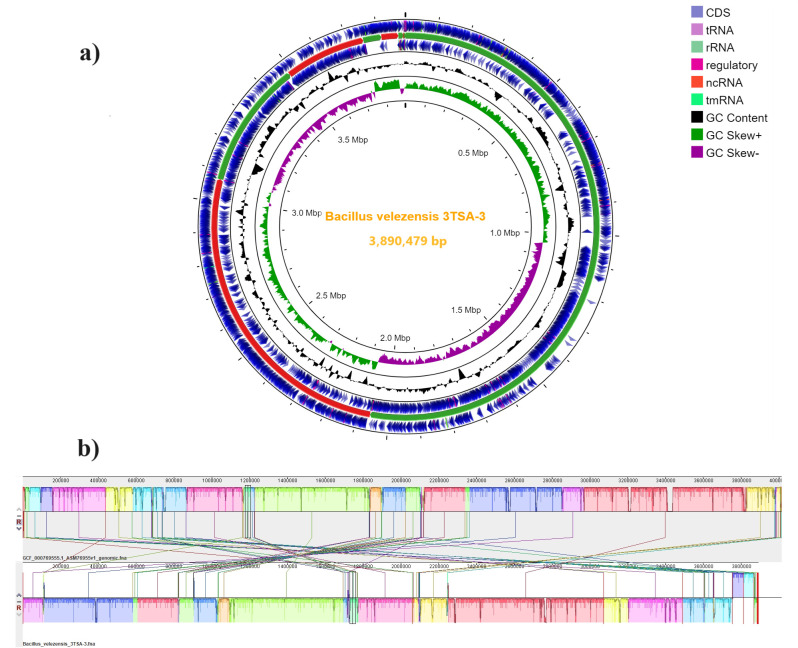 Fig 1
Fig 1- —Corporación Ecuatoriana para el Desarrollo de la Investigación y la Academia (CEDIA)
Peer Reviews
No public reviews on file for this paper yet. If you reviewed it on a platform where reviews are public (OpenReview, ICLR, NeurIPS, ICML), you can paste yours below so the community can read it here.
Videos
No videos yet. Explain this paper in a talk, walkthrough, or lecture? Add one.
Taxonomy
TopicsGenomics and Phylogenetic Studies · Bacteriophages and microbial interactions · Probiotics and Fermented Foods
ANNOUNCEMENT
Bacillus velezensis is a probiotic bacterium beneficial to adult stages of Penaeus (Litopenaeus) vannamei (1–3). B. velezensis strain 3TSA-3 was isolated from P. vannamei postlarvae collected from a commercial larviculture tank in Santa Elena province, Ecuador, on 9 March 2021. Despite being affected by vibriosis, the postlarvae exhibited high survival rates at harvest. The strain 3TSA-3 was isolated from shrimp postlarvae macerated in tryptone-casein soy broth (TSB) with 2% sodium chloride. The mixture was then cultured on tryptone-casein soy agar (TSA). After 24 h of incubation at 30°C, colonies suggestive of Bacillus were subcultured on TSA.
Genomic DNA (gDNA) of B. velezensis 3TSA-3 was extracted from an overnight culture on TSA using a DNeasy UltraClean Microbial Kit (Qiagen, The Netherlands). The quality and concentration of gDNA were assessed using a Denovix DS-11 spectrophotometer (Denovix Inc., USA).
The whole-genome library was prepared using the NEBNext ULtra DNA Prep Kit for Illumina (350 bp), and sequencing was performed by Novogene Inc. (Sacramento, USA) using the Illumina NovaSeq 6000 PE150. Whole-genome sequencing analyses were performed using the Bactopia pipeline v3.0.0 (4) with default software and parameters. The quality of the raw reads was assessed using FastQC v0.12.1. This analysis yielded a total of 8,254,750 high-quality reads with a Phred score of 36.5. De novo assembly was performed with Shovill v1.1.0. A circular genomic map (Fig. 1a) was generated using Proksee server v1.1.0 (5). 3TSA-3 was identified as B. velezensis based on the Kraken v2.0 taxonomic classification system (6) and 16S rRNA gene sequence homology using BLASTN (7). The contigs were ordered and oriented on one reference genome of B. velezensis (Strain JS25R, Genbank accession number GCA_000769555.1) using CSAR v1.1.1 (8). Average nucleotide identities with the reference genome B. velezensis strain JS25R were calculated using fastANI v1.3.3 (5), which showed a close similarity (98.05%) of strain 3TSA-3 strain to B. velezensis strain JS25R. In addition, the contigs of the circular genome were aligned to the reference genome using Mauve v20150226 (9) (Fig. 1b). Genome annotation was performed using the NCBI Prokaryotic Genome Annotation Pipeline (PGAP) (10). Quality and statistics of the assembled genome sequence were performed using QUAST v5.2 (11). The assembly data revealed a total of 3,890,479 bp in 13 scaffolds of >500 bp (minimum size of 630 bp, maximum size of 2,060,921 bp, and N50 contig length of 2,060,921), with a GC content of 46.43% and an average read coverage of 312×. Homology-based gene prediction identified a total of 3,882 genes, including 3,684 protein-coding sequences (CDSs), 98 RNA genes (82 tRNA, 11 rRNA, and 5 ncRNA), and 100 pseudogenes. Several genes encoding enzymes involved in sporulation, biosynthesis of siderophores and arsenate bioremediation, biosynthesis of indole acetic acid, and biosynthesis of bacteriocins, such as the uberolysin/carnocyclin family, were detected.
Circular genome map and Mauve alignment of the Bacillus velezensis strain 3TSA-3. (a) Multiple scaffolds (13) of the incomplete genome of 3TSA-3 showing DNA coding sequences (CDSs), tRNAs, rRNAs, regulatory, ncRNA, tmRNA, GC content, and GC skews. (b) Mauve alignment of the 3TSA-3 draft genome with the B. velezensis reference genome strain JS25R (Genbank accession number GCA_000769555.1).
The discovery of effective probiotics and their genomic data are fundamental to the sustainability of the shrimp farming industry, especially considering the global threat of multi-resistance to antibiotics, which dictates the need to explore natural cost-effective alternatives such as probiotics.
The reference list from the paper itself. Each links out to its DOI / PubMed record.
- 1Chen L, Lv C, Li B, Zhang H, Ren L, Zhang Q, Zhang X, Gao J, Sun C, Hu S. 2021. Effects of Bacillus velezensis supplementation on the growth performance immune responses, and intestine microbiota of Litopenaeus vannamei. Front Mar Sci 8. doi:10.3389/fmars.2021.744281 · doi ↗
- 2Jeon HJ, Song JW, Lee C, Kim B, Park SY, Kim JH, Han JE, Park JH. 2022. Antibacterial activity of Bacillus strains against acute hepatopancreatic necrosis disease-causing Vibrio Campbellii in Pacific white leg shrimp. Fishes 7:287. doi:10.3390/fishes 7050287 · doi ↗
- 3Sun X, Liu J, Deng S, Li R, Lv W, Zhou S, Tang X, Sun Y, Ke M, Wang K. 2022. Quorum quenching bacteria Bacillus velezensis DH 82 on biological control of Vibrio parahaemolyticus for sustainable aquaculture of Litopenaeus vannamei. Front Mar Sci 9. doi:10.3389/fmars.2022.780055 · doi ↗
- 4Petit RA, Read TD. 2020. Bactopia: a flexible pipeline for complete analysis of bacterial genomes. m Systems 5:e 00190-20. doi:10.1128/m Systems.00190-2032753501 PMC 7406220 · doi ↗ · pubmed ↗
- 5Grant JR, Enns E, Marinier E, Mandal A, Herman EK, Chen C, Graham M, Van Domselaar G, Stothard P. 2023. Proksee: in-depth characterization and visualization of bacterial genomes. Nucleic Acids Res 51:W 484–W 492. doi:10.1093/nar/gkad 32637140037 PMC 10320063 · doi ↗ · pubmed ↗
- 6Wood DE, Lu J, Langmead B. 2019. Improved metagenomic analysis with Kraken 2. Genome Biol 20:257. doi:10.1186/s 13059-019-1891-031779668 PMC 6883579 · doi ↗ · pubmed ↗
- 7Johnson M, Zaretskaya I, Raytselis Y, Merezhuk Y, Mc Ginnis S, Madden TL. 2008. NCBI BLAST: a better web interface. Nucleic Acids Res 36:W 5–9. doi:10.1093/nar/gkn 20118440982 PMC 2447716 · doi ↗ · pubmed ↗
- 8Chen K-T, Liu C-L, Huang S-H, Shen H-T, Shieh Y-K, Chiu H-T, Lu CL. 2018. CSAR: a contig scaffolding tool using algebraic rearrangements. Bioinformatics 34:109–111. doi:10.1093/bioinformatics/btx 54328968788 · doi ↗ · pubmed ↗