Coding-complete genomic sequence of a rhinovirus C-32 in a human nasal swab sample that tested false positive in a SARS-CoV-2 antigen test
Tracey L. Moquin, Kuttichantran Subramaniam, John A. Lednicky

TL;DR
A nasal swab containing rhinovirus C-32 gave a false positive for SARS-CoV-2 in an American antigen test.
Contribution
This is the first report of rhinovirus C-32 causing false positives in a U.S. SARS-CoV-2 antigen test.
Findings
Rhinovirus C-32 can lead to false positive SARS-CoV-2 antigen test results.
The false positive was observed using an American antigen test kit.
Abstract
Rhinovirus-A was previously shown to cause false-positive results in a Japanese SARS-CoV-2 antigen test. We report that a false-positive result was obtained in a specimen with rhinovirus C-32 that had been tested using an American SARS-CoV-2 antigen test.
Genes, proteins, chemicals, diseases, species, mutations and cell lines named across the full text — each resolved to its canonical identifier and authoritative record.
Click any figure to enlarge with its caption.
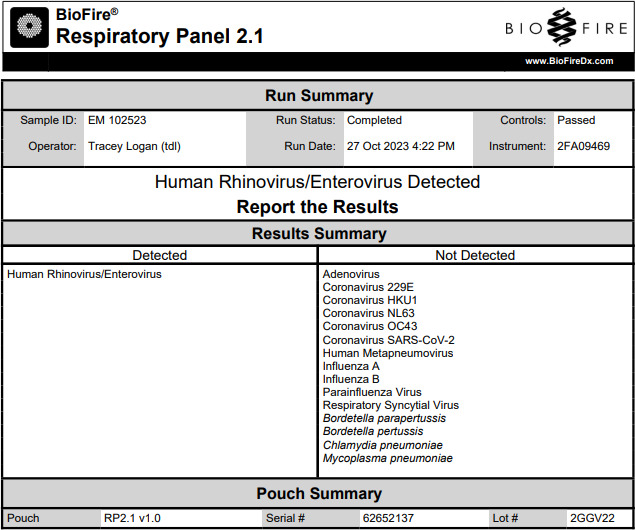 Fig 1
Fig 1Peer Reviews
No public reviews on file for this paper yet. If you reviewed it on a platform where reviews are public (OpenReview, ICLR, NeurIPS, ICML), you can paste yours below so the community can read it here.
Videos
No videos yet. Explain this paper in a talk, walkthrough, or lecture? Add one.
Taxonomy
TopicsRespiratory viral infections research · Viral Infections and Immunology Research · Mycobacterium research and diagnosis
ANNOUNCEMENT
The gold standard for COVID-19 testing has been the detection of severe acute respiratory syndrome coronavirus 2 (SARS-CoV-2) RNA through reverse transcriptase polymerase chain reaction (RT-PCR). But now that the COVID-19 pandemic has been downgraded by the WHO to a public health emergency of international concern, rapid at-home lateral flow antigen tests are typically used due to their widespread availability and ease of use. A nasal swab specimen obtained from a person with acute respiratory illness tested positive using an Abbott BinaxNOW COVID-19 Antigen Self-Test at a local clinic on 25 October 2023. To analyze the SARS-CoV-2 variant, a separate nasal swab specimen was obtained the same day using a flocked nylon swab, which was immersed into universal transport medium (UTM) (COPAN Diagnostics, Inc., Murrieta, CA, USA). However, RT-PCR tests targeting the N- and RdRp genes (1) of SARS-CoV-2 RNA in nucleic acids extracted using a QIAmp Viral RNA Mini Kit (QIAGEN Sciences, Inc., Germantown, MD) from material extruded into the UTM generated negative results. Attempts to isolate a virus in replicates of LLC-MK2, HeLa, MRC5, and Vero E6 cells (1, 2) inoculated with aliquots of the material in UTM and incubated at 33°C and 37°C for an observation period of 30 days were unsuccessful. An aliquot of the sample in UTM was then analyzed using a Biofire multiplex PCR FilmArray Respiratory Panel 2.1 test (Bio Mérieux, Marcy‐l'Etoile, France), which detected Rhinovirus/Enterovirus (Fig. 1). To identify the specific virus, nucleic acids that had been extracted from the sample were processed for next-generation sequencing. This work was IRB exempt, as this was a one-time assessment from a single person.
Data readout from Biofire multiplex PCR FilmArray Respiratory Panel 2.1 test.
A cDNA library was generated using a NEBNext Ultra RNA Library Prep Kit (New England Biolabs) and sequenced on an Illumina NextSeq1000 platform (Illumina, Inc., San Diego, CA). Upon completion of the sequencing run, a total of 95,207,899 reads with an average read length of 215 bp were obtained, and 85% of the human host sequences (GenBank accession number MSBL00000000.1) were removed using Kraken v2.0 (3). De novo assembly of the remaining untrimmed paired-end reads (14,650,757) was performed using MEGAHIT v1.1.4 with default parameters (4). BLASTX searches of the resulting contigs, using OmicsBox v1.2 against the National Center for Biotechnology Information nonredundant protein database, revealed a human rhinovirus C-32 (RV-32) (family Picornaviridae, genus Enterovirus, species Rhinovirus C) genome with an average coverage of 445 reads/nucleotide. Whereas the RV-32 coding region sequences were obtained, the 5′ and 3′ non-translated region sequences were not verified using rapid amplification of cDNA ends, so the genomic sequence we determined is considered “coding-complete” instead of “complete.”
The coding-complete RV-32 genome of this work has a G/C content of 42.70%, and a nucleotide BLAST search revealed 91% identity (6,423/7,034 nt) with that of RV-32 strain USA/CA/RGDS-2016-1008 (GenBank MK520815.1). A Protein BLAST search indicated that the deduced polyprotein amino acid sequence has 99% (2,111/2,142) identity with that of USA/CA/RGDS-2016-1008 (GenBank QBM01046). We designated the rhinovirus C genome that we analyzed as RV-32/USA/FL/UFEPI-2023-1, and its nucleotide sequence was deposited in GenBank (accession no. GenBank PP314216).
The reference list from the paper itself. Each links out to its DOI / PubMed record.
- 1Lednicky JA, Lauzardo M, Fan ZH, Jutla A, Tilly TB, Gangwar M, Usmani M, Shankar SN, Mohamed K, Eiguren-Fernandez A, Stephenson CJ, Alam MM, Elbadry MA, Loeb JC, Subramaniam K, Waltzek TB, Cherabuddi K, Morris JG, Wu CY. 2020. Viable SARS-Co V-2 in the air of a hospital room with COVID-19 patients. Int J Infect Dis 100:476–482. doi:10.1016/j.ijid.2020.09.02532949774 PMC 7493737 · doi ↗ · pubmed ↗
- 2Lednicky JA, Lauzardo M, Alam MM, Elbadry MA, Stephenson CJ, Gibson JC, Morris JG. 2021. Isolation of SARS-Co V-2 from the air in a car driven by a COVID patient with mild illness. Int J Infect Dis 108:212–216. doi:10.1016/j.ijid.2021.04.06333901650 PMC 8064821 · doi ↗ · pubmed ↗
- 3Wood DE, Salzberg SL. 2014. Kraken: ultrafast metagenomic sequence classification using exact alignments. Genome Biol 15:R 46. doi:10.1186/gb-2014-15-3-r 4624580807 PMC 4053813 · doi ↗ · pubmed ↗
- 4Li D, Liu CM, Luo R, Sadakane K, Lam TW. 2015. MEGAHIT: an ultra-fast single-node solution for large and complex metagenomics assembly via succinct de Bruijn graph. Bioinformatics 31:1674–1676. doi:10.1093/bioinformatics/btv 03325609793 · doi ↗ · pubmed ↗