The effect of lexical triggers on Spanish-English code-switched judgment tasks
Bryan Koronkiewicz, Rodrigo Delgado

TL;DR
This study examines how different types of words affect the acceptability of Spanish-English code-switched sentences.
Contribution
The study experimentally tests the influence of cognates and culturally specific items on code-switching acceptability.
Findings
Cognates and language-specific items are equally acceptable in code-switched sentences.
Judgment tasks were not affected differently by these types of lexical items.
Abstract
It has been argued that certain words can “trigger” intrasentential code-switching. While some researchers suggest that cognates establish triggering at the lexical level, others have argued that words that lack direct translations are more natural stories switch. Yet to be tested experimentally is to what extent different types of lexical items influence the acceptability of mixed utterances. The current study investigates this methodological consideration for code-switching research by having early US Spanish-English bilinguals (i.e., heritage speakers of Spanish) complete an acceptability judgment task with a 7-point Likert scale directly comparing cognates (e.g., sopa “soup”) and culturally specific items (e.g., pozole “traditional Mexican soup”) in otherwise identical grammatical switched sentences (N = 24). The results showed that there was no significant effect of condition (p…
Genes, proteins, chemicals, diseases, species, mutations and cell lines named across the full text — each resolved to its canonical identifier and authoritative record.
Click any figure to enlarge with its caption.
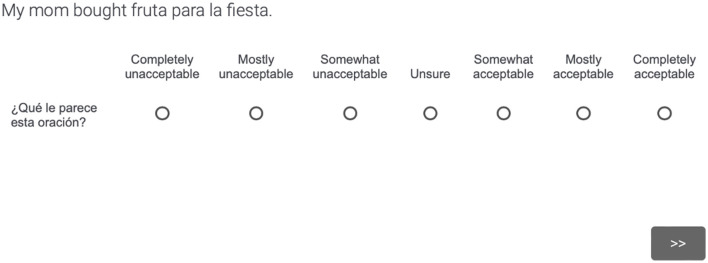 Figure 1
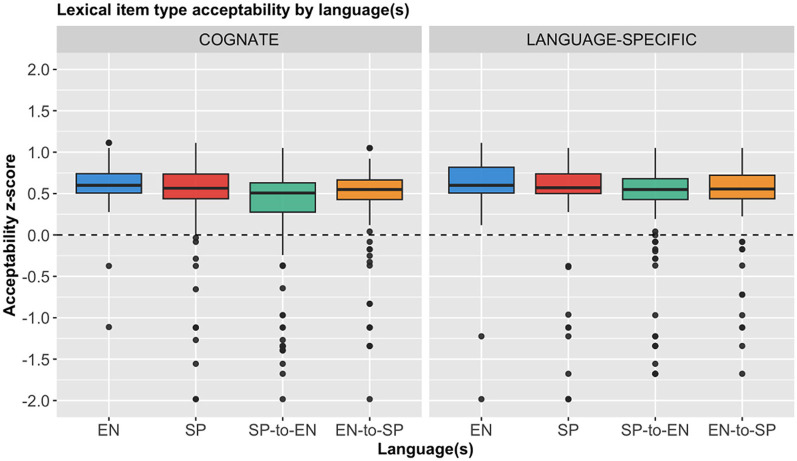 Figure 2
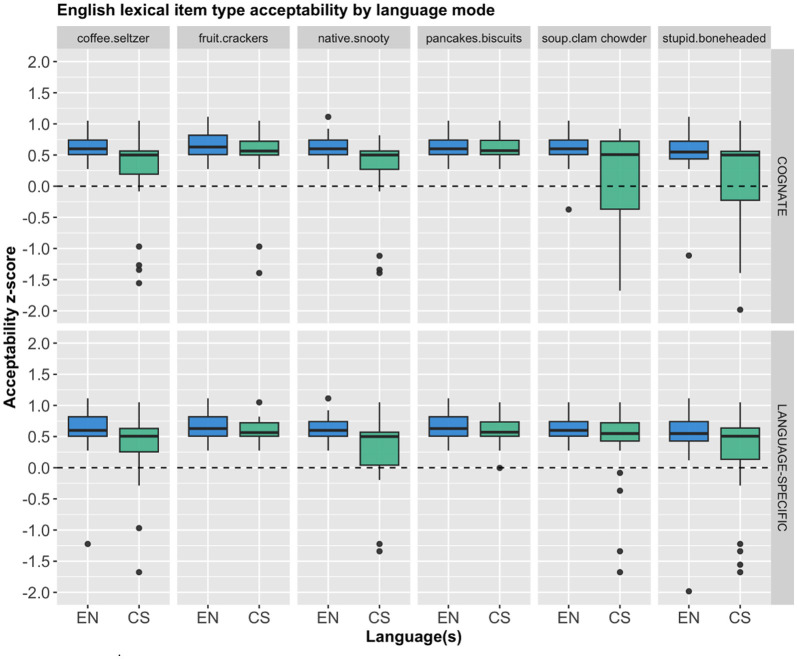 Figure 3
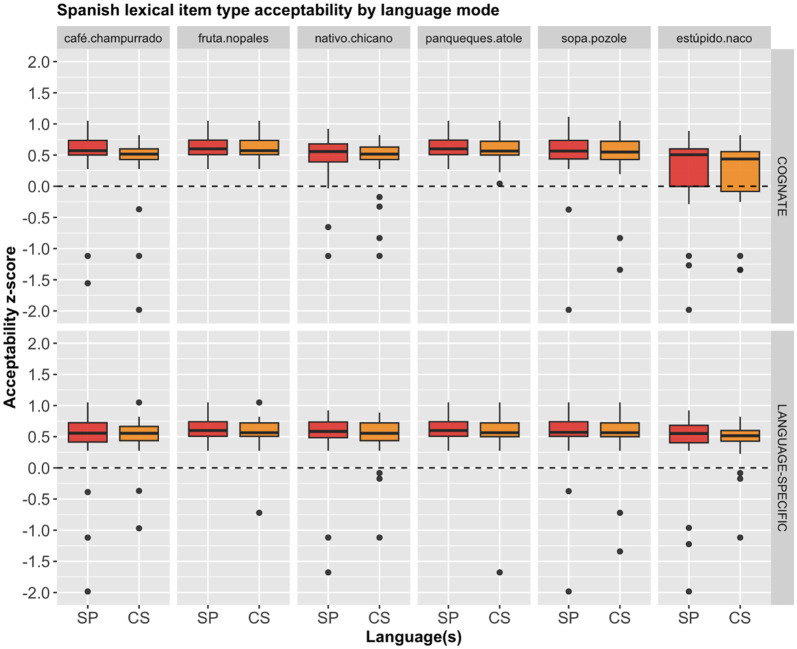 Figure 4
Peer Reviews
No public reviews on file for this paper yet. If you reviewed it on a platform where reviews are public (OpenReview, ICLR, NeurIPS, ICML), you can paste yours below so the community can read it here.
Videos
No videos yet. Explain this paper in a talk, walkthrough, or lecture? Add one.
Taxonomy
TopicsNeurobiology of Language and Bilingualism · Syntax, Semantics, Linguistic Variation · Language, Discourse, Communication Strategies