Modulation of intracortical circuits in primary motor cortex during automatic action tendencies
Xue Xia, Yansong Li, Yuyu Song, Yuanjun Dong, Robert Chen, Jian Zhang, Xiaoying Tan

TL;DR
The study shows that automatic actions, like approaching positive or avoiding negative stimuli, are linked to stronger brain activity in the primary motor cortex.
Contribution
The paper reveals that intracortical facilitation in the primary motor cortex is stronger during automatic actions compared to regulated actions.
Findings
Intracortical facilitation was stronger during automatic behavior than during regulated behavior.
Reaction times were negatively correlated with intracortical facilitation during automatic behavior.
No significant difference in intracortical inhibition was found between automatic and regulated behavior.
Abstract
Humans display automatic action tendencies toward emotional stimuli, showing faster automatic behavior (i.e., approaching a positive stimulus and avoiding a negative stimulus) than regulated behavior (i.e., avoiding a positive stimulus and approaching a negative stimulus). Previous studies have shown that the primary motor cortex is involved in the processing of automatic actions, with higher motor evoked potential amplitudes during automatic behavior elicited by single-pulse transcranial magnetic stimulation. However, it is unknown how intracortical circuits are involved with automatic action tendencies. Here, we measured short-interval intracortical inhibition and intracortical facilitation within the primary motor cortex by using paired-pulse transcranial magnetic stimulation protocols during a manikin task, which has been widely used to explore approaching and avoiding behavior.…
Genes, proteins, chemicals, diseases, species, mutations and cell lines named across the full text — each resolved to its canonical identifier and authoritative record.
Click any figure to enlarge with its caption.
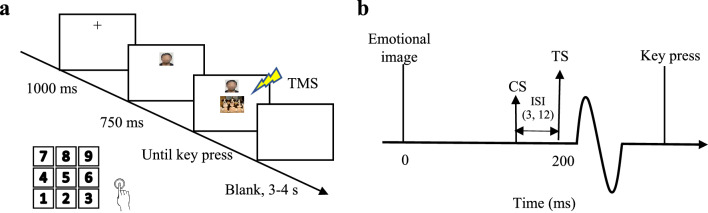 Figure 1
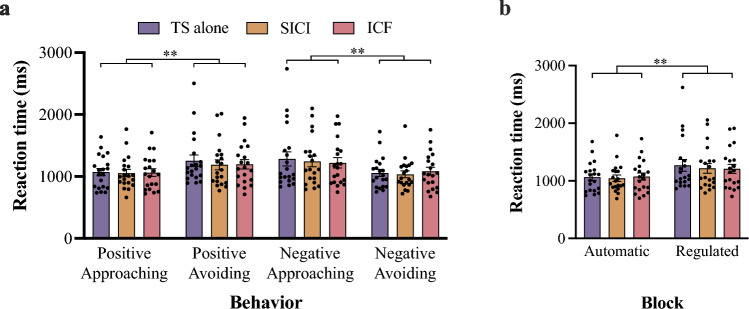 Figure 2
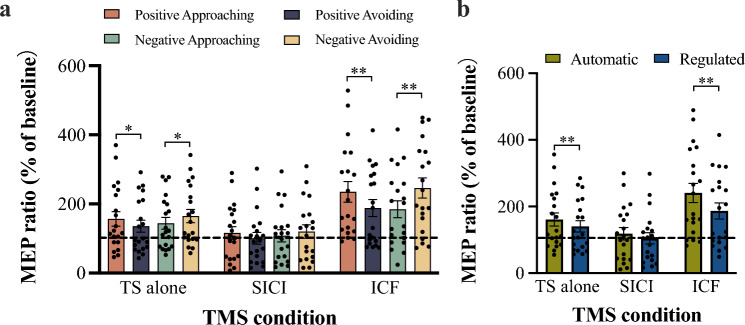 Figure 3
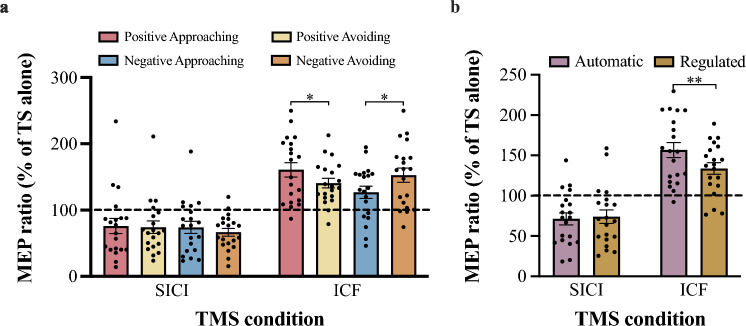 Figure 4
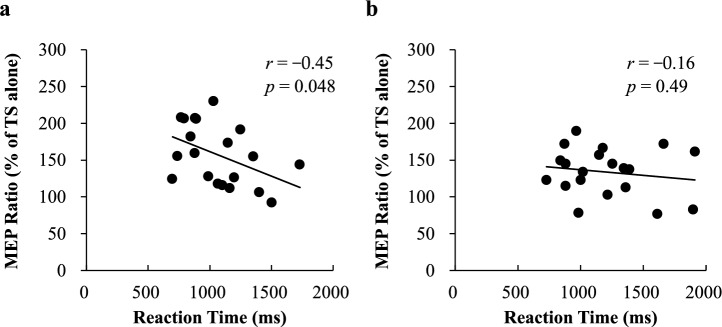 Figure 5
Peer Reviews
No public reviews on file for this paper yet. If you reviewed it on a platform where reviews are public (OpenReview, ICLR, NeurIPS, ICML), you can paste yours below so the community can read it here.
Videos
No videos yet. Explain this paper in a talk, walkthrough, or lecture? Add one.
Taxonomy
TopicsTranscranial Magnetic Stimulation Studies · Neural and Behavioral Psychology Studies · EEG and Brain-Computer Interfaces