Lotus sign: The lumen-apposing metal stent that failed to bloom
Gabriel Liu Yuan Cher, Yu-Ting Kuo, Chen-Ling Peng, Hsiu-Po Wang

Abstract
Genes, proteins, chemicals, diseases, species, mutations and cell lines named across the full text — each resolved to its canonical identifier and authoritative record.
Click any figure to enlarge with its caption.
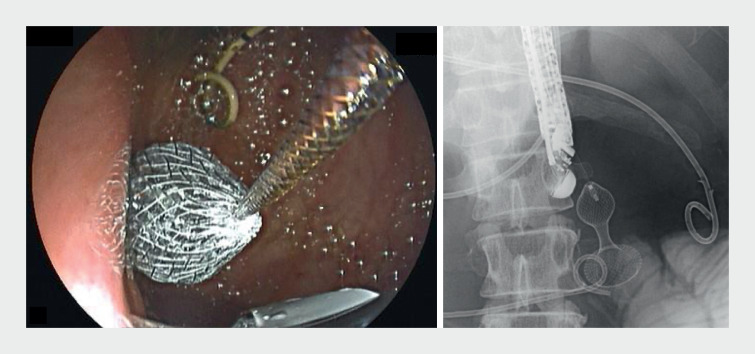 Fig. 1
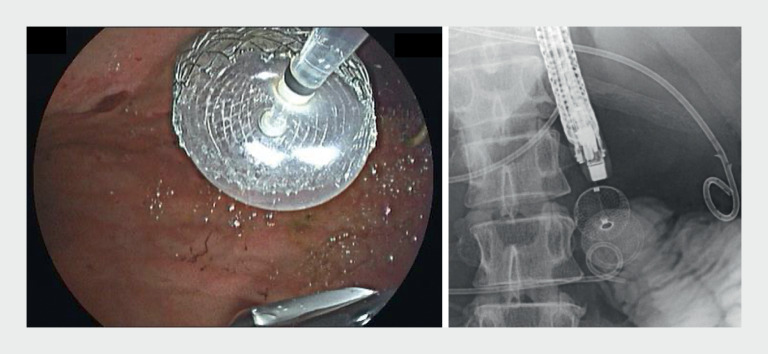 Fig. 2
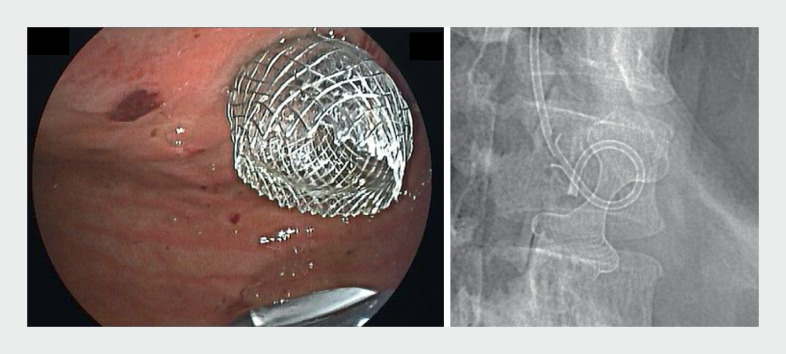 Fig. 3
Peer Reviews
No public reviews on file for this paper yet. If you reviewed it on a platform where reviews are public (OpenReview, ICLR, NeurIPS, ICML), you can paste yours below so the community can read it here.
Videos
No videos yet. Explain this paper in a talk, walkthrough, or lecture? Add one.
Taxonomy
TopicsEsophageal and GI Pathology · Biliary and Gastrointestinal Fistulas · Gallbladder and Bile Duct Disorders
Endoscopic ultrasound-guided gastroenterostomy (EUS-GE) with the use of a lumen-apposing metal stent (LAMS) has emerged as a promising modality for the treatment of a malignant gastric outlet obstruction (MGOO) 1 . The design of single-step delivery systems of LAMSs can significantly reduce the risk of adverse events. However, the process of stent deployment is the crucial step in determining the success of EUS-GE. This report describes the case of a patient who underwent EUS-GE with the deployment of the proximal flange of the LAMS failing to open.
A 54-year-old man with advanced pancreatic adenocarcinoma presented with vomiting due to MGOO. After admission, EUS-GE with the wireless simplified technique 2 was performed using a 20-mm LAMS (Hot AXIOS stent; Boston Scientific, Marlborough, Massachusetts, USA). The distal flange of the LAMS deployed successfully. However, on deployment of the proximal portion, the most proximal end of the LAMS failed to open, resulting in a lotus-shaped flange in the stomach ( Fig. 1 , Video 1 ). Despite gentle manipulation of the internal sheath and allowing some time for the flange to expand, it still failed to bloom. A 20-mm extraction balloon catheter was passed through the narrow opening of the proximal end and inflated carefully to dilate the flange ( Fig. 2 , Video 1 ). This was followed by gushing of methylene-blue colored saline that had been previously irrigated into the jejunum. Fluoroscopy confirmed successful placement of the LAMS ( Fig. 3 ). A follow-up abdominal X-ray the next day revealed the stable position of the LAMS and the patient progressed uneventfully from a liquid to a regular diet. Caution should be taken in the event of a rare incomplete blooming of a LAMS flange, which indicates that the lumen-apposing force may be reduced and stent migration can occur. Early recognition and intervention may prevent stent misdeployment 3 .
Endoscopy showed lotus sign of the proximal flange of the lumen-apposing metal stent (LAMS) resulting from the failure of the proximal end of LAMS to bloom.
A 20-mm extraction balloon catheter was passed through the narrow opening of the proximal end of LAMS and inflated carefully to dilate the flange.
The proximal flange of LAMS satisfactorily opened after repeated balloon inflation.
Unexpected failure of the proximal flange of lumen-apposing metal stent to open and rescue management to prevent stent misdeployment.Video 1
Endoscopy_UCTN_Code_CPL_1AL_2AG
The reference list from the paper itself. Each links out to its DOI / PubMed record.
- 1van der Merwe S Wvan Wanrooij RLJ Bronswijk M Therapeutic endoscopic ultrasound: European Society of Gastrointestinal Endoscopy (ESGE) Guideline Endoscopy 20225418520510.1055/a-1717-139134937098 · doi ↗ · pubmed ↗
- 2Bronswijk Mvan Malenstein H Laleman WEUS-guided gastroenterostomy: Less is more! The wireless EUS-guided gastroenterostomy simplified technique Video GIE 2020544210.1016/j.vgie.2020.06.012PMC 748241432954112 · doi ↗ · pubmed ↗
- 3Ghandour B Bejjani M Irani S Classification, outcomes, and management of misdeployed stents during EUS-guided gastroenterostomy Gastrointest Endosc 202295808934352256 10.1016/j.gie.2021.07.023 · doi ↗ · pubmed ↗