Response of Hypothenemus hampei Ferrari (Coleoptera: Curculionidae: Scolytinae) parasitized by the nematode Metaparasitylenchus hypothenemi Poinar (Tylenchida: Allantonematidae) to different colors of light
M. Simota-Ruiz, A. Castillo-Vera

TL;DR
This study examines how coffee berry borers parasitized by a nematode respond differently to various light colors compared to uninfected borers.
Contribution
The study reveals altered light attraction in parasitized coffee berry borers, suggesting potential host manipulation by the nematode.
Findings
Parasitized borers showed increased attraction to a wider range of light wavelengths (380–590 nm) compared to non-parasitized borers.
Parasitized borers had three peak attraction points (380 nm, 460 nm, and 520 nm), while uninfected borers peaked at 520 nm.
Parasitized borers were significantly more attracted to green light (520 nm) than to the control yellow light (570 nm).
Abstract
Metaparasitylenchus hypothenemi is a nematode that naturally parasitizes Hypothenemus hampei in a coffee-producing region in Chiapas, Mexico. This study investigated changes in the attraction of parasitized borers to light. We compared the attraction of adult H. hampei females (parasitized and uninfected) to 14 different light wavelengths (350–670 nm) with a control (570 nm, yellow) under laboratory conditions. The response ranges of non-parasitized and parasitized borers were 370–650 nm and 340–650 nm, respectively. The attraction curve showed a similar shape in both borer groups (parasitized and non-parasitized), but a wide wavelength range (380–590 nm) attracted more parasitized than non-parasitized borers. The maximum response of the uninfected borers occurred at 520 nm (green), while parasitized borers exhibited three response peaks (380 nm, violet; 460 nm, blue; 520 nm, green).…
Genes, proteins, chemicals, diseases, species, mutations and cell lines named across the full text — each resolved to its canonical identifier and authoritative record.
Click any figure to enlarge with its caption.
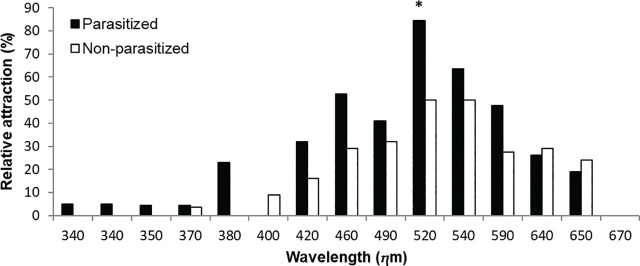 Figure 1
Peer Reviews
No public reviews on file for this paper yet. If you reviewed it on a platform where reviews are public (OpenReview, ICLR, NeurIPS, ICML), you can paste yours below so the community can read it here.
Videos
No videos yet. Explain this paper in a talk, walkthrough, or lecture? Add one.
Taxonomy
TopicsInsect and Pesticide Research · Forest Insect Ecology and Management · Plant and animal studies