Complete chloroplast genome of Angelica hirsutiflora Liu et al. 1961 (Apiaceae)
Chi-Chun Huang, Tsai-Wen Hsu, Kuo-Hsiang Hung, Wei-Kuang Wang

TL;DR
This study sequenced and analyzed the complete chloroplast genome of Angelica hirsutiflora, a plant native to Taiwan, to better understand its evolutionary relationships.
Contribution
The paper presents the first complete chloroplast genome of Angelica hirsutiflora and its phylogenetic placement within the genus Angelica.
Findings
The chloroplast genome is 154,266 bp in size with specific structural features like IRs, LSC, and SSC regions.
Phylogenetic analysis revealed A. hirsutiflora forms a distinct clade, separate from other Angelica species.
The genome contains 114 genes, including 80 protein-coding, 30 tRNA, and four rRNA genes.
Abstract
Angelica hirsutiflora Liu et al.1961, is a perennial herb in the Apiaceae family that is endemic to Taiwan. In this study, the complete circular chloroplast genome of A. hirsutiflora was reconstructed and annotated using Illumina sequencing. The size of the chloroplast genome is 154,266 bp, consisting of two inverted repeats (IRs, 25,075 bp) separated by a large single-copy region (LSC, 86,569 bp) and a small single-copy region (SSC, 17,547 bp). The GC content of the chloroplast genome is 37.6%. There are 114 different genes in the chloroplast genome of A. hirsutiflora, including 80 protein-coding genes, 30 tRNA genes and four rRNA genes. A maximum-likelihood phylogenetic analysis showed that A. hirsutiflora forms a distinct clade, and separated from other species within the genus Angelica. This study provided insights into the evolutionary relationships among different species of…
Genes, proteins, chemicals, diseases, species, mutations and cell lines named across the full text — each resolved to its canonical identifier and authoritative record.
Click any figure to enlarge with its caption.
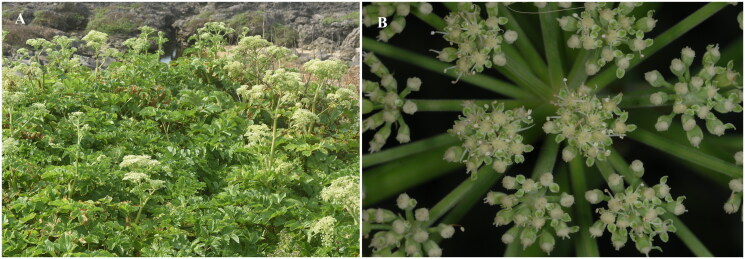 Figure 1
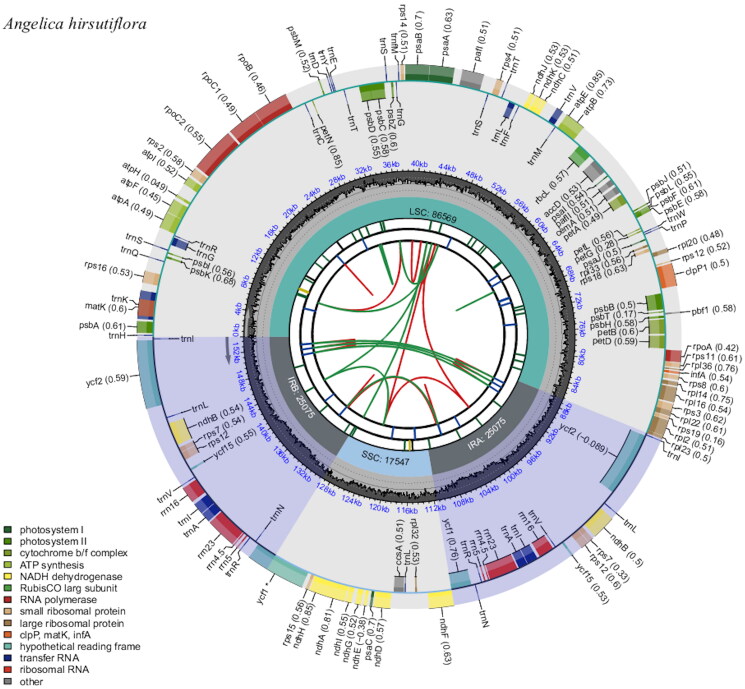 Figure 2
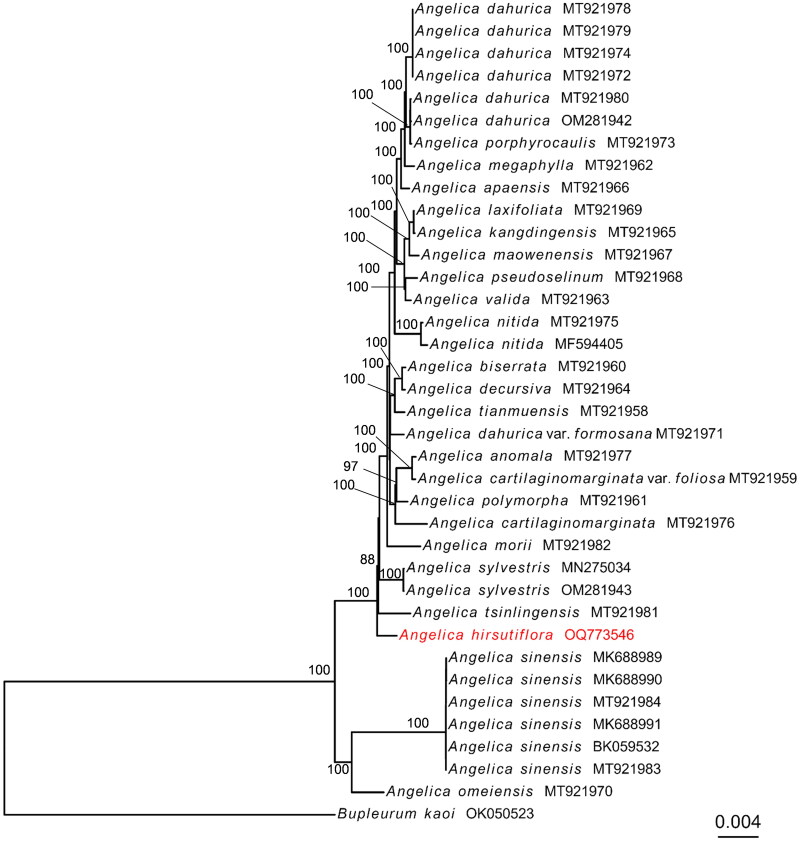 Figure 3
Peer Reviews
No public reviews on file for this paper yet. If you reviewed it on a platform where reviews are public (OpenReview, ICLR, NeurIPS, ICML), you can paste yours below so the community can read it here.
Videos
No videos yet. Explain this paper in a talk, walkthrough, or lecture? Add one.
Taxonomy
TopicsGenomics and Phylogenetic Studies · Plant chemical constituents analysis · Traditional Chinese Medicine Analysis