Analysis of Anonymous Student Narratives About Experiences with Emergency Medicine Residency Programs
Molly Estes, Jacob Garcia, Ronnie Ren, Mark Olaf, Shannon Moffett, Michael Galuska, Xiao Chi Zhang

TL;DR
This study analyzes student stories from an anonymous online community to understand their experiences with emergency medicine residency programs and identify areas for improvement.
Contribution
The study is the first to qualitatively analyze emergency medicine applicant narratives in anonymous online communities to identify modifiable program attributes.
Findings
Six major themes were identified, including living conditions, relationships, and learning experiences.
Modifiable sub-themes outnumbered non-modifiable ones, suggesting opportunities for program improvement.
Themes like patient population and program leadership personality were frequently mentioned by applicants.
Abstract
Academic emergency medicine (EM) communities have viewed anonymous online communities (AOC) such as Reddit or specialty-specific “applicant spreadsheets” as poor advising resources. Despite this, robust EM AOCs exist, with large user bases and heavy readership. Insights about applicants’ authentic experiences can be critical for applicants and program leadership decision-making. To date, there are no EM studies to qualitatively assess EM AOC narratives during the application cycle. Our goal was to perform a qualitative analysis of students’ EM program experiences through a publicly available AOC. This was a qualitative analysis of a publicly available, time-stamped, user-locked AOC dataset: “Official 2020–2021 Emergency Medicine Applicant Spreadsheet.” We extracted and then de-identified all data from selected sub-sheets entitled “Virtual Interview Impressions” and “Rotation…
Genes, proteins, chemicals, diseases, species, mutations and cell lines named across the full text — each resolved to its canonical identifier and authoritative record.
Click any figure to enlarge with its caption.
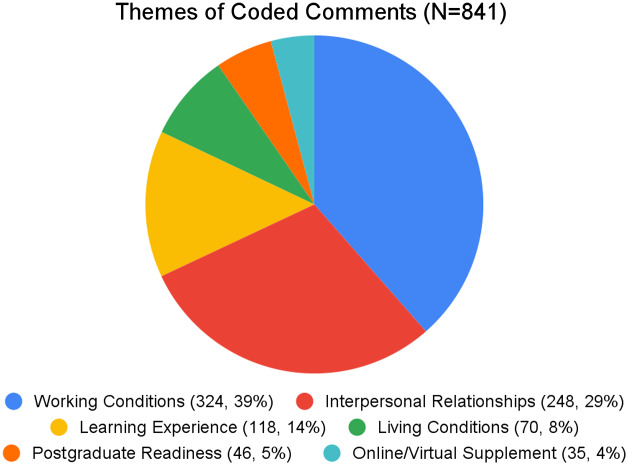 Figure 1
Peer Reviews
No public reviews on file for this paper yet. If you reviewed it on a platform where reviews are public (OpenReview, ICLR, NeurIPS, ICML), you can paste yours below so the community can read it here.
Videos
No videos yet. Explain this paper in a talk, walkthrough, or lecture? Add one.
Taxonomy
TopicsSocial Media in Health Education · Health Literacy and Information Accessibility · Mobile Health and mHealth Applications