Domain 3a mutation of VPS33A suppresses larval arrest phenotype in the loss of VPS45 in Caenorhabditis elegans
Keiko Gengyo-Ando, Masahiko Kumagai, Hideki Ando, Junichi Nakai

TL;DR
A mutation in the VPS33A protein can counteract the effects of losing VPS45 in C. elegans, revealing the importance of a specific protein domain in cellular processes.
Contribution
A novel mutation in VPS33A domain 3a is identified as a suppressor of VPS45 loss in C. elegans.
Findings
The VPS33A M376I mutation suppresses the temperature-sensitive lethality caused by VPS45 loss.
Domain 3a of VPS33A is essential for SNARE complex assembly and membrane fusion.
The results emphasize the functional significance of domain 3a in endosomal SM proteins.
Abstract
The Sec1/Munc18 (SM) protein VPS45 is a key regulator of SNARE-mediated membrane fusion in endosomal trafficking, but its precise role remains unknown. To understand the function of VPS45 in vivo , we performed a genetic suppressor screen in Caenorhabditis elegans . We found that the temperature-sensitive lethality caused by the loss of VPS-45 can be suppressed by a mutation in another SM protein, VPS33A. The VPS33A M376I mutation is located in domain 3a, which is predicted to be essential for SNARE complex assembly. These results highlight the functional importance of domain 3a in endosomal SM proteins and its role in specific membrane fusion.
Genes, proteins, chemicals, diseases, species, mutations and cell lines named across the full text — each resolved to its canonical identifier and authoritative record.
Click any figure to enlarge with its caption.
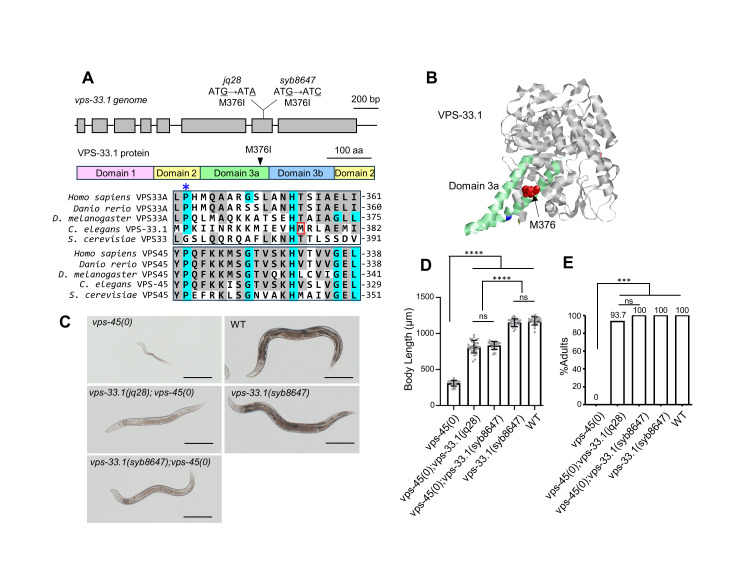 Figure 1
Peer Reviews
No public reviews on file for this paper yet. If you reviewed it on a platform where reviews are public (OpenReview, ICLR, NeurIPS, ICML), you can paste yours below so the community can read it here.
Videos
No videos yet. Explain this paper in a talk, walkthrough, or lecture? Add one.
Taxonomy
TopicsCellular transport and secretion · Photosynthetic Processes and Mechanisms · Lipid Membrane Structure and Behavior