Comparison of immediate versus post-stenting ureteroscopy for ureteral stones treatment
Ali Hadi Sabhan

TL;DR
This study compares two methods for treating ureteral stones and finds both approaches to be similarly effective and safe.
Contribution
The study provides a direct comparison of immediate and post-stenting ureteroscopy for ureteral stones in a prospective design.
Findings
Both groups had similar operative times and stone-free rates.
Complication rates were low and comparable between the two groups.
Hospital stay durations were not significantly different between the groups.
Abstract
Ureteroscopy is a highly effective treatment for ureteral stones, characterized by a high stone-free rate and a low need for re-treatment. Ureteral stent placement can improve the insertion of the ureteral access sheath and ureteroscope but may be associated with higher morbidity prior to and after ureteroscopy. The study aimed to compare immediate versus post-stenting ureteroscopy for ureteral stone treatment in terms of operative time, intra- and post-operative complications, length of hospital stay, and stone-free rate. This prospective study involved 126 patients with ureteral stones divided into two groups: the post-stenting ureteroscopy group (PS-URS), who underwent primary ureteral stenting by double J followed by delayed ureteroscopy, and the immediate ureteroscopy group (I-URS), who underwent immediate ureteroscopy without previous stenting. Sixty-six patients were included in…
Genes, proteins, chemicals, diseases, species, mutations and cell lines named across the full text — each resolved to its canonical identifier and authoritative record.
Click any figure to enlarge with its caption.
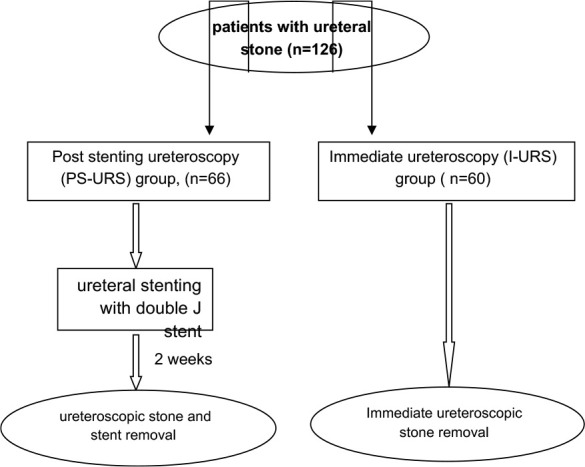 Figure 1
Peer Reviews
No public reviews on file for this paper yet. If you reviewed it on a platform where reviews are public (OpenReview, ICLR, NeurIPS, ICML), you can paste yours below so the community can read it here.
Videos
No videos yet. Explain this paper in a talk, walkthrough, or lecture? Add one.
Taxonomy
TopicsKidney Stones and Urolithiasis Treatments · Ureteral procedures and complications · Pediatric Urology and Nephrology Studies