The complete chloroplast genome of Eremurus zoae Vved. (Asphodelaceae), an endemic species of Kyrgyz Republic
Ju Eun Jang, Hyeon Jin Jeong, Aleksey L. Kim, Ye-Rim Choi, Georgii A. Lazkov, Chang-Gee Jang, Hyeok Jae Choi, Hee-Young Gil

TL;DR
This paper reports the complete chloroplast genome of Eremurus zoae, an endemic plant in Kyrgyz Republic, providing insights into its genetic structure and evolutionary relationships.
Contribution
The study provides the first complete chloroplast genome sequence for Eremurus zoae and reveals its phylogenetic relationship with E. chinensis.
Findings
The chloroplast genome of E. zoae is 153,744 bp long with specific structural features.
Phylogenetic analysis shows Eremurus forms a monophyletic group and E. zoae is closely related to E. chinensis.
Abstract
Eremurus zoae Vved. 1971 is a perennial herbaceous plant in the family Asphodelaceae and an endemic species of the Kyrgyz Republic; however, its complete chloroplast genome sequence has not been reported. Here, we investigated the complete chloroplast (cp) genome of E. zoae using next-generation sequencing. The cp genome was 153,744 bp long, with a large single copy (84,020 bp), a small single copy (16,766 bp), and a pair of inverted repeats (26,479 bp). The genome encodes 132 genes, including 86 protein-coding genes, 38 tRNA genes, and 8 rRNA genes. Phylogenetic analysis revealed that the genus Eremurus forms a monophyletic group and E. zoae is closely related to E. chinensis. This study provides a molecular foundation for future phylogenetic studies of Eremurus.
Genes, proteins, chemicals, diseases, species, mutations and cell lines named across the full text — each resolved to its canonical identifier and authoritative record.
Click any figure to enlarge with its caption.
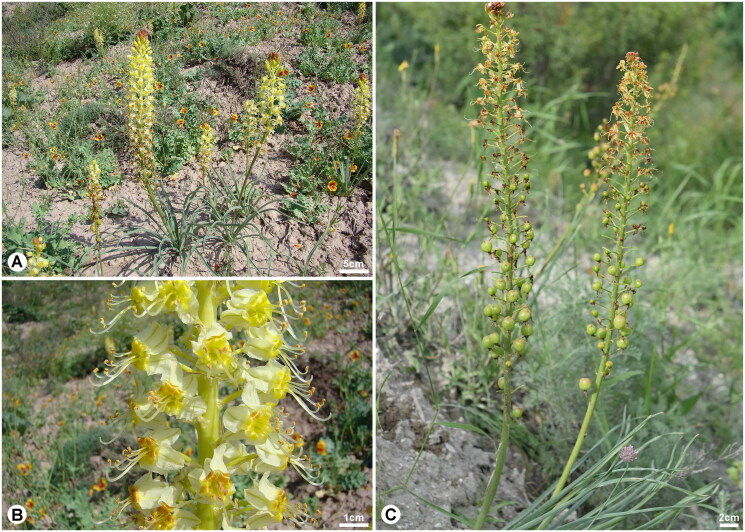 Figure 1
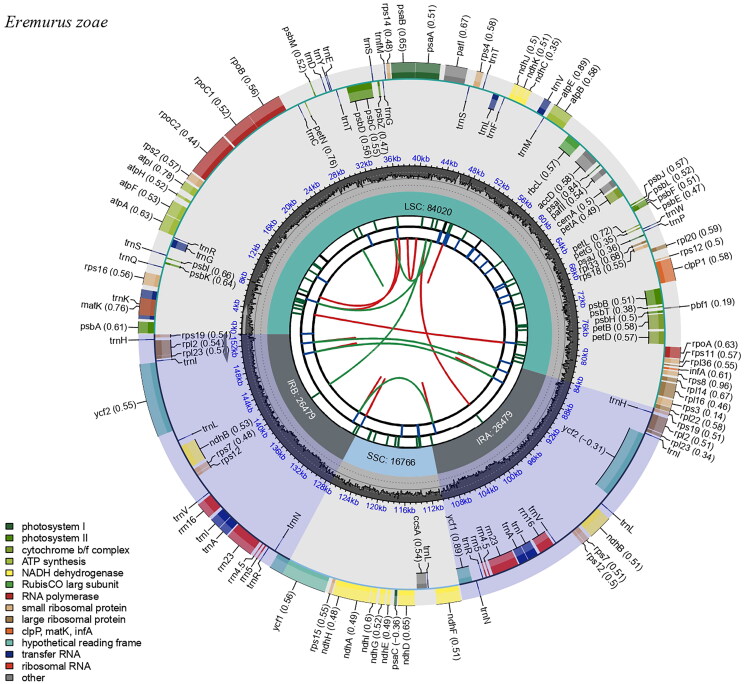 Figure 2
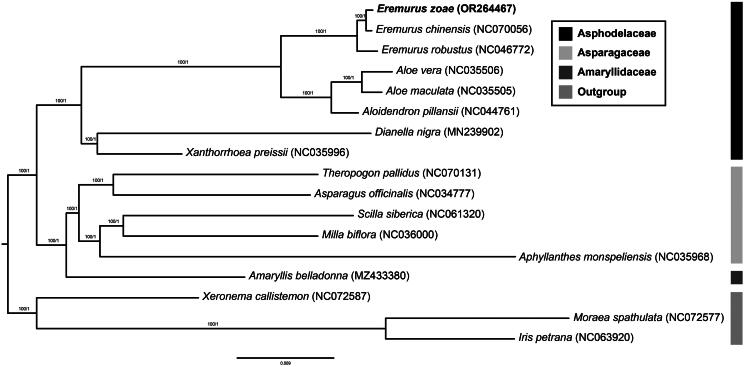 Figure 3
- —Korea National Arboretum10.13039/501100011908
- —Korea National Arboretum10.13039/501100011908
Peer Reviews
No public reviews on file for this paper yet. If you reviewed it on a platform where reviews are public (OpenReview, ICLR, NeurIPS, ICML), you can paste yours below so the community can read it here.
Videos
No videos yet. Explain this paper in a talk, walkthrough, or lecture? Add one.
Taxonomy
TopicsGenomics and Phylogenetic Studies · Plant and Fungal Species Descriptions · Phytochemistry and Biological Activities
Introduction
Eremurus M.Bieb. (Asphodelaceae) is known as foxtail lilies or desert candles, which is a perennial herbaceous plant belonging to the Asphodelaceae family (APG IV 2016; Muhidinov et al. 2020; Farhadi et al. 2023). This genus, which comprises over 50 species, is mainly distributed in Central and Western Asia, with the center of its diversity in Central Asia (Hedge and Wendelbo 1963; Naderi Safar et al. 2009; Farhadi et al. 2023). It is characterized by swollen, fleshy, thick roots; leafless flowering stems; white to pink or yellow flowers; and campanulate or funnel-shaped perianths (Fedchenko 1968; Xinqi et al. 2000; Naderi Safar et al. 2009; Farhadi et al. 2023). Modern pharmacological research has shown that many species in this genus exhibit antibacterial, antimicrobial, antioxidant, anti-inflammatory, antiradical, and anti-glycation activities (Karaman et al. 2011; Zhu et al. 2013). Eremurus is also an economically important plant with edible, medicinal, and ornamental uses (Kamenetsky and Rabinowitch 1999; Naderi Safar et al. 2009; Safar et al. 2014; Farhadi et al. 2023). Additionally, several Eremurus species contain water-soluble glucomannans and galactomannans in their roots. These substances become sticky when in contact with water and are utilized in the form of glue (Makhmudjanov et al. 2019; Muhidinov et al. 2020). Eremurus zoae Vved. 1971, which is endemic to Kyrgyz Republic, can be distinguished from related species by its 25–40 cm tall (Figure 1A), rather short and dense conical-cylindrical raceme with yellow flowers (Figure 1B). It is also often misidentified as Eremurus luteus Baker, but this species is clearly different from E. luteus by the shape of its capsule (Figure 1C): E. luteus has an elongated capsule, whereas E. zoae has a globose capsule (Lazkov and Sennikov 2015). This species also faces threats from factors such as overgrazing and plant collection. Consequently, it was classified as vulnerable (VU) in the Red Data Book of the Kyrgyz Republic (2006). Therefore, investigating the genetic diversity and structure of this species to conserve its genetic resources is essential. Although the chloroplast (cp) genome is a very useful genetic tool for inferring phylogenetic relationships, few studies involving the complete cp genome of Eremurus have been published (Cho et al. 2015; Song et al. 2022). Here, we report the complete cp genome of E. zoae for the first time to clarify the phylogenetic relationships between E. zoae and related species and to facilitate further research for a systematic understanding of Eremurus.
Eremurus zoae Vved 1971 (Photographs was taken by Georgy A. Lazkov in Issyk Kul, Kyrgyz Republic). A, Habitat; B, Flower; C, Capsule. E. zoae is a perennial herb with a height of 25–40 cm. The flowers are campanulate, with yellow petals that reflex in fruiting. The capsules are globose. The flowering period is from April to May and the fruiting period is from May to June.
Materials and methods
Eremurus zoae was collected from Issyk Kul, Kyrgyz Rupublic (latitude 42°27′32.4″, longitude 76°05′42.0″; Figure 1). The voucher specimen was deposited at the herbarium of the Korea National Arboretum (KH, http://www.nature.go.kr/kbi/plant/smpl/KBI_2001_030100.do, Hee-Young Gil, E-mail: [email protected]) under the voucher number KZ_160513_403. Fresh leaves were dried using silica gel. DNA was extracted from the silica gel-dried leaves using a DNeasy Plant Mini Kit (Qiagen Inc., Valencia, CA, USA). Next-generation sequencing was conducted on the MiSeq platform (Illumina Inc., Seoul, South Korea) with a 500 bp insert size, and 9,009,222 reads were obtained. We performed de novo assembly using GetOrganelle (Jin et al. 2020) with E. chinensis as a reference (NC_070056) and conducted the final assembly of the complete cp genome using the Geneious Prime program (Kearse et al. 2012). The cp genome was annotated using GeSeq (Tillich et al. 2017) and the tRNAscan-SE software (Lowe and Chan 2016). A circular map of the E. zoae cp genome and cis- and trans-spliced genes was generated using CPGview (Liu et al. 2023). The complete cp genome of E. zoae was submitted to GenBank under the accession number OR264467.
To investigate the phylogenetic relationships, we analyzed 17 species together with three outgroup taxa (one Xeronemataceae and two Iridaceae), which were downloaded from NCBI GenBank, except E. zoae. For phylogenetic analysis, 82 protein-coding genes were aligned using MAFFT, and the most suitable model for the maximum likelihood (ML) and Bayesian inference (BI) methods was determined using ModelFinder in the PhyloSuite software (Katoh and Standley 2013; Kalyaanamoorthy et al. 2017; Zhang et al. 2020). The ML tree was constructed using IQ-TREE under the GTR + R3 + F model with 5,000 ultrafast bootstraps, whereas the BI tree was inferred using MrBayes 3.2.6 under the GTR + F + I + G4 model (two parallel runs, 2,000,000 generations), in which the initial 25% of the sampled data were discarded as burn-in (Guindon et al. 2010; Ronquist et al. 2012; Minh et al. 2013; Nguyen et al. 2015; Zhang et al. 2020).
Results and discussion
The cp genome of E. zoae was 153,744 bp in length, with an overall GC content of 42.9% and an average coverage of 446.60 (Figure 2, Figure S1). The assembled genome has a typical quadripartite structure, including a large single copy (LSC: 84,020 bp), a small single copy (SSC: 16,766 bp), and a pair of inverted repeats (IRa and IRb: 26,479 bp). The cp genome contained 132 genes (86 protein-coding genes, 38 tRNA genes, and 8 rRNA genes), including 20 genes (8 protein-coding genes, 8 tRNA genes, and 4 rRNA genes) duplicated in the IR regions. In total, 11 cis-splicing genes (Figure S2) and one trans-splicing gene, rps12 (Figure S3), were detected. Of the 11 cis-splicing genes, nine (rps16, atpF, rpoC1, petB, petD, rpl16, rpl2, ndhB, and ndhA) contained one intron, and two (pafl, clpP1) contained two introns. Gene rpl32 was missing in some species of subfamily Asphodelaceae, which is related to Eremurus zoae (including genus Eremurus, Aloe, Aloidendron in Figure 3). The absence of rpl32 gene has been recently reported in Aloe vera (Xie et al. 2019). Gene losses in plastid genomes might be attributed to the functional transfer to the nucleus or replacement of nuclear genes (Shrestha et al. 2020; Han et al. 2022).
Complete chloroplast genome map of Eremurus zoae Vved. drawn using CPGview. The circle map contains six tracks. The first track indicates the repeat distribution. The second track shows the tandem repeats as a blue bar. The third track represents microsatellite sequences in green and yellow. The fourth track shows the LSC, SSC, and IR regions. The fifth track indicates the GC contents, and the sixth track represents genes.
Phylogenetic tree of 17 species with three outgroup taxa (one Xeronemataceae, two Iridaceae) based on 82 protein-coding genes using the ML and BI methods. The numbers above the nodes indicate the bootstrap support values and the Bayesian posterior probabilities. The newly reported chloroplast genome in this study is indicated in red. All sequences used in the analysis are as follows: Eremurus zoae (OR264467, this study), Eremurus chinensis (NC070056), Eremurus robustus (NC046772, Makhmudjanov et al.2019), Aloe vera (NC035506), Aloe maculata (NC035505), Aloidendron pillansii (NC044761), Dianella nigra (MN239902), Xanthorrhoea preissii (NC035996), Theropogon pallidus (NC070131), Asparagus officinalis (NC034777), Scilla siberica (NC061320), Milla biflora (NC036000), Aphyllanthes monspeliensis (NC035968), Amaryllis belladonna (MZ433380), Xeronema callistemon (NC072587, Kamra et al.2023), Moraea spathulata (NC072577, Kamra et al.2023), and Iris petrana (NC063920, Volis et al.2022).
The topologies of the two methods (ML and BI) precisely correspond. Phylogenetic trees strongly supported the idea that Asphodelaceae is a monophyletic group (bootstrap value = 100). Within Asphodelaceae, three subfamilies (Asphodeloideae, Xanthorrhoea, and Hemerocallidoideae) formed distinct clades with high support values. E. zoae was the most closely related to E. chinensis (Figure 3). Our results are consistent with those of a previous Asparagales phylogenetic study (Chase et al. 2009).
Conclusions
In this study, we reported the first complete chloroplast genome of E. zoae. The plastid genome of E. zoae was determined to be 153,744 bp in length, containing a total of 132 genes. A phylogenetic tree reconstructed by concatenated 82 protein-coding genes showed that Eremurus formed a monophyletic group. Our tree also revealed that E. zoae was most closely related to E. chinensis. This result provides useful information regarding the phylogenetic system and evolution of the genus Eremurus.
Supplementary Material
Supplemental Material
The reference list from the paper itself. Each links out to its DOI / PubMed record.
- 1APG IV. 2016. An update of the Angiosperm Phylogeny Group classification for the orders and families of flowering plants: APG IV. Bot J Linn Soc. 181(1):1–20. doi:10.1111/boj.12385. · doi ↗
- 2Chase MW, Reveal JL, Fay MF. 2009. A subfamilial classification for the expanded asparagalean families Amaryllidaceae, Asparagaceae and Xanthorrhoeaceae. Bot J Linn Soc. 161(2):132–136. doi:10.1111/j.1095-8339.2009.00999.x. · doi ↗
- 3Cho KS, Yun BK, Yoon YH, Hong SY, Mekapogu M, Kim KH, Yang TJ. 2015. Complete chloroplast genome sequence of tartary buckwheat (Fagopyrum tataricum) and comparative analysis with common buckwheat (F. esculentum). P Lo S One. 10(5):e 0125332. doi:10.1371/journal.pone.0125332.25966355 PMC 4428892 · doi ↗ · pubmed ↗
- 4Farhadi F, Avan R, Sahebkar A, Eghbali S. 2023. A comprehensive review on Eremurus species: phytochemistry, pharmacology and traditional uses. Phytochem Lett. 53:142–149. doi:10.1016/j.phytol.2022.12.002. · doi ↗
- 5Fedchenko BA. 1968. Eremurus. In: komarov VL, editor. Flora of the USSR. Vol. 4. Leningrad: botanical Institute of Academy of Science; p. 27–40.
- 6Guindon S, Dufayard JF, Lefort V, Anisimova M, Hordijk W, Gascuel O. 2010. New algorithms and methods to estimate maximum-likelihood phylogenies: assessing the performance of Phy ML 3.0. Syst Biol. 59(3):307–321. doi:10.1093/sysbio/syq 010.20525638 · doi ↗ · pubmed ↗
- 7Han S, Ding H, Bi D, Zhang S, Yi R, Gao J, Yang J, Ye Y, Wu L, Kan X. 2022. Structural Diversities and Phylogenetic Signals in Plastomes of the Early-Divergent Angiosperms: A Case Study in Saxifragales. Plants. 11(24):3544. doi:10.3390/plants 11243544.36559654 PMC 9787361 · doi ↗ · pubmed ↗
- 8Hedge I, Wendelbo P. 1963. Notes on the giant Asphodels of Afghanistan. J Roy Hort Soc London. 88(9):402–406.